
Children's Spaces & Acoustic Comfort: Speech, Behaviour and Everyday Regulation
A practical guide to acoustic comfort in children’s spaces, covering speech clarity, reverberation, background noise, overstimulation, early learning rooms, family homes, play areas, quiet zones and the design decisions that support calmer everyday use.


.avif)
Children’s spaces need acoustic comfort, not just noise control
Children’s spaces are often full of sound. Voices, play, movement, singing, instruction, crying, laughter, chairs, toys, footsteps, doors, appliances and outdoor activity can all happen in the same environment.
That does not mean these spaces should be silent. Children need to play, communicate, move and explore. Sound is part of childhood and part of learning.
The acoustic question is whether the room supports those activities or makes them harder. A space can be active without being chaotic. It can be lively without being harsh. It can support play without overwhelming children, educators, parents or carers.
Good acoustic design for children’s spaces is about comfort, clarity and regulation. It helps reduce avoidable noise stress, improves the way speech is heard and creates calmer places for learning, play, rest and everyday routines.
Sound affects how a space feels to children
Children may experience sound differently from adults. They may have less control over where they are, when they can leave, how noise is managed and how much they can adjust the environment.
A room that feels mildly noisy to an adult may feel more intense to a child, especially when the sound is unpredictable, reverberant or full of overlapping voices. A child who is tired, anxious, sensory-sensitive, neurodivergent, younger, learning a new language or struggling to follow instructions may find the same acoustic environment more difficult again.
This is why children’s spaces need more than a general “not too loud” approach. They need acoustic conditions that support listening, communication and emotional regulation across a range of needs.
The aim is not to remove all sound. The aim is to make sound easier to understand, easier to tolerate and easier to recover from.
Speech clarity is central
Children’s spaces are communication spaces. Instructions, stories, questions, songs, corrections, emotional reassurance and everyday conversation all rely on speech being clear.
Speech clarity is affected by reverberation, background noise, distance, room layout, furniture, surface finishes, mechanical noise and the number of people speaking at once. In a room with high reverberation or background noise, children may hear that someone is speaking but miss the words.
This matters in classrooms, early learning rooms, therapy rooms, libraries, family homes and play spaces. A child may need to hear a teacher, parent, carer or peer clearly while other activity is happening nearby.
Better acoustics do not replace good teaching, care or communication. They create conditions where communication is less effortful.
Reverberation can make children’s spaces feel louder
Reverberation is the sound that remains in a room after the source has stopped. In a reverberant room, sound lingers and overlaps.
This can make children’s spaces feel louder than they need to be. Voices build up. Group activity becomes harder to separate. Chair movement and play sounds feel sharper. Instructions may be less clear. Educators and carers may raise their voices, which adds more sound to the room.
Hard ceilings, plasterboard walls, glass, timber floors, concrete, tile and minimal soft furnishings can all contribute to excessive reverberation.
Reducing reverberation usually requires absorption in the right places. Acoustic ceilings, soft wall treatment, curtains, rugs, upholstered furniture, acoustic plaster, fabric panels, pinboards and integrated joinery can all help depending on the space.
The goal is not to deaden the room. The goal is to reduce the sound build-up that makes children’s environments feel chaotic.
Background noise competes with communication
Background noise can come from many sources: air conditioning, fans, traffic, playgrounds, corridors, adjacent rooms, plumbing, appliances, doors, equipment, rain, outdoor activity or other children.
When background noise is high, speech becomes harder to understand. This can increase listening effort, especially for younger children, children with hearing differences, children learning language, children with attention difficulties and children who are already overwhelmed.
In early learning and school settings, background noise should be considered as part of the acoustic design, not accepted as unavoidable. In homes, background noise from appliances, televisions, open-plan spaces and outdoor sources can also affect children’s sleep, study, play and regulation.
Reducing background noise may involve better zoning, door separation, glazing, services review, soft materials, mechanical noise control or changes to how active and quiet areas relate to one another.
Behaviour is not caused by acoustics alone
It is important to be careful here. A child’s behaviour is influenced by many factors: development, relationships, sleep, stress, sensory needs, communication, health, routine, expectations and environment. Acoustics are only one part of that environment.
However, the acoustic environment can make behaviour easier or harder to regulate.
A loud, echoey, unpredictable room may increase fatigue, stress or frustration. A calmer room with clearer speech and fewer sharp reflections may make routines, transitions and communication easier. This does not mean the room controls behaviour. It means the room can either add load or reduce load.
Good acoustic design should be understood as supportive. It helps create better conditions for children and adults, rather than claiming to solve complex developmental or behavioural issues on its own.
Regulation needs places of lower acoustic intensity
Children often need different sound conditions at different moments. A room for active play may not be suitable for rest. A group learning area may not support a child who needs to calm down. A noisy open-plan space may not provide enough retreat for children who are tired or overstimulated.
Acoustic regulation is supported by providing a range of spaces:
active play zones
group learning zones
quiet corners
sleep or rest rooms
reading nooks
withdrawal spaces
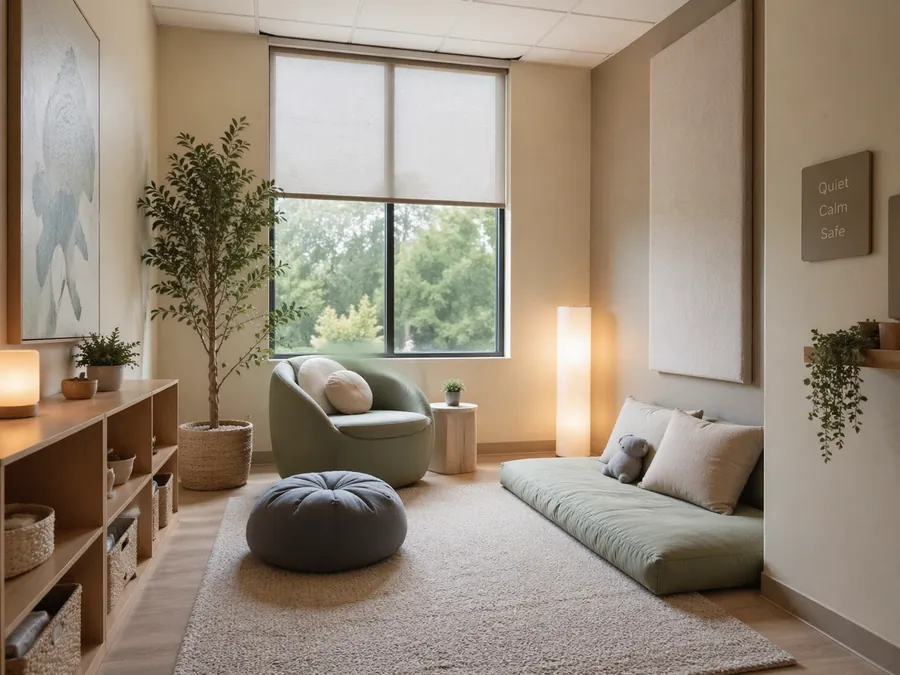
sensory retreat rooms
smaller rooms for focused activity
buffered transition areas
The important thing is that lower-intensity spaces must genuinely feel calmer. A quiet corner beside a noisy doorway may not work. A rest room beside a busy kitchen or bathroom may be interrupted by services noise. A retreat area in a reverberant room may provide visual separation but not acoustic relief.
Regulation spaces need acoustic protection as well as visual softness.
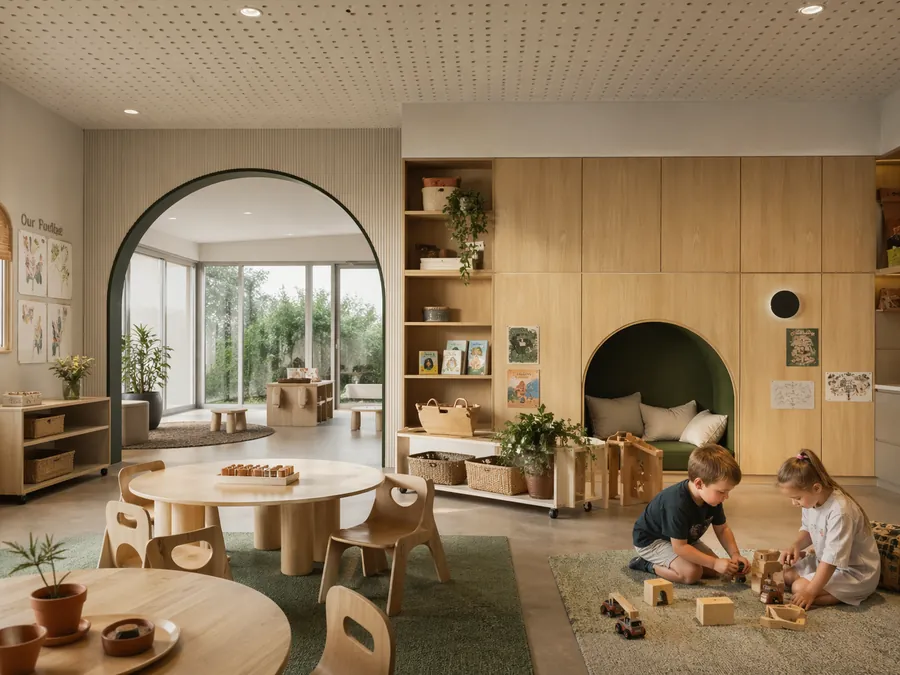
Early learning rooms need acoustic zoning
Early learning spaces often combine many activities in one environment: play, eating, nappy changing, group time, rest, music, conversation, movement and indoor-outdoor transitions.
These activities have different acoustic needs. Active play can be lively. Story time needs speech clarity. Rest areas need calm. Eating areas need conversation without excessive noise. Staff need to communicate clearly. Children need predictable spaces for transition and regulation.
Acoustic zoning helps these uses coexist. This may involve ceiling treatment, soft furniture, rugs, curtains, partial screens, joinery, room layout, storage buffers, quiet corners and better separation between active and calm zones.
The aim is not to restrict play. It is to prevent every activity from acoustically dominating every other activity.
Children’s rooms at home also need acoustic thought
Children’s spaces in homes are often designed around furniture, storage, colour and flexibility. Acoustic comfort is easy to overlook.
Bedrooms, playrooms, study corners and shared family spaces all affect children’s daily experience. A bedroom beside a living room may be difficult for sleep. A playroom with hard surfaces may become loud quickly. A study nook in an open-plan kitchen may be too distracting. A nursery near a bathroom or laundry may be affected by services noise.
Acoustic improvements in homes do not need to be technical or obvious. Curtains, rugs, upholstered furniture, soft storage, door seals, careful room choice, quieter appliances and better zoning can all help.
For children who are light sleepers, sensory-sensitive, neurodivergent or easily distracted, the acoustic planning of home spaces can make everyday routines easier.
Play spaces can be lively without becoming harsh
Play generates sound. That is natural and appropriate. The goal is not to make play quiet, but to prevent the room from making play sound harsher than it needs to be.
Hard floors, high ceilings, bare walls and large windows can make play sounds reflect and build. Toys, footsteps, voices and movement can become sharper and more tiring.
Play spaces often benefit from durable acoustic treatment: absorptive ceilings, soft floor areas, wall panels, curtains, storage elements, upholstered seating and material choices that reduce excessive reflection.
The design needs to be robust. Children’s spaces require finishes that can handle touch, movement, cleaning and wear. Acoustic treatment should support real use, not create fragile surfaces that people avoid.
Rest and sleep spaces need stronger acoustic protection
Rest rooms, nap spaces and children’s bedrooms need more acoustic calm than active play areas.
Sleep and rest can be affected by internal noise, external noise, doors, corridors, plumbing, mechanical systems, kitchen activity, siblings, neighbours and outdoor sound. Even if a child sleeps through some noise, a calmer environment can support a more settled routine.
Acoustic design for rest spaces may involve room location, door sealing, curtains, soft finishes, background noise control, separation from active areas and careful services planning.
A rest space should not be placed directly beside the loudest activity if that can be avoided. If adjacency is unavoidable, walls, doors, ceilings and services may need more careful detailing.
Classrooms need conditions that support listening
Classroom acoustics are closely connected to children’s communication and learning. Excessive background noise and reverberation are widely recognised as key causes of poor classroom acoustics, and children can be more affected by these conditions than adults.
A classroom does not need to be silent, but it should allow speech to be heard clearly. This is especially important for younger children, children with hearing differences, children learning a new language and children who need more favourable listening conditions.
Good classroom acoustic design may involve ceiling absorption, wall treatment, quieter services, better door separation, reduced corridor noise, suitable room layout and control of external noise.
The acoustic goal is simple: make listening easier.
Children with sensory sensitivity may need more predictable sound
Some children are more sensitive to sound than others. This may include some autistic children, ADHD children, children with sensory processing differences, children with anxiety, children with hearing differences or children who are tired or stressed.
For these children, unpredictable sound can be particularly difficult: sudden door slams, scraping chairs, overlapping voices, loud fans, hand dryers, alarms, corridor noise or echoey rooms.
Sensory-aware acoustic design can help by reducing reverberation, controlling mechanical noise, providing quiet retreat spaces, softening transitions and separating active and calm zones.
The key is not to assume all children need the same thing. The design should provide options and reduce unnecessary acoustic stress.
Transitions can be difficult
Children often move between different acoustic environments: classroom to playground, bedroom to living room, quiet corner to group activity, hallway to learning space, car park to centre, bathroom to playroom.
These transitions can be challenging when the sound changes suddenly or when a noisy space spills directly into a calm one.
Acoustic transitions can be softened through thresholds, lobbies, corridors, curtains, door placement, furniture, material changes and clear zoning. These design moves help children understand and manage changes in activity level.
A calmer transition can support routines, especially in early learning, therapy and sensory-sensitive settings.
Adults benefit from better children’s acoustics too
Children’s spaces are also working spaces for adults: educators, teachers, carers, parents, therapists and support staff.
Poor acoustics can make adults speak louder, repeat themselves more often and work harder to communicate. This can increase fatigue and stress over a long day.
A calmer acoustic environment supports adults as well as children. Clearer speech, lower reverberation and reduced background noise can make supervision, teaching, caregiving and conversation easier.
This matters because adult regulation affects the whole environment. A room that supports staff comfort is more likely to support children’s comfort too.
Furniture and layout influence acoustic comfort
Furniture is part of the acoustic design. Shelves, rugs, soft seating, cushions, curtains, storage units, reading nooks and play structures can all help shape sound.
Storage can act as a buffer. Rugs can soften floor reflections. Soft seating can absorb sound near children. Bookshelves can break up reflections. Curtains can reduce reflections from glass. Furniture layout can separate active and quiet zones.
However, furniture alone may not solve a highly reverberant room. Ceiling and wall treatment may still be needed, especially in larger rooms or spaces with hard finishes.
The best children’s spaces use furniture, finishes and room treatment together.
Ceiling treatment is often highly effective
The ceiling is often the largest continuous surface in a children’s space. If it is hard and reflective, it can contribute strongly to reverberation.
Acoustic ceiling treatment can be one of the most efficient ways to reduce sound build-up. It can support clearer speech, calmer play and less harsh room sound.
The treatment needs to suit the setting. In schools and early learning centres, durability, access, cleaning, fire requirements, lighting, air conditioning, sprinklers and maintenance all matter. In homes, the ceiling treatment may need to be subtle and integrated.
Ceiling treatment works best when it is coordinated early with the rest of the design.
Walls and display surfaces can support acoustics
Children’s spaces often use walls for display, storage, artwork, pinboards and learning materials. These surfaces can also contribute acoustically if designed carefully.
Pinboard-style acoustic panels, fabric display surfaces, absorptive wall zones, curtains, soft panels, timber systems with backing and integrated joinery can all help reduce reflections.
Wall treatment should be placed where it matters. It should also be robust enough for the age group and activity. In children’s spaces, acoustic treatment must be practical, safe, cleanable and durable.
The visual role of walls can support the acoustic role when planned early.
Hard materials need acoustic balance
Children’s spaces often use hard materials for good reasons: durability, hygiene, cleaning, impact resistance and cost. Vinyl floors, plasterboard walls, glass, tile, timber, concrete and laminate surfaces are common.
These materials can be practical, but they need acoustic balance.
Soft furnishings, acoustic ceilings, rugs, curtains, upholstered furniture, wall treatment and careful zoning can reduce the harshness of hard surfaces. In wet areas or high-use zones, treatment may need to be placed nearby rather than directly on the hardest surfaces.
The aim is to keep the room practical while reducing unnecessary acoustic intensity.
Outdoor noise can affect indoor comfort
Children’s spaces often connect to outdoor play areas, streets, courtyards, gardens, schools, neighbours or playgrounds. Outdoor noise can enter through windows, doors, façades and open transitions.
This is not always a problem. Indoor-outdoor connection is valuable. But if rest, study, therapy, sleep or quiet learning spaces are exposed to outdoor noise, the design may need better separation.
Options may include room placement, façade design, door seals, glazing, acoustic lobbies, scheduling, zoning and careful location of outdoor play relative to quieter rooms.
Outdoor sound should be planned, not simply accepted as unavoidable.
Mechanical noise and appliances can become stressors
Mechanical systems and appliances can be particularly noticeable in children’s spaces. Fans, air conditioning, refrigerators, hand dryers, pumps, projectors, equipment and plumbing can all add background noise.
Some sounds are steady. Others are sudden or intermittent. The character of the noise matters as much as the level.
A hand dryer near a sensory-sensitive area may be highly disruptive. A loud fan in a rest room may prevent calm. A noisy air-conditioning grille in a classroom may affect speech clarity.
Services should be reviewed as part of acoustic comfort. The room should not rely on children adapting to intrusive mechanical noise.
Behavioural expectations should match the room
A room that is acoustically harsh may make quiet behaviour harder. If voices echo, children may speak louder. If play sounds build up, the room may feel more chaotic. If instructions are unclear, adults may need to repeat themselves. If there is no quiet retreat, children may struggle to regulate.
This does not mean the room is responsible for all behaviour. It means expectations should match the environment.
If a space is expected to support calm, focus or rest, the room needs acoustic conditions that make those behaviours more achievable.
Design and behaviour should support each other.
Existing children’s spaces can be improved
Many acoustic improvements happen in existing rooms. A playroom may feel too loud. A classroom may be hard to teach in. A home study area may be distracting. A rest room may be affected by corridor noise. An early learning centre may have overlapping active and quiet zones.
The first step is to identify the main issue. Is the room too reverberant? Is background noise too high? Are active and calm zones too close? Is speech unclear? Are services noisy? Is the door weak? Are hard surfaces dominating? Is there no retreat space?
Once the issue is clear, solutions can be targeted. Options may include ceiling treatment, wall treatment, rugs, curtains, door seals, services review, layout changes, zoning changes, soft furniture or more careful separation between uses.
The best improvement is the one that reduces the actual acoustic load.
Buildability and safety matter
Children’s spaces need acoustic solutions that are safe, durable and maintainable. Materials should suit the age group and level of use. Panels should be secure. Surfaces should be cleanable. Edges should be considered. Ceiling treatment should coordinate with services. Curtains should be safe and operable. Soft furnishings should be practical.
A fragile acoustic solution may not last. A treatment that cannot be cleaned or maintained may not be suitable. A solution that interferes with supervision or safety may not be appropriate.
Good acoustic design for children’s spaces is practical as well as supportive.
Consultation should include people who use the space
Children’s acoustic needs are best understood through observation and consultation. Educators, parents, carers, therapists, support staff and children themselves may all notice different issues.
Where possible, design decisions should be informed by how the space is actually used: busy times, quiet times, transitions, group activities, rest routines, sensory needs and staff experience.
A room may look fine in a drawing but feel different during a full day of use.
Post-occupancy feedback can also be valuable. Children’s spaces change over time, and acoustic strategies may need adjustment as use patterns evolve.
When to get acoustic advice
It is worth getting acoustic advice when a children’s space feels loud, echoey, stressful, hard to communicate in or difficult for rest, focus or regulation.
Advice is especially useful for early learning centres, classrooms, playrooms, children’s bedrooms, therapy rooms, libraries, sensory rooms, shared family spaces and school support areas.
An acoustic review can help identify whether the issue is reverberation, background noise, services noise, speech clarity, zoning, external noise, sound transfer or material balance. From there, the design can focus on practical changes that make the space calmer and more usable.
Final thought
Children’s spaces should be allowed to sound alive. They should support play, learning, movement, communication and care.
But they should not force children and adults to work against unnecessary acoustic stress.
The strongest acoustic design for children’s environments creates clearer speech, lower reverberation, more predictable sound, better quiet zones and calmer transitions. It supports behaviour and development by improving the conditions around communication, focus, rest and regulation.
A good children’s space does not demand silence. It gives sound enough structure that children can use the room with more comfort, confidence and ease.
Frequently Asked Questions
Acoustic Design for Children’s Spaces
Practical acoustic advice for early learning rooms, classrooms, play spaces, bedrooms, therapy rooms and sensory-aware environments.
Acoustic Design for Children’s Spaces
Practical acoustic advice for early learning rooms, classrooms, play spaces, bedrooms, therapy rooms and sensory-aware environments.
Read Nicholas Marriott's bio