
Classroom Acoustics & Learning Spaces: Speech Intelligibility and Better Learning Conditions
A practical guide to classroom and learning-space acoustics, covering speech intelligibility, reverberation, background noise, room finishes, flexible teaching spaces, sensory comfort and the design decisions that support clearer listening.


.avif)
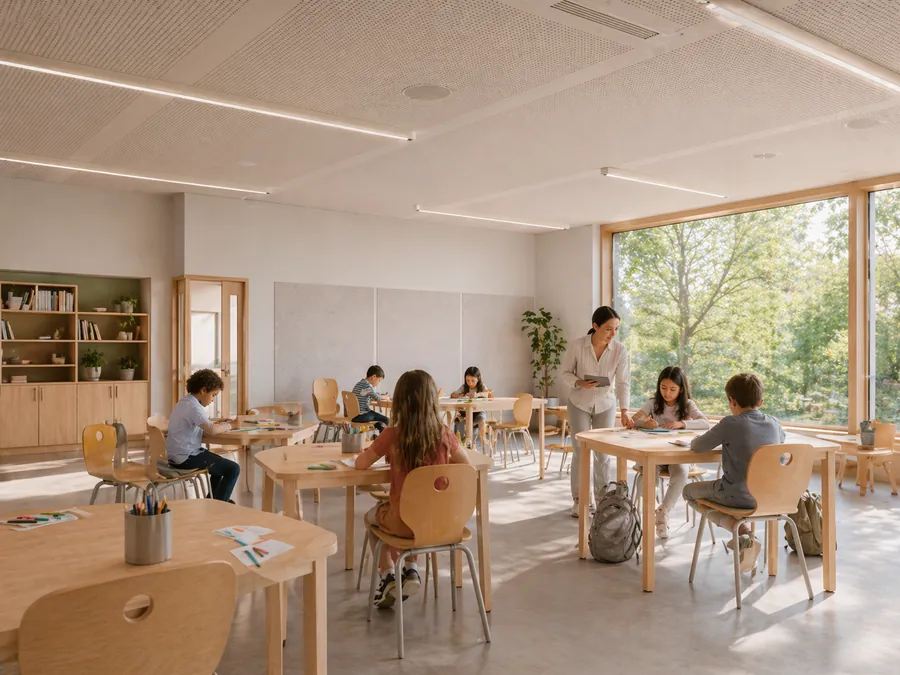
Classroom acoustics affect how easily students can listen
A classroom is a listening environment before it is anything else. Students need to hear instructions, questions, explanations, discussion and each other. Teachers need to speak without strain. The room needs to support attention, clarity and participation throughout the day.
When the acoustics are poor, learning can become harder than it needs to be. Speech may sound unclear. Background noise may mask important information. Hard finishes may create echo. Group work may become overwhelming. Teachers may raise their voices. Students may miss details, lose focus or become fatigued.
Good classroom acoustic design is not about creating silence. Classrooms are active spaces. They need energy, movement and interaction. The goal is to make speech clearer, noise more manageable and the room easier to use for teaching and learning.
A well-designed learning space should help communication feel natural rather than effortful.
Speech intelligibility is the central issue
Speech intelligibility is the ability to understand spoken words clearly. In classrooms, it is one of the most important acoustic outcomes.
A teacher may be loud enough, but still not easy to understand if the room is too reverberant or if background noise is high. A student may hear that someone is speaking but miss the words. This matters because learning often depends on small details: instructions, examples, corrections, questions and discussion.
Speech intelligibility is affected by several factors at once:
room reverberation
background noise
distance from the speaker
teacher voice level
student noise
mechanical noise
room layout
surface finishes
openings and partitions
audio systems where used
A good classroom acoustic strategy considers the whole listening condition, not just one surface or product.
Reverberation can make speech less clear
Reverberation is the sound that remains in a room after the original sound source has stopped. In a classroom with too much reverberation, speech reflections overlap with new speech. This can make words less distinct.
Hard ceilings, plasterboard walls, glass, concrete, timber floors and minimal soft surfaces can all increase reverberation. The room may sound lively, but that liveliness can reduce clarity.
The problem becomes more obvious when several students speak, chairs move, bags rustle, air conditioning runs or activity increases. The room may feel noisy even when no one is being especially loud.
Reducing excessive reverberation usually requires absorption in the right places. Ceilings are often especially important because they provide a large surface area. Wall treatment, curtains, soft furnishings and acoustic panels can also help depending on the space.
The aim is not to make the classroom dead. It is to reduce the sound build-up that interferes with listening.
Background noise masks speech
Background noise is any ongoing sound that competes with speech. In learning spaces, it may come from air conditioning, fans, traffic, rain, neighbouring rooms, corridors, playgrounds, plumbing, projectors, equipment, chairs, student movement or external activity.
Even moderate background noise can make speech harder to understand, especially for students sitting further from the teacher or for students who need more favourable listening conditions.
Mechanical services are a common issue. A classroom may look well designed but still be difficult to use if ventilation or air conditioning noise is too high. External noise through windows can also affect learning spaces, especially where rooms face roads, playgrounds or busy outdoor areas.
Good classroom acoustic design should consider both the sound generated inside the room and the noise entering from outside it.
Teachers should not need to fight the room
Poor acoustics can affect teachers as well as students. When a room is reverberant or noisy, teachers may speak louder to be understood. Over time, that can contribute to fatigue and make teaching more demanding.
A classroom should help the teacher’s voice carry clearly without requiring constant vocal effort. This depends on controlling reverberation, reducing background noise, managing room layout and supporting good listening conditions across the room.
The goal is not amplification in every case. It is a room that allows normal speech to work more effectively.
Where voice reinforcement or assistive listening systems are used, the room still needs good acoustic conditions. Technology cannot fully compensate for a room that is too noisy or too reverberant.
Flexible learning spaces need careful acoustic planning
Modern learning environments often include flexible layouts, sliding walls, breakout zones, shared learning areas and multiple teaching modes. These spaces can support collaboration and adaptability, but they can also create acoustic challenges.
When several activities happen in one connected area, speech and noise can overlap. A group discussion may disturb quiet work. A teacher’s instruction may compete with another class nearby. A movable partition may not provide the same sound separation as a properly detailed wall. A large open learning area may become lively but difficult to manage acoustically.
Flexible spaces need acoustic zoning. Different activities should have different acoustic conditions where possible. Quiet tasks, group work, direct instruction and movement should not all compete in the same sound field.
The design can use ceiling treatment, partial separation, soft furnishings, layout, storage, curtains, screens, operable walls and material changes to help create acoustic order without removing flexibility.
Open learning areas need boundaries
Open learning spaces can easily become acoustically confusing if sound is allowed to travel without control. Boundaries are still needed, even when the design is visually open.
A boundary may be physical, acoustic, spatial or behavioural. It might be a wall, screen, joinery unit, curtain, bookshelf, change in ceiling treatment, floor material, furniture arrangement or distance between activity zones.
These boundaries help students and teachers understand where activities begin and end. They can reduce distraction and prevent one group from dominating the whole space.
A learning area does not need to be fully enclosed to have acoustic structure. But it does need enough separation and absorption to support the activities within it.
Group work creates different acoustic demands
Classrooms are not used only for teacher-led instruction. Group work, discussion, collaborative projects and peer learning all create more distributed sound.
This can be valuable educationally, but acoustically it increases complexity. Several small groups speaking at once can create a high overall noise level. If the room is reverberant, those voices build up and make listening harder for everyone.
A room designed only for one teacher speaking from the front may not support group work well. The acoustic design needs to account for multiple sound sources, changing layouts and different activity levels.
This may involve more distributed absorption, ceiling treatment, soft furniture, better zoning and room layouts that reduce direct competition between groups.
Students with different listening needs require better conditions
Some students need more favourable acoustic conditions than others. This may include younger students, students learning a new language, students with hearing differences, students with auditory processing challenges, neurodiverse students, students with sensory sensitivity and students who find it difficult to filter competing noise.
A room that seems acceptable to one person may be much harder for another. Poor acoustics can increase listening effort, distraction and fatigue.
Better classroom acoustics support inclusion because they reduce unnecessary barriers to listening. Clearer speech, lower background noise and more predictable sound conditions help more students access the same information.
This does not mean every learning space must become silent. It means classrooms should be designed so that speech is clear and noise is manageable for a wider range of users.
Early learning spaces need particular care
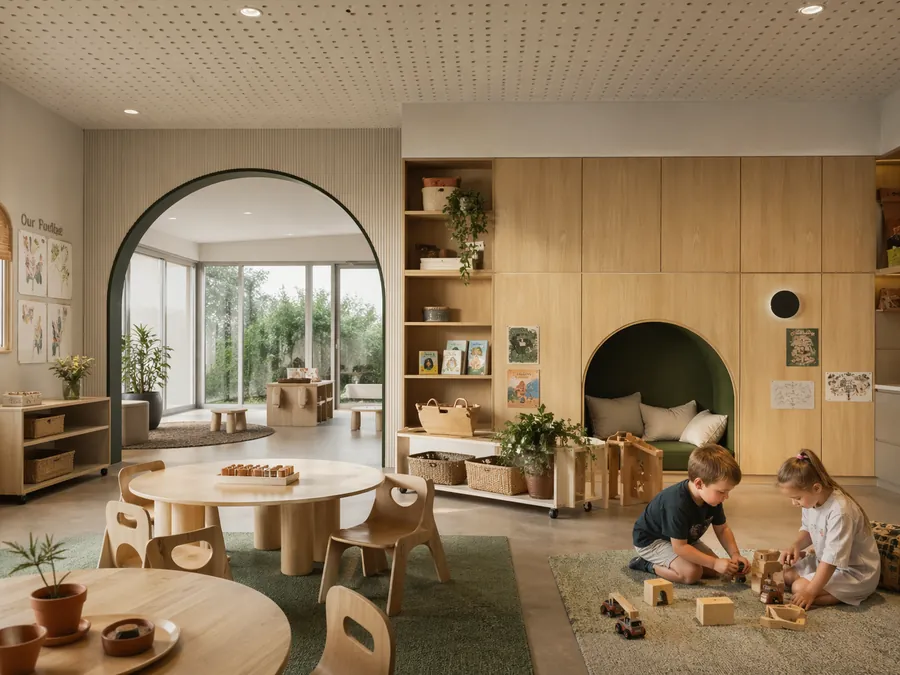
Early learning environments often combine speech, play, movement, singing, group activity, eating, rest and sensory regulation. These spaces can become loud quickly, especially when hard surfaces and open layouts are used.
Young children may be more affected by noise and may also generate more variable sound levels. Staff need to communicate clearly while supervising multiple activities. Calm zones, rest areas and focused activities need different sound conditions from active play areas.
Acoustic planning in early learning settings should consider zoning, soft materials, ceiling absorption, room volume, furniture, quiet corners, outdoor noise, services noise and the relationship between active and calm areas.
The aim is not to suppress play. It is to reduce unnecessary acoustic stress and support clearer communication.
Specialist learning and sensory spaces need predictable sound
Some learning environments serve students who are more sensitive to sound, change or overstimulation. In these settings, predictability can be as important as noise reduction.
Sudden sounds, sharp reverberation, loud mechanical systems, overlapping speech and uncontrolled activity can make a space harder to use. A room may need calmer finishes, lower reverberation, reduced background noise, soft transitions, quiet retreat zones and careful separation from louder spaces.
This does not mean designing a sterile environment. It means designing spaces where sound is less chaotic and more controllable.
Acoustic design can support regulation, communication and comfort when it is considered as part of the overall sensory environment.
Corridors and adjacent spaces matter
Classroom acoustics are not only shaped by the classroom itself. Corridors, breakout spaces, neighbouring rooms, playgrounds, toilets, halls, music rooms and outdoor areas can all affect learning conditions.
Noise from corridors can enter through doors, glazing, gaps or lightweight partitions. Sound from adjacent rooms can travel through walls, ceilings or shared services. Playground or traffic noise can enter through façades and windows. Flexible partitions can allow sound to pass between spaces.
Good acoustic planning considers the classroom’s context. A room beside a noisy corridor may need better door seals, a different threshold or additional separation. A classroom next to a music room may need more serious isolation. A room facing a busy road may need façade and ventilation planning.
A classroom is part of a larger acoustic environment.
Doors and glazing can limit speech privacy and separation
Doors and glazing are common weak points in schools and learning spaces. A standard door with gaps can allow corridor noise into the classroom. Glass walls can support visibility but may reduce acoustic separation if not properly designed. Operable walls may provide flexibility but may not achieve the same performance as fixed construction.
These elements need to be selected and detailed according to the room’s use. A standard classroom may need a different level of separation from a music room, therapy room, exam room, meeting room or quiet support space.
The door leaf, frame, seals, threshold, glazing system and installation quality all matter.
Visual connection and acoustic separation can work together, but they need to be designed intentionally.
Ceiling treatment is often the most efficient intervention
In classrooms, the ceiling is often the largest available acoustic surface. Treating it can significantly reduce reverberation and improve clarity.
Ceiling treatment may include acoustic tiles, acoustic plaster, suspended absorptive panels, rafts, baffles or integrated ceiling systems. The right approach depends on the room, services, budget, durability and design language.
Ceiling treatment also needs coordination with lights, fans, air conditioning, sprinklers, projectors, speakers, sensors and access panels. If services are not coordinated, the treatment may lose area or become fragmented.
A good classroom ceiling strategy supports speech clarity while still meeting practical construction and maintenance needs.
Wall treatment can support clarity and comfort
Wall treatment can help reduce reflections, flutter and noise build-up. It can also improve comfort where ceilings alone are not enough.
Acoustic wall panels, fabric-wrapped surfaces, pinboard-style treatment, timber systems with absorptive backing, curtains, soft displays and integrated joinery can all contribute depending on the room.
Wall treatment needs to be durable. Learning spaces involve chairs, bags, student movement, display materials, cleaning and everyday wear. The finish should suit the age group and use of the space.
Placement matters. Treatment should be located where it contributes to speech clarity and reverberation control, not simply where a spare wall is available.
Furniture and soft materials contribute to acoustic comfort
Furniture is part of the acoustic environment. Soft seating, rugs, curtains, display boards, bookshelves and upholstered elements can reduce harshness and help define zones.
In early learning, libraries and breakout spaces, soft furniture can make spaces feel calmer and more settled. In classrooms, furniture layout can influence how students hear the teacher and each other.
However, furniture should not be relied on as the only acoustic treatment if the room has significant reverberation or background noise. It can help, but the main room surfaces usually still need to be considered.
The best learning spaces combine durable surfaces with enough softness to support comfort.
Technology works best in good rooms
Classrooms often use projectors, speakers, video conferencing systems, microphones, interactive screens and assistive listening technology. These systems can help communication, but they do not remove the need for good room acoustics.
If a room is too reverberant, amplified speech may still be unclear. If background noise is high, microphones and speakers may not solve the listening problem. If the room has poor zoning, technology may amplify sound into already noisy areas.
Audio systems should be designed with the room, not used to compensate for an unsuitable acoustic environment.
Good acoustics make technology more effective.
Libraries and study spaces need a different balance
Libraries, study rooms and resource spaces need different acoustic conditions from general classrooms. They often need calm, focus and lower distraction, while still allowing some movement, discussion and group work.
A library that is too live can feel busy and difficult to concentrate in. A study space that is too silent may make every small sound feel intrusive. A shared resource area may need zones for quiet reading, group work, technology use and circulation.
Acoustic zoning is important. Quiet areas should be separated from active areas. Soft finishes, ceiling treatment, shelving, furniture layout and background noise control can all help create a usable balance.
A good study environment is not always silent. It is predictable, comfortable and supportive of focus.
Multipurpose halls and shared learning spaces need flexibility
Some school spaces need to support many uses: assemblies, sport, music, presentations, exams, drama, community events and learning activities. These spaces can be acoustically difficult because each use has different needs.
A hall that works for sport may not provide good speech clarity. A room that works for amplified presentations may not suit music. A multipurpose space may need variable treatment, curtains, banners, absorptive panels, sound systems or zoning strategies.
The design should identify the main uses and prioritise acoustic conditions accordingly. It may not be possible to optimise everything equally.
Flexible acoustic design is about making the space usable across its most important functions.
Mechanical noise should be controlled early
Ventilation and air conditioning are essential, but they can create background noise that interferes with speech clarity.
Fans, ducts, grilles, air speed, plant location and vibration can all affect learning spaces. A classroom may have adequate acoustic treatment but still be difficult if the air-conditioning system is noisy.
Mechanical noise should be considered early because it is hard to fix after installation. Quiet operation, appropriate grille selection, duct design, plant location and vibration control can all help.
A comfortable learning space needs both fresh air and clear listening conditions.
Acoustic design should be durable and maintainable
Learning spaces are hard-working environments. Acoustic finishes need to survive daily use.
Ceiling systems need access and maintenance. Wall panels may need impact resistance. Fabric finishes may need cleaning. Pinboards may need to hold displays. Treatment in early learning spaces may need to withstand contact. Any acoustic element should be suitable for the age group, use and maintenance expectations.
A treatment that performs well but is easily damaged may not be the right choice. A durable but non-absorptive surface may not solve the acoustic problem.
Good acoustic design balances performance, durability, safety, maintenance and visual character.
Existing classrooms can still be improved
Many classroom acoustic improvements happen in existing buildings. A room may feel echoey, noisy, hard to teach in or unsuitable for students with specific listening needs.
Improvement is usually possible, but the first step is to identify the main issue. Is the room too reverberant? Is background noise too high? Is corridor noise entering through the door? Are adjacent rooms too loud? Are services noisy? Is the layout creating problems? Is the room being used for activities it was not designed to support?
Once the issue is clear, upgrades can be targeted. Options may include ceiling treatment, wall treatment, door sealing, mechanical noise review, layout changes, soft furnishings, glazing improvements or more serious separation work.
The best upgrade is the one that addresses the actual listening barrier.
Buildability matters in school environments
School projects often need acoustic improvements to work within budgets, programmes, maintenance requirements, safety needs and construction timing. Work may need to happen during holidays or staged around school operation.
Buildability matters. Ceiling treatment must coordinate with services. Wall treatment must be durable. Doors and seals need to be practical. Flexible spaces need details that survive daily use. Treatments must be installable and maintainable.
A good acoustic solution should suit the school environment, not just the acoustic model.
The most useful advice is practical: what will improve the room, what can be installed, and what will remain effective over time.
When to get acoustic advice
It is worth getting acoustic advice when a classroom or learning space feels noisy, echoey, hard to teach in, difficult for speech clarity or unsuitable for students who need better listening conditions.
Advice is especially useful during new school design, classroom refurbishment, early learning projects, flexible learning space planning, library upgrades, sensory room design, music room adjacency planning and any project where acoustic comfort affects use.
An acoustic review can help identify whether the issue is reverberation, background noise, room separation, services noise, layout or material balance. From there, the design can target the right problem.
Final thought
Classroom acoustics are about access to communication.
When speech is clear, background noise is controlled and the room is not overly reverberant, listening becomes easier. Teaching becomes less effortful. Group work becomes more manageable. More students can participate with less strain.
Good acoustic design does not make a learning space silent. It makes it clearer, calmer and more usable.
The strongest learning environments consider acoustics as part of the design from the beginning: room shape, finishes, ceilings, walls, doors, services, zoning and the needs of the people using the space every day.
Frequently Asked Questions
Classroom & Learning Space Acoustic Design
Practical acoustic advice for classrooms, early learning spaces, libraries, study areas and specialist learning environments.


Classroom & Learning Space Acoustic Design
Practical acoustic advice for classrooms, early learning spaces, libraries, study areas and specialist learning environments.
Read Nicholas Marriott's bio