
Control Room Acoustic Design in Sydney: Monitoring Accuracy, Bass Control and Mix Translation
A practical guide to control room acoustic design in Sydney, covering speaker placement, symmetry, bass control, early reflections, room treatment, listening position, background noise, calibration and the acoustic decisions that help mixes translate beyond the studio.


.avif)
A control room is a decision-making room
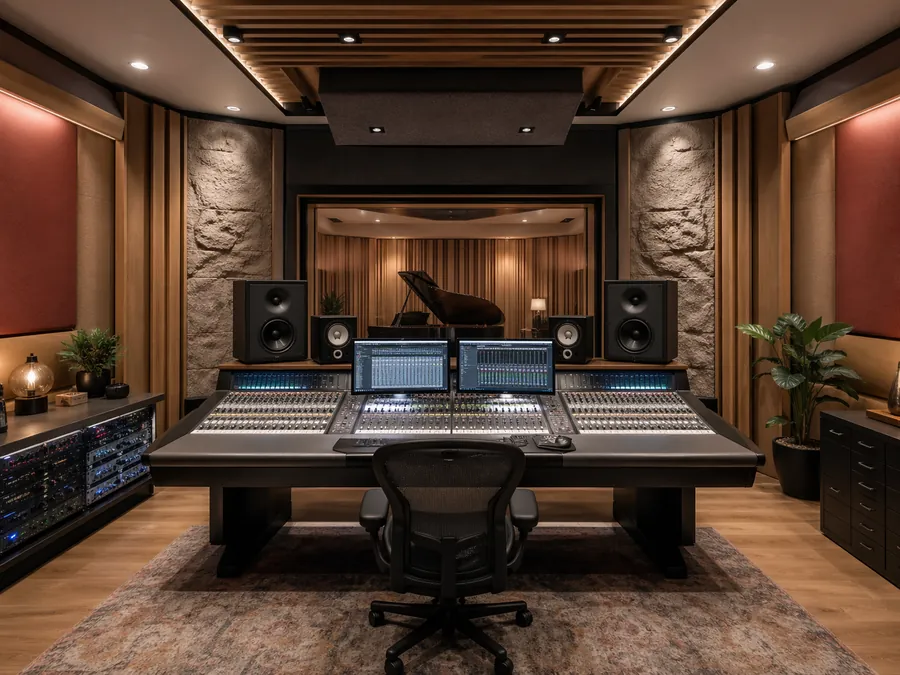
A control room is not just a room with studio monitors. It is the place where decisions are made about balance, tone, stereo image, depth, dynamics and low-frequency content. If the room is misleading, those decisions become harder to trust.
This is why control room acoustic design matters. The aim is not simply to make a studio look treated. The aim is to create a listening environment where the engineer, producer or artist can hear the work clearly enough to make reliable decisions.
In a Sydney studio, home studio or production room, the control room might be purpose-built, adapted from an existing room or developed inside a residential setting. Each version has different constraints. But the underlying goal is the same: the monitoring system and room need to work together.
Good monitoring accuracy comes from the relationship between the room, speakers, listening position, acoustic treatment, background noise, construction and workflow. The room is part of the monitoring chain.
Mix translation is the real test
A control room succeeds when mixes translate. That means decisions made in the room still make sense on other systems: headphones, cars, small speakers, clubs, phones, home stereos and broadcast environments.
Poor translation often comes from a room that exaggerates or hides parts of the sound. If bass is too strong at the listening position, the engineer may under-mix the low end. If bass disappears at the listening position, the mix may leave the studio too heavy. If early reflections blur the stereo image, panning and depth decisions become less reliable.
Mix translation is not about chasing a perfectly flat graph. It is about reducing the room’s most misleading behaviours so decisions become more consistent.
A good control room should help the listener build confidence. It should reveal problems without exaggerating them and support long sessions without fatigue.
Monitoring accuracy is not only about the speakers
High-quality studio monitors are important, but they cannot perform properly in a poor acoustic environment. A monitor system that is accurate in principle can still sound unreliable if the room introduces strong reflections, modal peaks, nulls, flutter echo or background noise.
The loudspeaker, listener and room operate as one system. Speaker placement affects bass and imaging. The listening position affects tonal balance. Nearby surfaces affect reflections. The ceiling and rear wall influence clarity and depth. The desk can create comb filtering. The room dimensions shape low-frequency behaviour.
This is why control room acoustic design should happen before finalising furniture, speaker positions and treatment. If the room layout starts wrong, every later decision becomes more difficult.
Room choice and orientation come first
Before panels and bass traps are selected, the room itself needs to be assessed. Room size, shape, ceiling height, construction, openings, symmetry and surrounding spaces all affect what can be achieved.
A small square room may create severe low-frequency issues. A very narrow room may limit speaker placement. A room with one side wall open and the other side wall solid may make stereo imaging difficult. A room with a low ceiling may need careful control of ceiling reflections. A room with a large rear window or door may need a more considered rear-wall strategy.
Orientation is also important. In many control rooms, the speakers are best placed firing down the length of the room, but this depends on the exact layout, proportions and constraints. The goal is to give the monitoring position the best chance of symmetry, balanced bass and useful reflection control.
Room selection and orientation are high-value decisions because they shape everything that follows.
Symmetry supports stereo imaging
Control rooms need a stable stereo image. The left and right speakers should interact with the room in similar ways so that the centre image, panning and depth can be judged reliably.
This makes symmetry particularly important around the front of the room. If the left speaker is near a solid wall and the right speaker is beside a window, opening or different surface, the two channels may behave differently. This can shift the apparent centre, blur imaging and make mix decisions less reliable.
Symmetry does not mean every object in the room must be mirrored perfectly. But the critical monitoring zone should be carefully considered. The front wall, side walls, speaker positions, listening position, desk and first reflection areas all need to support balanced left/right behaviour.
A control room with poor symmetry can still be improved, but it often requires more compromise.
Speaker placement sets the foundation
Speaker placement is one of the most important parts of control room acoustic design. Small changes in speaker position can strongly affect bass response, boundary interaction, imaging and tonal balance.
Monitors may need to be placed in relation to the front wall, side walls, listening position and desk surface. The distance from the front wall can influence low-frequency response. Placement near corners can exaggerate bass. Poor height or angle can reduce imaging and clarity. A large desk between the speakers and listener can create additional reflection problems.
The listening position is equally important. Sitting too close to the rear wall can exaggerate low-frequency issues. Sitting in a modal null can make bass disappear. Sitting in an awkward part of the room can make the system feel inconsistent.
Before treatment is finalised, speaker and listener placement should be tested, modelled or assessed so the acoustic design works with the room rather than against it.
Bass control is the hardest part of most control rooms
Low-frequency control is usually the most difficult and most important acoustic challenge in a control room. Bass is strongly influenced by room dimensions, boundaries, speaker placement and listening position.
In a poorly controlled room, bass may feel powerful but inaccurate. Certain notes may dominate while others disappear. The engineer may make decisions that sound right in the room but fail elsewhere. This can affect kick drums, bass guitars, synths, low toms, sub bass, cinematic sound design and overall mix weight.
Bass problems are rarely solved by thin foam or light decorative panels. Effective low-frequency control usually requires a combination of good room layout, speaker/listener positioning, bass trapping, broadband absorption, boundary treatment and sometimes more substantial construction or tuned systems.
The aim is not to remove low end. The aim is to make low end more even, controlled and trustworthy.
Early reflections affect clarity and depth
Early reflections occur when sound from the speakers reflects off nearby surfaces and reaches the listener shortly after the direct sound. These reflections can affect stereo imaging, clarity, perceived depth and tonal balance.
In a control room, the main early reflection points usually include the side walls, ceiling, desk and sometimes nearby equipment or windows. If these reflections are strong, the listening position may feel less precise.
Treatment at early reflection points can improve focus, but the treatment needs to be designed in relation to the speaker and listener positions. It should not be applied randomly.
A control room that is too reflective may feel confusing. A room that is over-absorbed may feel lifeless and fatiguing. The best outcome is controlled but still natural enough for long sessions.
The ceiling is a critical surface
The ceiling is sometimes underestimated in studio design, but it can strongly influence control room accuracy. Ceiling reflections can affect the listening position, especially in rooms with low or medium ceiling heights.
A ceiling cloud or integrated ceiling treatment can help manage early reflections and reduce vertical flutter. In more refined studio projects, the ceiling may also be used for broader absorption, diffusion, lighting integration or architectural expression.
The ceiling strategy needs to coordinate with lighting, air conditioning, cable routes, fire services, height constraints and visual design. A ceiling cloud that works acoustically but blocks sightlines, traps heat or conflicts with services may not be the right solution.
Good ceiling design improves monitoring while still allowing the room to function as a working studio.
The front wall and rear wall do different jobs
The front wall, behind the speakers, and the rear wall, behind the listener, often require different acoustic strategies.
The front of the room affects speaker boundary interaction, early reflections, imaging and low-frequency behaviour. Depending on the design, the front wall may need broadband absorption, controlled boundary treatment, soffit-style integration or other strategies that support the monitor system.
The rear wall can create strong reflections back to the listening position, especially in smaller rooms. If the listener is close to the rear wall, this becomes more critical. Rear-wall treatment may involve absorption, diffusion, deep treatment or a hybrid approach, depending on room size and distance.
There is no single correct formula. The right front-wall and rear-wall strategy depends on the room, the speaker system, the listening position and the intended use.
Diffusion, absorption and balance
Control room treatment is often discussed in terms of absorption and diffusion. Both can be useful, but neither should be used without purpose.
Absorption reduces reflected energy and can help control early reflections, reverberation and low-frequency behaviour when designed properly. Diffusion scatters reflections and can help preserve a sense of space without creating strong direct reflections back to the listening position.
In small rooms, diffusion must be used carefully because there may not be enough distance for it to work as intended. In many compact control rooms, broadband absorption and bass control are higher priorities. In larger rooms, diffusion or hybrid systems may become more useful.
The key is balance. A control room should not be painfully dead, but it should not be so live that the room overrides the monitors. The acoustic response should support decision-making.
The desk can be an acoustic problem
The studio desk is a practical necessity, but it can also create acoustic issues. Large desks can reflect sound from the monitors to the listener, causing comb filtering and changes in tonal balance. Equipment racks, screens and hard surfaces can also affect the monitoring path.
This does not mean a control room should have no desk. It means the desk size, shape, height and position should be considered acoustically.
Nearfield monitors on a large reflective desk may behave differently from monitors on stands or integrated into a more controlled front-wall arrangement. Screens should be placed with sightlines and reflections in mind. Equipment should be accessible without compromising symmetry and early reflection control.
A good control room supports both acoustic accuracy and workflow. One should not destroy the other.
Background noise affects critical listening
A control room needs a suitably low noise floor. If the room is affected by air conditioning, computer fans, external traffic, neighbours, plant equipment or ventilation noise, quiet details in the mix may be masked.
Background noise is especially important for editing, mixing, mastering, voice work, film post-production and detailed production work. A noisy room makes it harder to judge low-level ambience, fades, breaths, noise reduction, reverb tails and dynamic range.
Noise control may involve quieter mechanical services, better duct design, equipment relocation, isolation, seals, door upgrades, window upgrades or ventilation planning.
A control room cannot be judged only by how it handles loud playback. It also needs to reveal quiet information.
Isolation depends on use and neighbours
Some control rooms need significant sound isolation. Others need only modest separation from adjacent rooms.
The right isolation strategy depends on playback levels, subwoofer use, operating hours, neighbours, building construction and the rooms around the studio. A control room in a detached garage has different requirements from a control room in an apartment or a room beside bedrooms.
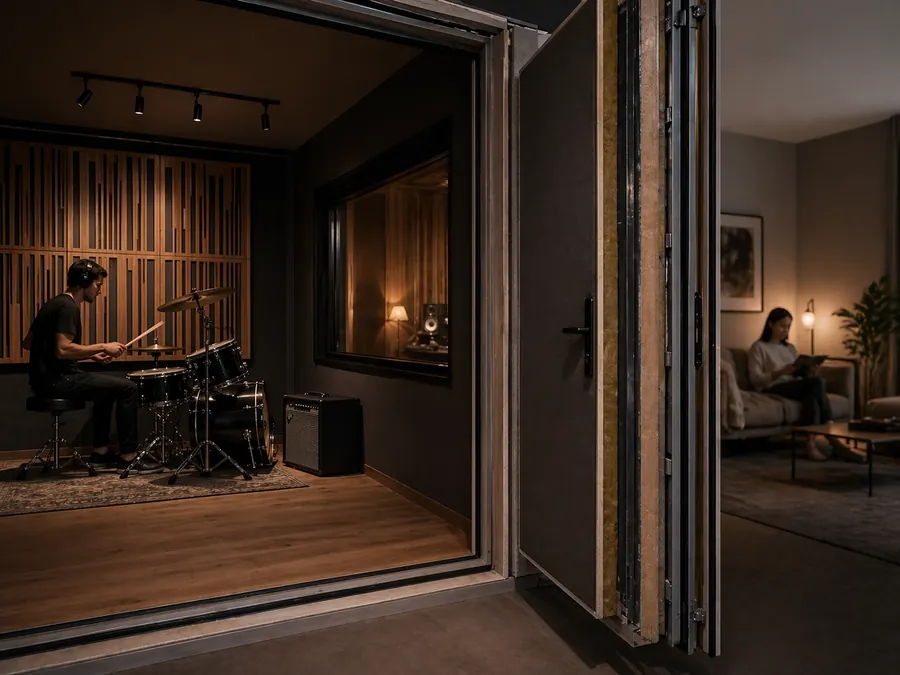
Sound isolation is different from room treatment. Acoustic panels do not usually stop sound from leaving the studio. Isolation involves construction: walls, ceilings, floors, doors, windows, seals, penetrations, ventilation and flanking paths.
If isolation matters, it needs to be considered early. Retrofitting isolation after a control room is finished can be expensive and disruptive.
Calibration and measurement are useful, but not magic
Measurement can be extremely useful in control room design. It can help identify frequency response issues, decay behaviour, modal problems, speaker/listener relationships and the effect of treatment.
But measurement is not a substitute for design judgement. A graph needs interpretation. The room’s purpose, listening preferences, speaker system, construction, workflow and budget all matter.
Calibration can help align the monitoring system, but it should not be used as a shortcut to avoid acoustic treatment or poor placement. Equalisation may reduce some response issues at one listening position, but it cannot fully solve room decay, reflections, nulls, flanking noise or poor geometry.
The strongest results come from combining layout, treatment, measurement, listening and practical refinement.
Small control rooms need clear priorities
Many Sydney control rooms are small. They may be in spare bedrooms, converted garages, apartments, writing rooms or compact production suites. Small rooms can work well, but they need honest priorities.
In a small control room, bass control is usually difficult. The listening position may be close to boundaries. Treatment may need to be deeper than expected. Diffusion may be less useful than absorption. Desk size may need restraint. Speaker choice and placement become especially important.
The goal is not to force a small room to behave like a large commercial studio. The goal is to make it as reliable as possible within its limits.
A well-designed small control room can be highly productive when its constraints are understood.
Workflow and comfort still matter
Control rooms are working environments. Sessions can be long, and the room needs to support focus, comfort and creative decision-making.
Acoustic treatment must work with lighting, ventilation, equipment access, seating, screens, storage, cable management and collaboration. If the room is uncomfortable, too hot, visually cluttered or awkward to use, the acoustic design will not be fully successful.
Good control room design is not only technical. It supports the person working in the room. It allows the engineer or producer to stay oriented, comfortable and confident.
Buildability is part of the design
Control room acoustic design can become complex. Treatment systems, bass traps, ceiling clouds, speaker positions, doors, glazing, ventilation, lighting, wiring and finishes all need coordination.
A design that looks good on paper may fail if it is not buildable. Services may clash with ceiling treatment. Doors may leak sound. Wall panels may not be deep enough. Junctions may be poorly sealed. Contractors may not understand why a detail matters.
Practical acoustic design needs to be specific enough to build and flexible enough to fit the project constraints.
The best control rooms are not only designed. They are carefully executed.
When to get acoustic advice
It is worth getting acoustic advice when a control room is being planned, renovated or upgraded, especially if monitoring accuracy, mix translation, bass control or isolation matters.
Early advice can help with room selection, layout, speaker placement, listening position, treatment strategy, services and construction details. For existing rooms, an acoustic review can help identify why mixes are not translating, why bass feels unreliable or why the room feels fatiguing.
Control room problems can become expensive when the wrong issue is treated first. Good advice helps prioritise the decisions that matter most.
Final thought
A control room should help you trust what you hear.
That trust comes from the whole room: symmetry, speaker placement, listening position, bass control, early reflection treatment, background noise, isolation, calibration, workflow and buildability.
The best control room acoustic design is not about making the room look impressive. It is about making decisions more reliable. When the room supports the monitoring system, the work becomes clearer, faster and more confident.
For Sydney studios, producers, engineers and serious home studio owners, control room design is one of the most valuable acoustic investments because it affects every decision made in the room.
Frequently Asked Questions
Control Room Acoustic Design in Sydney
Specialist acoustic advice for monitoring accuracy, bass control, mix translation and professional studio performance.
Control Room Acoustic Design in Sydney
Specialist acoustic advice for monitoring accuracy, bass control, mix translation and professional studio performance.
Read Nicholas Marriott's bio