
Critical Listening Room Acoustic Design: Hi-Fi, Reference Audio and Room Balance
A practical guide to critical listening room acoustic design, covering stereo imaging, speaker placement, bass smoothness, reflection control, room treatment, background noise and the design decisions that help hi-fi, reference and review systems perform at their best.


.avif)
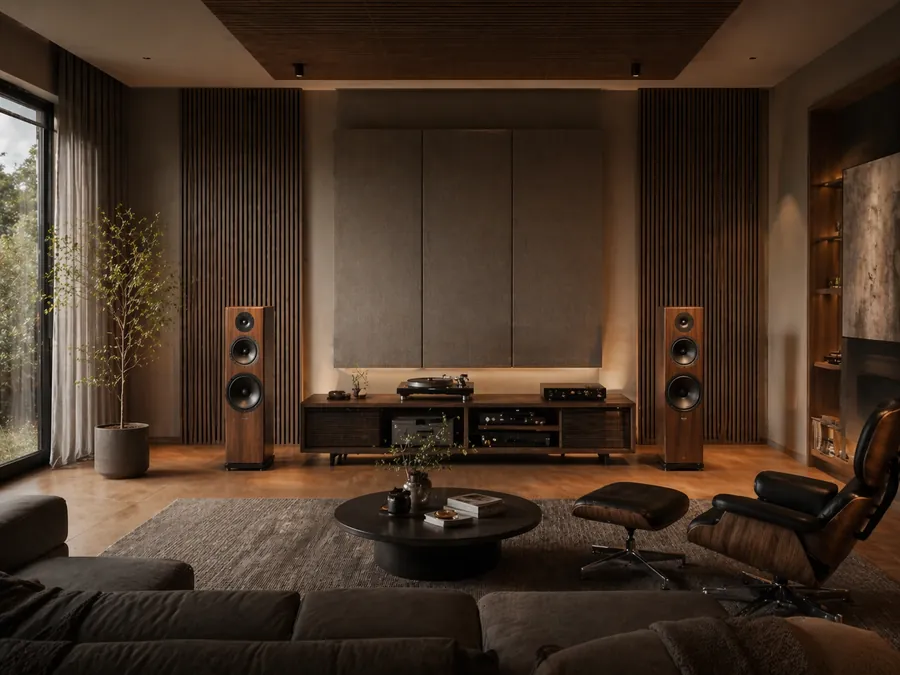
A listening room is part of the audio system
A critical listening room is not just a place to put good speakers. It is part of the audio system itself.
The room shapes tonal balance, stereo imaging, bass response, clarity, depth, background noise and listening comfort. Even a high-quality hi-fi or reference system can sound uneven, harsh, boomy or unfocused if the room is working against it.
This is why critical listening room acoustic design matters. The aim is not to make the room look technical or over-treated. The aim is to create a space where the loudspeakers, listener and room work together.
A successful listening room should reveal detail without becoming fatiguing. It should support bass without becoming boomy. It should feel immersive without losing accuracy. It should allow the system to perform naturally, not fight the architecture around it.
Critical listening is different from casual listening
Many rooms are used for casual music playback. A living room, media room or open-plan space may provide enjoyable listening without needing a highly controlled acoustic response.
Critical listening is different. It requires more confidence in what the room is presenting.
A critical listening room may be used for hi-fi listening, mastering checks, mix review, audio evaluation, product testing, reference playback, film sound review or serious music appreciation. In these settings, the listener is paying attention to tonal balance, imaging, dynamics, low-frequency control, spatial depth and detail.
The acoustic design should support that level of listening. It does not need to feel clinical, but it does need to reduce the room behaviours that mislead the listener.
The speaker, listener and room form one system
A listening room cannot be designed by looking at the speakers alone. The loudspeakers, listening position and room boundaries form one connected system.
Speaker placement affects bass response, imaging and boundary interaction. The listening position affects tonal balance and low-frequency consistency. The side walls, ceiling, floor and rear wall affect reflections and perceived space. Furniture and soft finishes affect comfort and absorption. The room’s dimensions affect modal behaviour.
If any part of this system is ignored, the result may be compromised. A speaker that performs well in one room may sound unbalanced in another. A room that looks calm may still produce strong bass peaks or blurred imaging.
The strongest listening room design begins with the relationship between the speakers, listener and room.
Stereo imaging depends on symmetry and reflection control
One of the most important qualities in a critical listening room is stereo imaging. A good system should create a stable centre image, believable width and depth, and a sense that the recording space is being reproduced clearly.
Room asymmetry can damage this. If one speaker is near a solid wall and the other is beside a window, opening or different surface, the left and right channels may behave differently. This can shift the centre image or reduce focus.
Early reflections can also blur imaging. Strong reflections from side walls, the ceiling, floor or nearby furniture can interfere with the direct sound from the speakers.
A good listening room does not remove all reflections. It controls the reflections that reduce clarity and imaging while preserving enough room character for natural listening.
Speaker placement is a high-value acoustic decision
Speaker placement is one of the most powerful tools in listening room design. It can change bass response, stereo image, tonal balance and depth before any treatment is added.
The distance from the front wall, side walls and corners matters. The height and toe-in of the speakers matter. The distance between the speakers and the listener matters. The relationship between the listening position and the rear wall matters.
In many rooms, small placement changes can produce large acoustic differences. A speaker too close to a boundary may sound heavy or uneven. A speaker placed without symmetry may image poorly. A listening position in a bass null may make low frequencies seem weak, even when the system is capable of much more.
A listening room should not be arranged only by furniture convenience. The speaker/listener geometry should be one of the first design decisions.
Bass smoothness is often the hardest part
Low-frequency control is one of the main challenges in critical listening rooms. Bass behaves differently from mid and high frequencies. It is strongly influenced by room dimensions, boundaries, speaker position and listening position.
A room may have too much bass at one seat and too little bass at another. Certain notes may boom while others disappear. This can affect the perceived quality of the loudspeakers and the recording itself.
In hi-fi listening, uneven bass can be frustrating because it changes the emotional and tonal balance of the music. In reference listening, it can make evaluation unreliable.
Bass control may involve speaker placement, listening position, low-frequency absorption, bass trapping, boundary treatment, multiple subwoofers in some designs, and measurement-guided adjustment. It is rarely solved by thin panels or surface treatment alone.
The goal is not maximum bass. The goal is smooth, controlled and believable bass.
Early reflections need careful balance
Early reflections are reflections that reach the listener shortly after the direct sound from the speakers. They can come from side walls, the ceiling, floor, coffee tables, equipment racks, windows or nearby furniture.
In a critical listening room, early reflections need careful handling. Too many strong early reflections can blur stereo imaging and reduce clarity. Too much absorption, however, can make the room feel unnaturally dry or narrow.
The design decision is not simply “absorb everything.” It is to decide which reflections should be reduced, which can be softened, and which room characteristics should remain.
This may involve broadband absorption at first reflection points, ceiling treatment, rugs, curtains, carefully positioned furniture or hybrid treatment that balances absorption and scattering.
The rear wall can strongly affect the listening position
The wall behind the listener is often critical, especially in smaller rooms where the listening position is close to the rear boundary.
A strong rear-wall reflection can affect clarity, depth and bass perception. If the listener is very close to the rear wall, the room may feel congested or uneven. Low-frequency pressure can also build near boundaries, changing the tonal balance at the listening position.
Rear-wall treatment may involve absorption, diffusion, deep broadband treatment, shelving, furniture or a hybrid system. The right approach depends on the distance from the listener, room size, speaker type, listening level and desired room character.
A rear wall should not be treated casually. It often has a strong influence on how the room feels.
Absorption and diffusion both have roles
Critical listening rooms often use a combination of absorption and diffusion, but each must be used with purpose.
Absorption reduces reflected energy. It can help control early reflections, reverberation, bass decay and room harshness. Diffusion scatters sound and can help preserve spaciousness without creating strong direct reflections.
In smaller rooms, diffusion has to be used carefully because the listener may be too close for some diffusers to work as intended. In larger rooms, diffusion or hybrid treatment may become more useful, especially on rear or upper wall areas.
The best listening rooms usually avoid extremes. They are not bare and reflective, but they are not completely dead either. They allow the system to breathe while reducing the room behaviours that confuse the listening experience.
Interior design and acoustic design should work together
A critical listening room can still feel beautiful, comfortable and residential. It does not need to look like a laboratory or control room unless that is the desired aesthetic.
Acoustic performance can often be integrated into the interior through curtains, rugs, upholstered furniture, timber slat systems, fabric wall panels, bookshelves, acoustic plaster, ceiling features, joinery or custom wall linings.
This matters because many listening rooms are also part of a home. The room may need to be elegant, relaxing and usable outside formal listening sessions.
The strongest listening room design does not separate sound from atmosphere. The room should feel good to sit in, look at and listen to.
Furniture can help or hurt the sound
Furniture is part of the acoustic environment. Sofas, chairs, rugs, curtains, coffee tables, shelves, equipment racks and sideboards all influence reflections and absorption.
A comfortable listening chair or sofa can support the listening position, but a large reflective coffee table between the speakers and listener may create unwanted reflections. Bookshelves can add useful scattering, but poorly placed storage may disrupt symmetry. Heavy curtains can help with window reflections, but they will not solve bass problems.
Furniture should not be an afterthought. In a critical listening room, it should support the speaker geometry, reflection control and listening comfort.
Good furniture placement can make the acoustic design feel natural rather than added.
Background noise affects perceived detail
A critical listening room needs a suitably low background noise level. Quiet musical detail, ambience, decay, room tone and dynamic contrast can all be masked by unwanted noise.
Common background noise sources include traffic, air conditioning, fans, computers, fridges, pumps, neighbours, plumbing and external plant. In a quiet room, even small noises can become noticeable.
Noise control may involve better glazing, door seals, mechanical services planning, equipment relocation, ventilation design or room isolation. The required level depends on how the room will be used.
A hi-fi room does not always need the same noise floor as a mastering room, but background noise should still be considered if critical listening is the goal.
Sound isolation may or may not be required
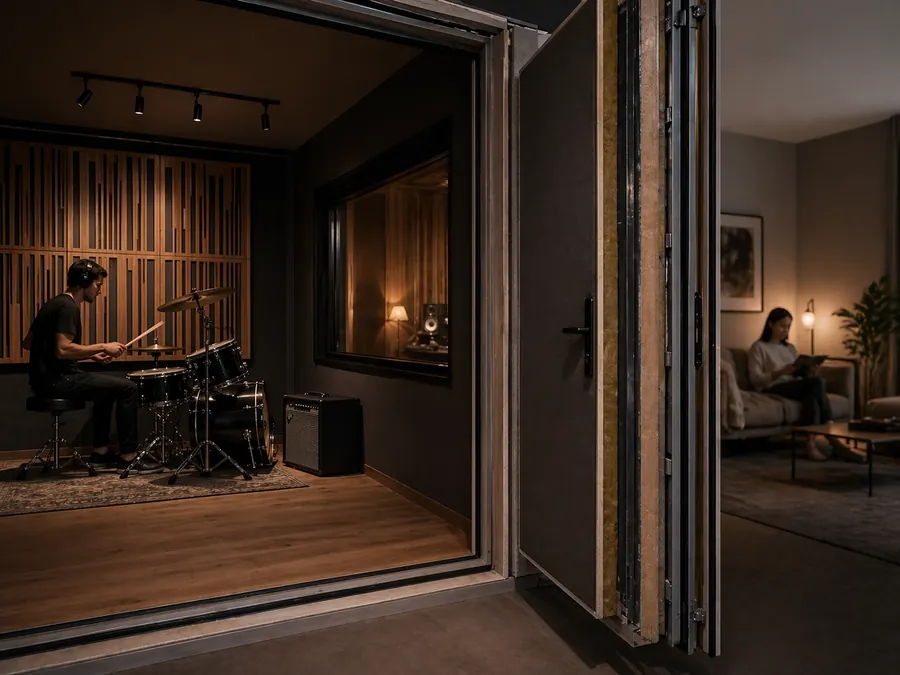
A listening room may need sound isolation if it is near bedrooms, neighbours, apartments, shared walls or sensitive spaces. This is especially relevant when the system includes subwoofers, high playback levels or late-night listening.
Sound isolation is not the same as acoustic treatment. Acoustic treatment improves the sound inside the room. Isolation reduces sound transfer to and from other spaces.
Isolation may involve walls, ceilings, floors, doors, windows, seals, penetrations, ventilation and flanking paths. It is usually easier to plan during renovation or construction than after the room is complete.
Not every listening room needs heavy isolation, but the issue should be considered early if disturbance or privacy matters.
Measurement can guide decisions
Measurement can be very useful in a critical listening room. It can help identify frequency response problems, bass modes, decay behaviour, early reflection issues and changes caused by speaker placement or treatment.
However, measurement should support the design process, not replace listening judgement. A graph can reveal useful information, but the room’s purpose, listener preference, speaker type, construction and interior design all matter.
The aim is not to chase perfect numbers at the expense of a room that feels uncomfortable or unnatural. The aim is to use measurement to make better decisions about placement, treatment and calibration.
A well-designed listening room combines technical assessment with careful listening.
Calibration is helpful, but it cannot fix everything
Digital room correction and calibration can help refine a listening system, but they cannot solve every acoustic issue.
Equalisation may reduce some frequency response problems at a listening position, but it cannot remove strong reflections, fix poor speaker placement, shorten room decay, solve deep nulls, reduce flanking noise or improve sound isolation. It also cannot make an uncomfortable room feel inviting.
Calibration is most effective after the fundamentals are addressed: room layout, speaker placement, listening position, treatment and background noise.
A good acoustic room gives calibration a better starting point.
Existing rooms can still be improved
Many critical listening rooms are created from existing spaces: spare rooms, lounges, studios, apartments, media rooms, garages or converted bedrooms. These rooms may not begin with ideal proportions or perfect symmetry, but meaningful improvement is often possible.
The first step is to identify the main constraint. Is the room too reflective? Is bass uneven? Is the stereo image unstable? Is the listening position too close to the rear wall? Is the background noise too high? Is the room visually resistant to treatment?
From there, improvements can be prioritised. Sometimes speaker placement and furniture changes make a significant difference. Sometimes ceiling, wall or bass treatment is needed. Sometimes isolation or glazing is the main concern.
The best upgrade path is specific to the room, not a generic list of products.
Apartments and shared buildings need realistic expectations
Critical listening in an apartment can be very satisfying, but it requires realistic planning. Shared structures, neighbours, strata rules and bass transmission can limit playback level and isolation options.
A room may be improved for internal listening quality while still needing restraint around volume and subwoofer use. Low-frequency sound can travel through structure more easily than expected, even when the room itself sounds controlled.
This does not mean apartment listening rooms cannot work. It means the acoustic strategy needs to balance internal performance with neighbour impact and building constraints.
In some cases, a carefully designed nearfield listening setup may be more appropriate than a high-output system in a small shared space.
Buildability matters
Critical listening room acoustic design has to be practical. Wall and ceiling treatment must coordinate with lighting, joinery, windows, power, ventilation, artwork, furniture and speaker placement. Bass treatment needs enough depth to work. Curtains need the right fabric, fullness and coverage. Doors and seals need to suit the room’s use.
A design that performs acoustically but is visually unacceptable, difficult to build or uncomfortable to live with is unlikely to succeed.
The best listening room solutions are buildable, durable and integrated. They should support long-term use rather than feel like a temporary experiment.
When to get acoustic advice
It is worth getting acoustic advice when a listening room is being planned, renovated or upgraded, especially if the system is high quality, bass performance is important, the room is difficult, or the space needs to feel visually refined.
Advice is also useful when the listening room is in an apartment, near bedrooms, part of a shared building or expected to perform as a reference environment.
An acoustic consultation can help with speaker/listener geometry, bass control, reflection treatment, isolation expectations, background noise and buildable design options before money is spent on equipment or treatment.
Final thought
A critical listening room should help the listener trust what they hear.
That trust comes from the whole room: speaker placement, listening position, symmetry, bass smoothness, reflection control, background noise, treatment balance, calibration and comfort.
The best listening rooms do not simply add acoustic products. They shape the room around the act of listening. They let the system perform with clarity and ease, while still feeling like a space people want to spend time in.
For hi-fi, reference audio and serious listening, the room is not secondary. It is part of the instrument.
Frequently Asked Questions
Critical Listening Room Acoustic Design in Sydney
Specialist acoustic advice for hi-fi rooms, reference listening spaces, review rooms and high-performance audio environments.
Critical Listening Room Acoustic Design in Sydney
Specialist acoustic advice for hi-fi rooms, reference listening spaces, review rooms and high-performance audio environments.
Read Nicholas Marriott's bio