Architecture, Interiors & Buildability
Design-led acoustic guidance for choosing interior finishes that support comfort, clarity and spatial atmosphere.

Interior Finishes & Reverberation: How Materials Shape the Acoustic Feel of a Space

A practical guide to interior finishes and reverberation, covering how plasterboard, stone, glass, timber, rugs, curtains, upholstery, acoustic plaster, joinery and ceiling treatments influence the way a room sounds and feels.

BY Nicholas marriott
April 8, 2026
updated
April 25, 2026
9 min read
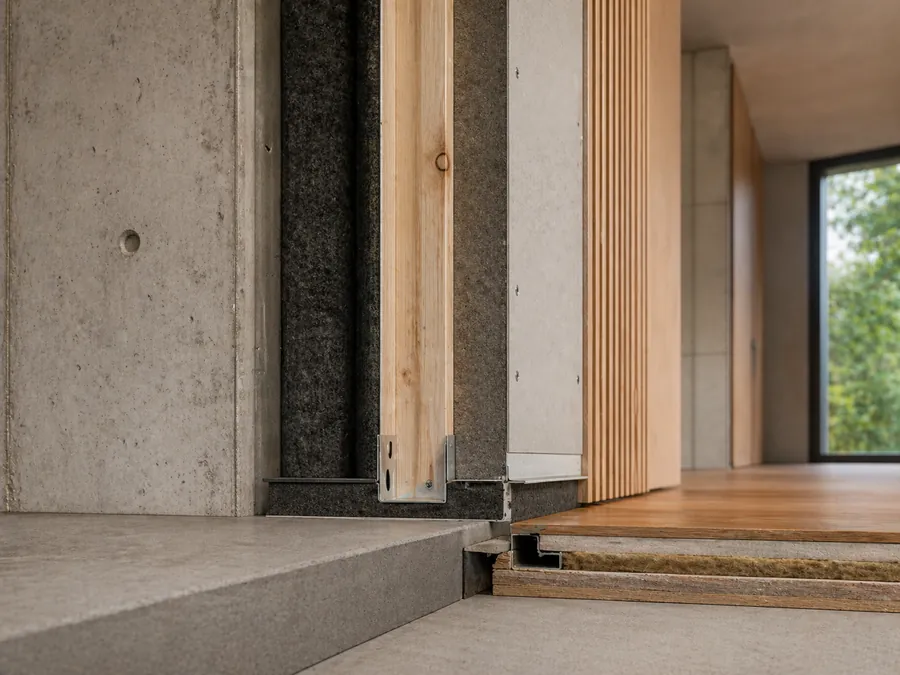
Interior acoustic design materials including timber, stone, fabric and acoustic finishes for reverberation control.

Interior finishes shape how a room feels acoustically

The sound of a room is not created only by its size or shape. It is also shaped by the materials that cover its surfaces.

Plasterboard, glass, stone, concrete, tile, timber, carpet, rugs, curtains, upholstery, acoustic plaster, fabric panels and joinery all influence how sound behaves. Some surfaces reflect sound. Some absorb it. Some scatter it. Some do almost nothing at the frequencies that matter most.

This is why interior finishes are an important part of acoustic design. They do not simply create the visual character of a space. They also affect comfort, clarity, privacy, energy and fatigue.

A room can look soft but sound hard. A room can look minimal but feel noisy. A room can use beautiful materials and still become acoustically tiring if every surface reflects sound. Good acoustic design helps the material palette support the way the room is used.

Reverberation is the sound that remains in the room

Reverberation is the persistence of sound after the original sound source has stopped. In simple terms, it is the way sound lingers in a room.

A room with too much reverberation can feel loud, unclear or tiring. Voices overlap. Dining becomes noisy. Work becomes harder. Children’s voices feel sharper. Music loses detail. Restaurants become exhausting. Open-plan homes feel busier than they should.

A room with too little reverberation can feel flat, dry or uncomfortable. It may lose atmosphere. Music may feel lifeless. Conversation may feel unnaturally close.

The goal is not always to make a room as quiet as possible. The goal is to create the right acoustic feel for the room’s purpose.

A bedroom, living room, classroom, studio, restaurant, office and gallery should not all sound the same.

Hard finishes are not the enemy

Stone, glass, polished concrete, tile, timber and plaster are common in refined interiors. They are chosen for good reasons: durability, light, elegance, texture, maintenance, warmth and architectural clarity.

These materials do not need to be avoided. The issue is balance.

A room can include hard finishes and still sound comfortable if the design includes enough acoustic relief. Problems usually arise when every major surface is reflective: hard floor, hard ceiling, hard walls, large glazing, stone benchtops, minimal furniture and no meaningful absorption.

In that situation, sound has nowhere to go. It reflects, builds and remains in the room longer than it should.

Good acoustic design does not remove the character of hard finishes. It balances them with materials and details that soften the room acoustically.

The ceiling is often the most important surface

In many interiors, the ceiling is one of the largest uninterrupted surfaces. It can have a major effect on reverberation, especially in rooms with hard floors and large windows.

Ceiling treatment is often powerful because it can absorb sound without requiring walls to be covered in visible acoustic panels. It can be especially useful in open-plan living areas, kitchens, dining rooms, workplaces, classrooms, studios and hospitality spaces.

The treatment does not need to look commercial. Depending on the project, it might involve acoustic plaster, perforated plasterboard, timber acoustic linings, fabric-wrapped panels, ceiling rafts, baffles, concealed absorptive zones or integrated architectural features.

The best ceiling strategy is planned early. If lighting, air conditioning, sprinklers, speakers and access panels are already fixed, acoustic opportunities may become harder to integrate.

Floors influence comfort, but they rarely work alone

Floors have a strong effect on the acoustic feel of a room. Hard floors such as timber, concrete, stone and tile can make a room feel brighter and more reflective. Soft floors such as carpet or large rugs can reduce some reflections and make the space feel calmer.

Rugs are particularly useful in residential interiors because they can improve comfort without changing the architecture. A large rug in a living or dining area can reduce floor reflections and help define an acoustic zone.

But floors rarely solve reverberation alone. In a room with hard walls, ceiling and glazing, a rug may help but not fully control the acoustic environment. It may soften the room without addressing reflections from above or around the room.

Floor finishes should be considered as part of a wider acoustic balance, not as the only solution.

Curtains can be acoustically useful when designed properly

Curtains can play a valuable acoustic role, especially where large windows or glazed doors create strong reflections.

Heavy, full-height curtains with generous fullness can reduce some mid and high-frequency reflections and make a room feel softer. They can also support privacy, light control and a sense of enclosure.

However, curtains are not a complete soundproofing solution. They may improve the internal acoustic feel of a room, but they do not usually provide significant sound isolation from traffic, neighbours or external noise unless they are part of a more specific window strategy.

Curtain performance depends on fabric weight, fullness, coverage, air gap, track position and how often they are closed. A thin decorative sheer will not perform like a heavier acoustic curtain.

Used well, curtains are one of the most design-friendly acoustic tools available.

Upholstery and furniture help create acoustic softness

Furniture is often underestimated in acoustic design. Sofas, armchairs, cushions, upholstered dining chairs, banquette seating, beds, rugs, bookshelves and soft furnishings all affect the way a room sounds.

A furnished room usually sounds more comfortable than an empty one because furniture absorbs and scatters sound. This is why some interiors sound harsh before furniture arrives and more settled afterwards.

However, furniture alone may not be enough in larger or more reflective spaces. A sofa can help a living room, but it may not solve a high ceiling, long reverberation time or large glass façade. Upholstered dining chairs may help conversation, but they may not fully control a hard-surfaced dining room.

Furniture should be part of the acoustic strategy, especially in homes, hospitality, workplaces and shared interiors. It should not be treated as an afterthought.

Timber can reflect, scatter or absorb depending on the detail

Timber is often assumed to be acoustically warm. Visually, it may feel warm, but acoustically it depends on how it is detailed.

A flat timber panel can be reflective. A slatted timber system may scatter sound and, if backed with absorption and a suitable cavity, can also provide useful acoustic control. Timber battens without absorptive backing may look acoustic but provide limited absorption. Perforated timber can work well when designed with the right backing, perforation pattern and depth.

This distinction matters. Many interiors use timber as an acoustic-looking finish without the backing needed for performance.

Timber can be an excellent acoustic material, but only when the detail matches the intended acoustic role.

Glass needs acoustic balance

Glass is important for light, views and spatial connection, but it is usually reflective inside the room. Large glazed areas can make interiors feel bright and lively, but they can also contribute to harshness, flutter and reverberation.

This is common in open-plan homes, offices, hospitality spaces and studios with large windows or glass doors.

Glass does not need to be avoided. It needs balance. Curtains, rugs, ceiling treatment, soft furniture, acoustic wall zones, joinery and layout can all help reduce the dominance of glass reflections.

If the issue is external noise entering through glazing, that becomes a sound isolation question rather than a reverberation question. The glass, frame, seals, air gaps and installation quality all matter in that case.

The same material can create different acoustic issues depending on whether the problem is inside-room reflection or sound transfer from outside.

Stone, tile and concrete need soft counterpoints

Stone, tile and concrete are durable, elegant and often central to contemporary interiors. They are also acoustically reflective.

In kitchens, bathrooms, dining areas, lobbies, galleries and high-end residential spaces, these materials can make sound feel sharp if they are not balanced by softer surfaces elsewhere.

The solution is not necessarily to remove hard finishes. It may be to provide absorptive ceiling areas, curtains, rugs, upholstery, acoustic plaster, soft wall zones or joinery-based treatment. In some spaces, even small amounts of strategic absorption can make a noticeable difference.

Hard materials can remain visually dominant while softer acoustic elements work in the background.

Acoustic plaster can be useful when the design needs subtlety

Acoustic plaster can be a strong option where the design requires a clean, seamless surface. It can provide sound absorption while maintaining a refined architectural look.

It is often used in ceilings, but can also be considered on walls or selected surfaces. It may suit homes, galleries, workplaces, hospitality spaces and other interiors where visible panels are not desirable.

However, acoustic plaster is not just normal plaster with better sound performance. It needs the correct system, thickness, backing, substrate, installation and detailing. Lighting, services, edges and access requirements must be coordinated.

Used properly, acoustic plaster can make acoustic treatment feel almost invisible. Used poorly, it can become expensive without delivering the expected result.

Joinery can become acoustic treatment

Joinery is one of the most useful opportunities for integrating acoustic treatment into interiors. Shelving, wall units, banquettes, bedheads, media walls, storage, slatted linings and built-in seating can all contribute acoustically when designed with intention.

For example, a slatted timber wall with absorptive backing may reduce reflections while still reading as a refined interior feature. A banquette may add useful soft absorption in a dining area. A media wall may integrate treatment around speakers. Bookshelves can scatter sound and reduce visual blankness.

The key is to decide whether the joinery is decorative, absorptive, diffusive, or simply a useful break-up surface. Those roles require different details.

Acoustic joinery works best when the acoustic purpose is considered before the joinery is documented.

Not every acoustic product belongs in every interior

There are many acoustic products available: panels, baffles, rafts, tiles, plasters, curtains, screens, timber systems, felt, fabric systems and modular treatments. Some are useful. Some are inappropriate for certain interiors. Some look acoustic but offer limited performance.

The right product depends on the room use, surface area, reverberation target, visual intent, durability, installation conditions and budget.

A decorative panel may not have enough absorption for a large dining room. A commercial ceiling tile may not suit a refined residential interior. A fabric panel may not be durable enough for a busy school or hospitality setting. A timber system may need backing to perform as expected.

Acoustic design is not product selection alone. It is the process of matching performance, appearance and buildability.

Frequency matters

Not all materials absorb sound equally across all frequencies.

Thin soft materials may reduce higher frequencies but do little for low-frequency or low-mid energy. This can make a room sound dull on top while still feeling boomy or congested. Thick, porous materials may provide broader absorption. Low-frequency control usually requires more depth, mass, placement strategy or specialised design.

This matters because rooms do not only have one acoustic problem. A living room may be bright and reflective. A restaurant may be loud and low-mid heavy. A studio may have bass problems. A classroom may need speech clarity. A bedroom may need both internal softness and sound isolation.

The material choice should match the frequency problem, not just the visual mood.

Reverberation targets depend on room use

There is no single ideal reverberation time for all rooms. The right level depends on the room’s purpose.

A bedroom should feel calm and restful. A living room should support conversation without feeling dead. A kitchen needs durability but should not become harsh. A classroom needs speech clarity. A restaurant needs atmosphere without excessive noise. A studio or control room needs more precise acoustic control. A gallery may need a balance between atmosphere and comfort.

This is why acoustic design should respond to use rather than apply a generic treatment level.

The question is not simply “how do we reduce echo?” The better question is “what should this room feel like, and what sound behaviour supports that use?”

Material palettes should be reviewed acoustically

Interior material palettes are usually reviewed for appearance, cost, durability and maintenance. They should also be reviewed acoustically.

A proposed palette may include stone floors, plasterboard ceilings, glass partitions, timber joinery and minimal furnishings. That may look beautiful, but acoustically it may be very reflective. Another palette may include rugs, curtains, upholstery, acoustic plaster and textured surfaces, creating more balance.

The aim is not to make every material absorptive. The aim is to understand which surfaces are doing acoustic work and which are not.

An acoustic review of the material palette can identify whether the room is likely to feel too hard, too live, too dead or poorly balanced before the finishes are locked in.

Early coordination protects the design

Acoustic finishes often need coordination with architecture, interiors, lighting, services and construction.

A ceiling treatment may need to work around downlights, air conditioning, sprinklers, speakers and access panels. A wall treatment may need to align with joinery, artwork, power points, switches and furniture. Curtains need track details, stack space and fabric selection. Slatted linings need backing, cavities and edges. Acoustic plaster needs substrate and detailing.

If these decisions happen late, the acoustic solution may look added rather than integrated.

Early coordination allows acoustic performance to become part of the design language. It also reduces the risk that treatment is value-engineered out because it was never properly integrated.

Buildability matters as much as specification

A finish does not perform just because it is named in a specification. It needs to be installed correctly.

Acoustic plaster, perforated timber, fabric panels, acoustic ceilings, curtains and joinery-based treatment all depend on details: backing, cavities, thickness, fixing, edge conditions, coverage and continuity.

A slatted timber wall without the correct absorptive backing may not perform as intended. A curtain without enough fullness may be less useful. A ceiling panel interrupted by services may lose area. A fabric panel placed only where it looks convenient may miss the main reflection path.

Buildability turns acoustic intent into performance. It should be considered from the start.

Existing interiors can still be improved

Many acoustic improvements happen after a room is already built. An existing living room, dining area, office, classroom, studio or hospitality space may feel too loud or harsh once occupied.

Improvement is still possible, but the options depend on what can be changed. Furniture, rugs, curtains, wall treatment, ceiling treatment, joinery additions and layout changes can all help. In some rooms, discreet treatment may be enough. In others, a more substantial design response may be needed.

The first step is to identify whether the problem is reverberation, reflection, background noise, sound transfer, poor zoning or a combination of issues.

Once the problem is clear, the most visually appropriate treatment options can be selected.

When to get acoustic advice

It is worth getting acoustic advice when an interior uses many hard finishes, when a room feels echoey or tiring, when speech clarity matters, when the project is still selecting materials, or when acoustic treatment needs to be integrated discreetly.

Advice is especially useful for open-plan homes, kitchens, dining rooms, classrooms, workplaces, studios, hospitality spaces, galleries and other interiors where sound affects the user experience.

An acoustic review can help identify which surfaces should remain reflective, which should absorb, where treatment will have the most value and how acoustic performance can be integrated without compromising the design.

Final thought

Interior finishes are not only visual decisions. They are acoustic decisions.

A room’s materials influence whether it feels calm, lively, harsh, intimate, tiring, clear or comfortable. Hard surfaces can be beautiful, but they need balance. Soft finishes can help, but they have limits. Acoustic products can be useful, but only when they are selected and detailed for the room’s actual needs.

The strongest acoustic interiors are not over-treated. They are balanced.

They allow the architecture, furniture, finishes and acoustic performance to work together so the room feels resolved both visually and sonically.

Frequently asked questions

Frequently Asked Questions

How do interior finishes affect acoustics?
What is reverberation in an interior space?
Do rugs and curtains really help acoustics?
Is timber good for acoustics?
Can acoustic treatment be integrated into interior design?
Do hard surfaces always make a room sound bad?
When should I get acoustic advice for interior finishes?
RELEVAnt service

Interior Acoustic Design & Material Advice

Design-led acoustic guidance for interior finishes, reverberation control, material balance and integrated acoustic treatment.

Interior Acoustic Design & Material Advice

Design-led acoustic guidance for interior finishes, reverberation control, material balance and integrated acoustic treatment.

Read Nicholas Marriott's bio
Acoustics
Sustainability
Construction