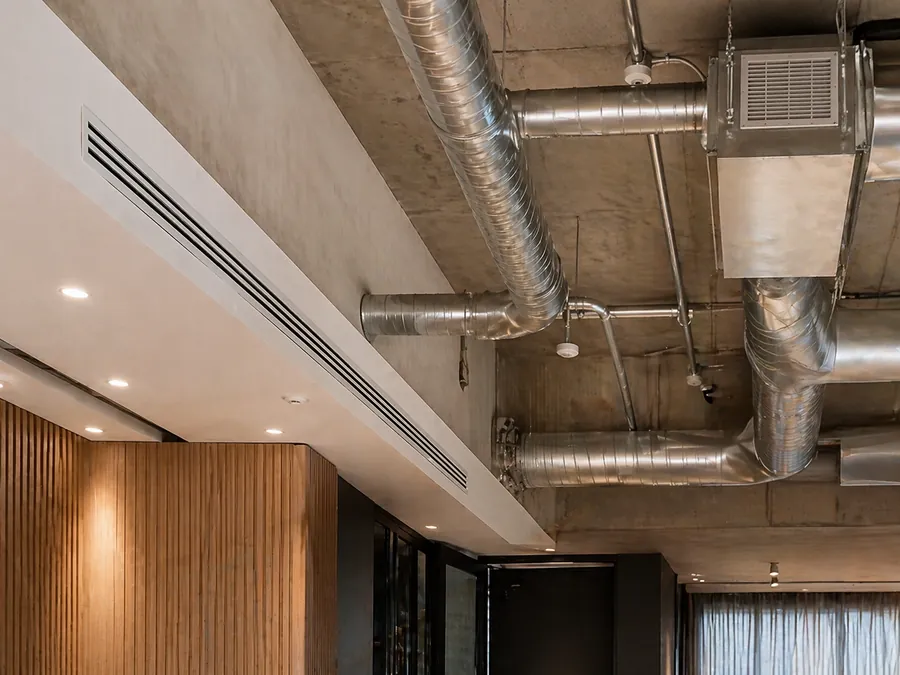
Joinery, Wall Linings & Integrated Acoustic Treatment
A practical guide to integrated acoustic treatment, covering joinery, timber slats, wall linings, fabric panels, media walls, shelving, banquettes, ceilings and the construction details that help acoustic performance become part of the interior design.

On this page
Acoustic treatment works best when it belongs to the room
Acoustic treatment is often imagined as something added after a room is finished: a panel on a wall, a cloud on a ceiling or a product selected once the echo becomes obvious.
That approach can work in some situations, but it is rarely the most elegant option.
In refined interiors, acoustic treatment works best when it belongs to the room from the beginning. It can be part of the joinery, wall lining, ceiling, curtains, shelving, furniture or architectural language. It does not have to look like a correction. It can look like the design.
This is where joinery, wall linings and integrated treatment become valuable. They allow acoustic performance to be embedded into the interior rather than applied over it.
The aim is not to hide acoustics completely. The aim is to make acoustic performance feel intentional, buildable and visually resolved.
Integrated acoustic treatment is not just decoration
A wall lining may look acoustic but still do very little. A timber slat wall may look technical but provide limited absorption if it has no acoustic backing. A fabric panel may soften a room but fail to address the right surface. A media wall may look substantial but still leave the room too reflective.
Integrated acoustic treatment only works when the detail has a real acoustic function.
That function might be absorption, reflection control, reverberation reduction, bass management, diffusion, sound isolation support, speech clarity or listening comfort. The detail needs to be designed around the acoustic problem, not only the visual idea.
A good integrated solution answers two questions at once:
What does the room need acoustically?
How can that performance become part of the architecture?
Joinery can do more than store things
Joinery is one of the most useful opportunities for acoustic integration because it already belongs to the interior.
Shelving, storage walls, media units, wardrobes, banquettes, study nooks, bedheads, display joinery and built-in furniture can all influence how sound behaves. Some joinery reflects sound. Some scatters sound. Some can absorb sound if detailed correctly.
For example, a media wall can incorporate absorptive lining around speakers. A dining banquette can add soft absorption where hard chairs and floors would otherwise dominate. A bookshelf can scatter reflections and reduce acoustic harshness. A wardrobe zone can help buffer a bedroom wall. A slatted timber wall can combine visual rhythm with absorption if backed properly.
The acoustic value of joinery depends on design intent. It should not be assumed. It should be planned.
Slatted timber needs the right backing
Slatted timber is one of the most common acoustic-looking interior details. It is used in homes, studios, offices, hospitality spaces, galleries and media rooms. It can be beautiful, warm and architecturally refined.
But slatted timber is not automatically acoustic.
If timber battens are fixed directly to a hard wall with no absorptive backing or cavity, the system may mostly reflect and scatter sound. It may change the character of reflections slightly, but it will not necessarily provide meaningful absorption.
To work as acoustic treatment, a slatted timber system usually needs an absorptive layer behind it and enough open area for sound to reach that layer. The depth of the cavity, the spacing between slats, the absorption material, the backing, the wall construction and the surface area all influence performance.
The visual detail and acoustic detail need to be designed together. Otherwise, the room may gain an acoustic aesthetic without much acoustic benefit.
Wall linings can control reverberation without looking like panels
Wall linings can be a powerful way to improve acoustic comfort while keeping the interior visually coherent.
A wall lining might be fabric-wrapped, timber-slatted, perforated, textured, upholstered, panelised, ribbed, curved, integrated into joinery or combined with lighting and display. It can be designed as an architectural surface rather than an acoustic product.
This is useful in rooms where wall treatment is visible and needs to feel intentional: living rooms, dining rooms, studios, media rooms, offices, meeting rooms, classrooms, reception areas, restaurants and listening spaces.
The important question is where the lining is placed. A beautiful absorptive wall may have limited effect if it is not addressing the main reflection or reverberation issue. Surface area, position and frequency range all matter.
A well-designed wall lining should contribute visually and acoustically.
Fabric panels can be refined when detailed properly
Fabric panels are often associated with studios or commercial interiors, but they can be refined when they are detailed carefully.
The fabric, frame, depth, backing, edge detail, panel size, alignment and relationship to other finishes all affect whether the treatment feels integrated or added. A fabric panel can read as a soft wall, a bedhead, a feature surface, a pinboard, a media-room lining or a calm architectural plane.
Fabric treatment is useful because it can provide broad absorption and visual softness. It can help reduce reverberation, control reflections and improve speech comfort.
However, fabric panels need to suit the room. Durability, cleaning, colour, texture, fire requirements, maintenance and the likelihood of impact all matter. A panel that works in a private listening room may not suit a school, corridor or hospitality space without additional thought.
The best fabric acoustic treatment feels like part of the interior palette.
Media walls are an acoustic opportunity
Media walls are common in living rooms, home theatres, media rooms and multi-purpose spaces. They often combine television, speakers, cabinetry, shelving, lighting, storage and display.
They are also a major acoustic opportunity.
A media wall can help manage front-wall reflections, integrate speaker positions, hide cabling, contain absorptive zones, incorporate slatted timber or fabric treatment and support better listening conditions. In some rooms, it can also help reduce the sense of hardness caused by large plasterboard or masonry surfaces.
But the detail needs care. Speaker placement, ventilation for equipment, cabinet resonance, access, cable paths, surface reflectivity and treatment depth all influence the result.
A media wall should not only hold equipment. It should support the acoustic purpose of the room.
Banquettes and upholstered built-ins can soften active spaces
Built-in seating is often used in dining areas, kitchens, hospitality spaces, waiting areas, children’s spaces and informal work zones. When designed well, it can also contribute acoustically.
Upholstered banquettes can add useful absorption at occupant level. They can reduce some reflections, soften conversation areas and improve comfort in hard-surfaced rooms. In dining spaces, they can be especially valuable because they place acoustic softness near voices.
Banquettes can also help define zones in open-plan rooms. They can create a more intimate acoustic area without adding walls.
The acoustic contribution depends on the upholstery, backing, size, placement and surrounding materials. A hard timber bench will not behave like an upholstered banquette. The softness needs to be real, not only visual.
Bookshelves and display walls can scatter sound
Shelving, books, objects and display walls can help break up flat reflective surfaces. They may scatter sound and reduce the strength of some reflections.
This can be useful in living rooms, studies, listening rooms, offices and creative spaces. A carefully designed shelf wall can feel natural, functional and acoustically helpful.
However, shelving is not the same as absorption. It may scatter or diffuse some reflections, but it may not significantly reduce reverberation unless it includes absorptive elements or soft contents. A sparse decorative shelf may have limited acoustic effect.
Shelving works best when it is part of a broader strategy. It can reduce acoustic harshness and visual blankness, but it should not be expected to solve every reverberation problem on its own.
Bedheads and wardrobes can support bedroom acoustics
In residential interiors, bedheads and wardrobes can play a useful acoustic role.
An upholstered bedhead can soften the area around the sleeper and reduce some local reflections. In a bedroom with hard floors and minimal curtains, this can make the room feel calmer. A large built-in wardrobe can also act as a buffer between the bed and an adjacent wall, depending on construction and layout.
This does not mean bedheads and wardrobes are soundproofing solutions. If neighbour noise is coming through a shared wall, a wardrobe alone may not provide enough isolation. If external noise enters through a window, a bedhead will not solve it.
But as part of the room’s acoustic comfort strategy, integrated furniture and joinery can help the bedroom feel more settled.
Ceilings and joinery should be coordinated
Wall treatments are not the only option. In many interiors, the ceiling is the most effective surface for acoustic control. Joinery and ceiling treatment should often be considered together.
For example, a kitchen and dining area may use acoustic ceiling treatment above the dining zone and absorptive joinery near a hard wall. A media room may use wall treatment around the screen and a ceiling cloud above the seating. A studio may use wall and ceiling treatment together to control early reflections. A reception area may use ceiling absorption with integrated joinery to manage speech build-up.
The ceiling can provide broad reverberation control, while joinery and wall linings can target specific reflection paths, zones or visual features.
Coordinating these elements early produces a more resolved design.
Integrated treatment needs enough surface area
One of the common problems with design-led acoustic treatment is that it looks good but does not cover enough area to change the room meaningfully.
A narrow feature panel may not reduce reverberation in a large room. A small slatted wall may look acoustic but leave most reflective surfaces untreated. A few upholstered elements may help locally but not affect the overall room response.
Surface area matters. Placement matters. Depth matters. Frequency range matters.
This does not mean every wall should be treated. It means the treatment should be sized and located in relation to the room’s acoustic need. A small amount of high-quality treatment in the right place can be valuable, but under-sized treatment should not be expected to solve a large acoustic problem
Integrated treatment also needs the right depth
Acoustic treatment depends not only on surface area but also on depth and construction.
Thin materials may absorb mostly higher frequencies. Deeper porous treatment can provide broader absorption. Low-frequency control usually needs more depth, mass, tuned systems, corner treatment or specific design. Slatted or perforated systems depend on backing, cavity and open area.
This is important because many interiors suffer from more than high-frequency brightness. They may also have low-mid build-up, bass issues, speech muddiness or excessive reverberation across a broader range.
If treatment is too shallow, the room may become dull at the top while still feeling congested or boomy.
Good integrated treatment should match the frequency problem, not just the visual opportunity.
Acoustic performance should be designed before shop drawings
Joinery and wall linings are often resolved in detailed drawings, shop drawings and fabrication documentation. If the acoustic design has not been considered before this stage, it may be difficult to add performance later.
Once panel sizes, batten spacing, backing materials, cavities, lighting, fixings, access panels and finishes are documented, the acoustic opportunity may already be limited.
Acoustic intent should inform the joinery design early enough to affect:
panel depth
open area
absorptive backing
cavity size
surface coverage
junction details
maintenance access
speaker and service integration
fabric and material selection
This does not need to overcomplicate the process. It simply means acoustic performance should be part of the brief, not an afterthought.
Buildability determines whether the detail works
Integrated acoustic treatment depends heavily on buildability. A detail may be acoustically sound in theory but fail if it cannot be built properly or if trades do not understand its purpose.
A slatted timber lining may need precise spacing and absorptive backing. A fabric panel may need durable framing and a clean edge detail. A joinery cavity may need to remain acoustically open rather than being blocked. A ceiling treatment may need coordination with services. A wall lining may need to avoid being compromised by power points, switches or access hatches.
The acoustic detail should be clear enough for builders, joiners and trades to execute. Ambiguity can lead to substitutions that reduce performance.
Buildability is not separate from acoustic design. It is the path from design intent to actual performance.
Acoustic treatment should work with lighting and services
Lighting, air conditioning, speakers, power, sprinklers, sensors, access panels and ventilation can all affect acoustic treatment.
A ceiling panel may be interrupted by downlights. A wall lining may need power outlets. A media wall may need speaker cables and ventilation. A fabric panel may need to avoid wall lights. A slatted feature may need to coordinate with air grilles. A recording room treatment may need quiet air paths.
If these elements are not coordinated early, the acoustic treatment can become fragmented or compromised.
Integrated treatment works best when acoustics, lighting, services, joinery and interior design are developed together. That is what allows the final room to feel resolved rather than patched.
Acoustic treatment and sound isolation should not be confused
Joinery and wall linings can improve internal room acoustics, but they do not automatically provide sound isolation.
This distinction matters. A fabric wall panel may reduce echo inside a room but may not stop neighbour noise. A slatted timber lining may improve room comfort but may not prevent sound from travelling through a wall. A media wall may improve listening conditions but may not isolate a home theatre from adjacent bedrooms.
Sound isolation depends on construction: mass, sealing, separation, doors, windows, junctions, penetrations and flanking paths. Acoustic treatment depends on how sound behaves inside the room.
Some projects need both, but they require different details.
Integrated treatment can support speech clarity
In workplaces, meeting rooms, classrooms, dining rooms and shared spaces, integrated treatment can improve speech clarity.
When a room is too reflective, speech overlaps and becomes harder to understand. People raise their voices. The room becomes louder. This can create fatigue and reduce comfort.
Joinery, wall linings, ceiling treatment, curtains and soft furniture can all help reduce excess reflections and improve communication. Treatment near conversation zones can be especially useful.
The design should consider where people speak, where listeners sit and which surfaces are contributing most to the problem. A treatment placed far from the main sound path may have limited value.
Speech clarity is one of the most practical reasons to integrate acoustic treatment early.
Integrated treatment can support music and media
Music rooms, listening rooms, home studios, media rooms and home theatres often need more precise acoustic control than general living spaces.
In these rooms, joinery and wall linings can help manage reflections, bass, imaging, tonal balance and listening comfort. A media wall may integrate speakers and absorption. A listening room wall may combine timber, fabric and diffusion. A home studio may use wall and ceiling treatment around the monitoring position. A music room may include absorptive joinery to reduce harshness without making the room dead.
These spaces need treatment to be placed according to the audio system and listener position, not only according to symmetry or visual composition.
The acoustic design should support the way sound is produced and heard in the room.
Cost should follow acoustic value
Integrated treatment can range from simple and economical to highly bespoke. Cost depends on material, fabrication, installation, performance requirements and design complexity.
The most expensive detail is not always the best acoustic investment. A beautifully made wall lining may have limited value if it is placed on the wrong wall or has no absorptive backing. A simpler ceiling treatment may provide more benefit if it addresses a large reflective surface. Curtains may offer excellent value in a glazed room. Upholstered furniture may help a dining area without requiring custom acoustic panels.
The acoustic design should help prioritise where money matters most.
Good value comes from matching cost to performance and visual impact.
When to get acoustic advice
It is worth getting acoustic advice when a project wants acoustic treatment to feel integrated rather than added. This is especially useful for homes, studios, media rooms, hospitality spaces, workplaces, meeting rooms, classrooms and high-design interiors.
Advice is valuable before joinery, wall linings, ceiling treatments, curtains, lighting and services are documented. At that stage, acoustic performance can still influence the details.
For existing spaces, advice can help identify whether integrated joinery, wall treatment, ceiling treatment, curtains or furniture changes will provide the most useful improvement.
Final thought
Acoustic treatment does not have to sit outside the design language of a room.
It can be part of the joinery, wall lining, ceiling, curtains, furniture and architectural rhythm. It can support speech clarity, listening comfort, reverberation control and everyday calm while still feeling visually refined.
The key is intention. Integrated treatment needs a real acoustic purpose, enough surface area, the right depth, suitable materials and buildable details.
When those elements come together, acoustic treatment stops feeling like a product and starts feeling like architecture.
Frequently Asked Questions
Integrated acoustic treatment is acoustic treatment designed as part of the interior architecture rather than added as a separate product. It can be built into joinery, wall linings, ceilings, curtains, fabric panels, timber systems, media walls, shelving or furniture.
Yes, joinery can improve room acoustics when it is designed with an acoustic purpose. Shelving, media walls, banquettes, wardrobes, slatted linings and built-in furniture can absorb, scatter or buffer sound depending on their construction and placement.
Timber slat walls are only meaningfully acoustic when they are detailed correctly. They usually need absorptive backing, an appropriate cavity and enough open area between slats. Timber battens fixed directly to a hard wall may look acoustic but provide limited absorption.
Yes. Acoustic panels and absorptive materials can often be integrated into fabric wall zones, joinery, ceiling features, curtains, media walls, upholstered furniture or timber linings. Early coordination makes the treatment feel intentional rather than added later.
Not usually. Acoustic wall linings generally improve the sound inside a room by reducing reflections or reverberation. Soundproofing, or sound isolation, requires construction details such as mass, sealing, separation, doors, windows and control of weak sound paths.
Acoustic treatment should be coordinated before joinery and wall linings are documented or fabricated. This allows the design to include the right backing, depth, open area, panel size, edge detail, service coordination and buildability requirements.
Integrated acoustic treatment can benefit living rooms, dining rooms, media rooms, studios, listening rooms, meeting rooms, classrooms, restaurants, offices and other interiors where sound comfort matters but the treatment needs to remain visually refined.
Integrated Acoustic Treatment for Interiors
Design-led acoustic advice for joinery, wall linings, timber systems, fabric panels and architectural acoustic treatment.
Integrated Acoustic Treatment for Interiors
Design-led acoustic advice for joinery, wall linings, timber systems, fabric panels and architectural acoustic treatment.
Read Nicholas Marriott's bio