
Music Practice Room Acoustic Design: Rehearsal, Teaching and Everyday Use
A practical guide to music practice room acoustic design, covering instrument loudness, sound isolation, room tone, treatment priorities, teaching use, rehearsal comfort and the trade-offs involved in making music spaces work in real buildings.


.avif)
Practice rooms need to support both music and repetition
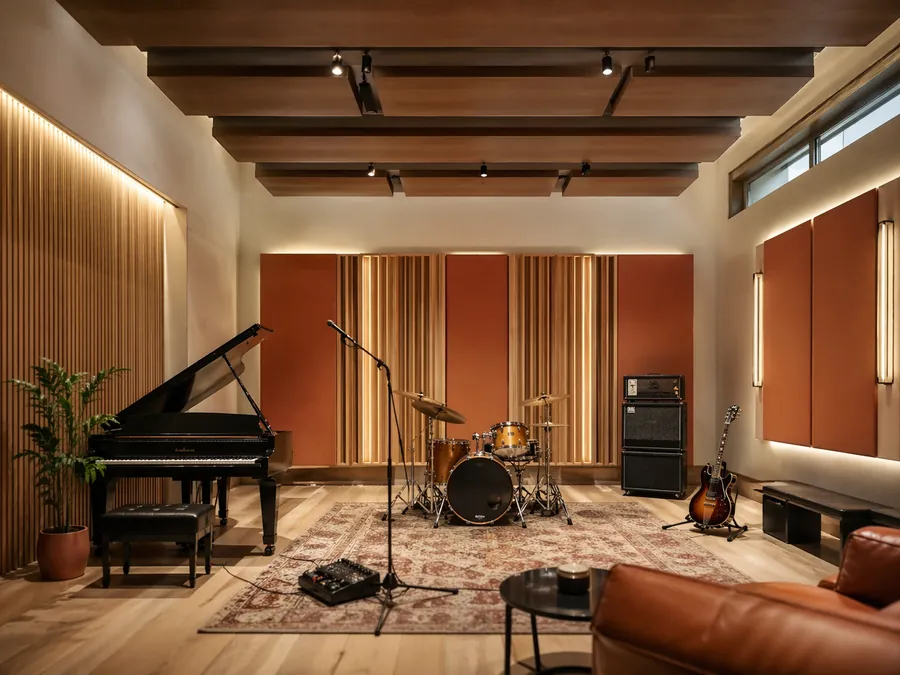
A music practice room is different from a listening room, control room or vocal booth. It is a space for repetition, learning, experimentation and daily use. It may be used by one person, a teacher and student, a small ensemble, a drummer, a vocalist, a pianist, a guitarist or a multi-instrument household.
That variety makes practice room acoustic design surprisingly complex.
The room needs to sound good enough to encourage playing, but not so live that it becomes tiring. It needs enough control to support focus, but not so much absorption that instruments feel flat or uninspiring. It may also need to reduce disturbance to family, neighbours or adjacent rooms.
A good music practice room is not just a room with acoustic panels. It is a room that supports the musician, the instrument, the building and the people around it.
The first question is what will be played
Practice room design should start with the instrument or activity. A piano practice room, drum room, guitar room, vocal room, violin room and teaching studio all have different acoustic requirements.
A piano produces a wide frequency range and can be powerful in a small room. Drums generate high sound levels, strong transients and low-frequency energy. Brass and saxophone can be intense and directional. Voice needs clarity and comfort. Strings need enough room tone to feel natural. Amplified guitar may need isolation more than reverberation. Electronic music may need monitoring accuracy as well as practice comfort.
Before choosing treatment, the room needs a clear brief. What instruments will be used? How loud will they be? How often will the room be used? Will it be used during the day, at night or both? Is the main concern the sound inside the room, sound escaping the room, or both?
The acoustic design follows the use.
Loudness changes everything
Music practice rooms often create higher sound levels than people expect. A room that seems fine for quiet guitar may be unsuitable for drums, brass, amplified instruments or energetic singing.
Loudness affects both the internal room sound and the isolation requirement. A louder source creates more reflected energy inside the room and more sound transfer to surrounding spaces. It can also make the room physically tiring for the player.
This is why a practice room for loud instruments needs more careful planning. The room may need stronger isolation, more robust doors and seals, deeper treatment, better low-frequency control, and more attention to ventilation and comfort.
A quiet writing room and a drum practice room should not be designed in the same way.
Room tone matters to the musician
Practice rooms are not always meant to be acoustically neutral. A musician often needs some response from the room. Too much absorption can make playing feel dry, exposed or discouraging. Too much reflection can make the room harsh, loud and difficult to judge.
The goal is a useful room tone.
For practice, the room should give enough feedback for the player to hear articulation, dynamics and expression clearly. For teaching, the teacher and student need speech clarity as well as instrument clarity. For ensemble practice, players need to hear each other without the room becoming overwhelming.
Good practice room acoustic design is about balance. The room should support musical confidence, not fight it.
Isolation and treatment are different problems
One of the most important distinctions in music practice rooms is the difference between acoustic treatment and sound isolation.
Acoustic treatment changes how the room sounds inside. It can reduce harsh reflections, control reverberation, improve clarity and make the space more comfortable.
Sound isolation reduces sound transfer to other rooms, neighbours or adjoining spaces. It depends on construction: walls, ceilings, floors, doors, windows, seals, junctions, penetrations and flanking paths.
Adding treatment inside a practice room may make it sound better for the player, but it will not necessarily stop the sound reaching a bedroom, apartment above or neighbouring property. If the main concern is disturbing others, isolation needs to be addressed directly.
Many practice rooms need both, but they are not the same design task.
Doors are often the weak point
Practice rooms often lose acoustic performance through the door. A lightweight door, poor perimeter seals or a large gap under the door can allow sound to escape easily.
This can be especially noticeable with piano, voice, brass, saxophone, drums and amplified instruments. Even if the walls are reasonably solid, a weak door can limit the whole room.
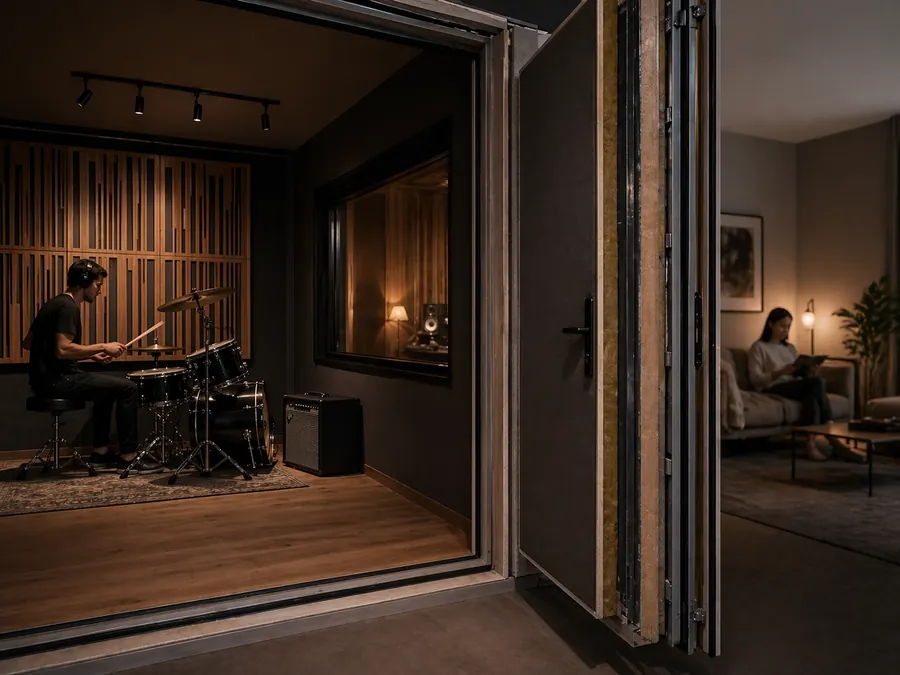
A better door strategy may involve a solid door leaf, acoustic seals, a drop seal, a suitable frame and careful threshold detailing. In higher-performing rooms, a sound lock or double-door arrangement may be needed.
The right level depends on the instrument, the room location and the required reduction. A home piano room may not need the same isolation as a drum room, but the door should still be treated as part of the acoustic system.
Windows and glazing need careful thought
Windows can be helpful for light, comfort and visual connection, but they can also be weak points for isolation and internal reflections.
A practice room facing a neighbour, courtyard, street or shared boundary may leak sound through windows or balcony doors. The glass, frame, seals, operable sections and installation all matter. Heavy curtains may improve the internal feel of the room, but they should not be relied on as a complete sound isolation solution.
Windows can also create strong reflections inside the room. Depending on the instrument and layout, curtains, angled surfaces, treatment or careful placement may be needed.
The best solution is not always to remove windows. It is to understand what role they play in the room’s light, ventilation, comfort, isolation and internal sound.
Small rooms can become intense
Many practice rooms are small. A spare bedroom, study, converted garage corner or compact studio can work well for some uses, but small rooms can become acoustically intense.
Sound reflects quickly from nearby walls, ceiling and floor. Loud instruments can feel overwhelming. Low-mid build-up can make the room sound boxy. High-frequency reflections can make the room sharp. Players may feel fatigued after short sessions.
Small rooms usually need more absorption than larger rooms, but treatment should still be balanced. Thin foam or lightweight treatment may only reduce high frequencies while leaving low-mid problems unresolved. The room may then sound dull and boxy at the same time.
A small practice room needs carefully chosen treatment, not simply more treatment.
Drums need a serious acoustic strategy
Drums are one of the hardest instruments to accommodate in a home or shared building. They are loud, percussive and broadband. They generate strong impact, sharp transients and low-frequency energy. They can disturb adjacent rooms and neighbours even when the room seems treated internally.
A drum practice room usually needs both isolation and internal control. The room may require robust construction, door and seal upgrades, ceiling or wall treatment, floor considerations, bass control and careful ventilation. Electronic drums may reduce some airborne sound, but they can still create impact noise through pedals and structure.
For drums, realistic expectations are essential. A few panels will not isolate a drum kit. If the goal is regular acoustic drum practice without disturbing others, the room needs to be assessed as a construction problem as well as a room acoustics problem.
Piano rooms need tonal balance
Piano practice rooms have their own challenges. A piano can sound beautiful in the right room and harsh or overpowering in the wrong one.
The instrument produces a wide frequency range and interacts strongly with room size, floor surfaces, walls, ceiling and furnishings. In a small hard room, piano can become loud, bright and fatiguing. In an over-treated room, it may lose life and resonance.
A good piano practice room often needs balanced absorption, some reflective character, suitable floor treatment, careful placement and enough room volume for the instrument to breathe. Upright and grand pianos also behave differently, so placement should be considered in relation to the room shape and surfaces.
The aim is not to make the piano quiet internally. The aim is to make it comfortable, musical and controlled.
Teaching rooms need speech clarity as well as music clarity
Music teaching rooms need to support both instruction and performance. The teacher and student need to hear speech clearly, but the room also needs to handle the instrument.
This can be a difficult balance. A room that is lively enough for music may make spoken instruction less clear. A room that is very dry for speech may feel uninspiring for performance.
Teaching rooms also often have repeated use. A space that is slightly too loud or reflective may become tiring after a full day of lessons. For children or less experienced students, excessive loudness and harsh reflections can make the room harder to work in.
Good teaching room design supports communication, listening, demonstration and repetition. It should reduce fatigue for both teacher and student.
Rehearsal rooms need musicians to hear each other
A rehearsal room is different from a solo practice room. It needs to support interaction between players.
If the room is too live, the ensemble may become loud and unclear. If it is too dead, musicians may struggle to feel connected. If one part of the room dominates, balance becomes difficult. If bass builds up in corners, the rhythm section may overpower other players.
A good rehearsal room allows players to hear timing, pitch, articulation and each other’s dynamics. It should support communication without forcing everyone to play louder.
The design may involve distributed absorption, low-frequency control, ceiling treatment, wall treatment, layout planning and sometimes moveable elements that allow the room to adapt to different groups.
Background noise affects practice and recording
Some practice rooms are also used for recording, online lessons, auditions, content creation or exam preparation. In those cases, background noise becomes more important.
Traffic, air conditioning, fans, fridges, neighbours, plumbing, computer noise and external activity can all interfere with microphones or focused practice. Even if the room is not a professional recording studio, unwanted noise can reduce the quality of the experience.
Ventilation and cooling can also introduce noise. A room that is well sealed for isolation may become uncomfortable unless air movement is planned. A fan added later may solve comfort but create recording noise.
The acoustic design should consider whether the room will ever be recorded or streamed. If so, the noise floor matters.
Ventilation and comfort are part of the room
Practice rooms are often used for long sessions. They need to be comfortable.
A sealed room can become warm and stuffy, especially with multiple players, lighting, equipment or closed doors. But opening a window or adding a noisy fan may compromise isolation or recording quality.
Ventilation should be considered early if the room needs isolation. Quiet air movement, appropriate cooling, low-noise fans, lined duct paths or carefully planned grilles may be needed depending on the level of performance required.
A room that sounds good but feels uncomfortable will not be used properly. Comfort is part of the acoustic outcome because it affects practice quality, focus and performance.
Materials need to survive real use
Practice rooms are working rooms. Instruments, stands, cases, chairs, pedals, cables and students all create wear.
Acoustic treatment needs to suit that reality. Fragile panels may not be appropriate in a room used daily by children or multiple musicians. Exposed fabric may need durability. Wall treatment may need to sit above chair height or be protected. Floors may need to handle movement without excessive noise.
The treatment also needs to work with the room visually. In a home, teaching studio or creative space, the room should feel inviting rather than improvised.
Good practice room design combines performance, durability and atmosphere.
Apartments and shared buildings need realistic expectations
Music practice in apartments requires careful planning. Even moderate instruments can affect neighbours if the building has weak separation or strong flanking paths. Loud instruments, drums, subwoofers and amplified sources are particularly difficult.
Some apartment practice rooms can be improved with treatment, door seals, layout changes or modest isolation upgrades. But if the instrument is loud and the building is lightweight or highly connected, there may be hard limits on what can be achieved.
The right approach is to be honest about use. Quiet practice, teaching, electronic instruments or limited-time playing may be realistic. Acoustic drums or amplified rehearsal may not be suitable without significant construction.
Acoustic advice can help identify the gap between the desired use and the room’s practical capacity.
Garages and outbuildings can work well, but need care
Garages, sheds and outbuildings are often considered for practice rooms because they are separated from bedrooms and living areas. This can be an advantage, but these spaces bring their own issues.
They may have lightweight doors, poor thermal comfort, hard concrete floors, weak roofs, gaps, moisture issues, poor ventilation or strong external leakage. Sound may escape through roller doors, rooflines, side walls or gaps around openings.
A garage conversion may need construction upgrades before acoustic treatment is useful. The room may need sealing, lining, insulation, door upgrades, ceiling treatment, ventilation and thermal improvement.
These spaces can become excellent practice rooms, but they need to be treated as real building projects rather than just empty rooms to fill with panels.
Buildability matters
A music practice room acoustic design needs to be buildable. Treatment must work around instruments, storage, doors, windows, power, lighting, ventilation and circulation. Isolation details need careful sealing, junctions and penetrations. Doors and windows need practical hardware. Wall and ceiling treatments need to be installable and durable.
The design should also suit the scale of the project. A child’s piano room, a private teaching studio and a drum rehearsal room do not need the same level of construction.
The best acoustic solution is the one that targets the real problem and can be built properly within the room, budget and use case.
When to get acoustic advice
It is worth getting acoustic advice when a practice room will be used regularly, when loud instruments are involved, when neighbours or family members may be affected, or when the room is being renovated or converted.
Advice is especially useful for drums, piano, brass, amplified instruments, teaching rooms, rehearsal rooms, garage conversions and apartment music spaces. It can help clarify whether the main issue is room tone, isolation, loudness, impact, ventilation, background noise or all of these together.
An on-site acoustic consultation can help identify the best room, realistic performance targets and the most practical upgrade path before money is spent on treatment or construction.
Final thought
A music practice room should make playing easier, not harder.
It should provide enough acoustic control to reduce fatigue, enough liveliness to keep the instrument inspiring, enough isolation to suit the building context and enough comfort for regular use.
The best practice room design begins with the instrument and the person using it. Once the room’s purpose, loudness, location and constraints are clear, the acoustic decisions become more focused and effective.
For musicians, teachers and families, a well-designed practice room can become one of the most valuable spaces in a home or studio: a room that supports discipline, creativity and everyday music-making.
Frequently Asked Questions
Music Practice Room Acoustic Design in Sydney
Specialist acoustic advice for practice rooms, rehearsal spaces, teaching rooms and residential music environments.
Music Practice Room Acoustic Design in Sydney
Specialist acoustic advice for practice rooms, rehearsal spaces, teaching rooms and residential music environments.
Read Nicholas Marriott's bio