
Open-Plan Living Room Acoustics: Reduce Echo Without Losing the Architecture
TL;DR
Open-plan living rooms need acoustic balance, not silence or loss of architectural openness.
- Control reflections from large hard ceilings, floors, glazing and walls.
- Use zoning to organise kitchen, dining, living, media and study activities.
- Give ceilings, curtains, rugs, furniture or joinery a meaningful acoustic role.
- Separate internal reverberation from sound transfer to bedrooms or neighbours.
- Coordinate treatment with lighting, services, finishes and circulation.
- Use enough area to change the room rather than relying on small decorative additions.
The key point: a comfortable open-plan room preserves its architecture while reducing excessive reflection and conflict between uses.


.avif)
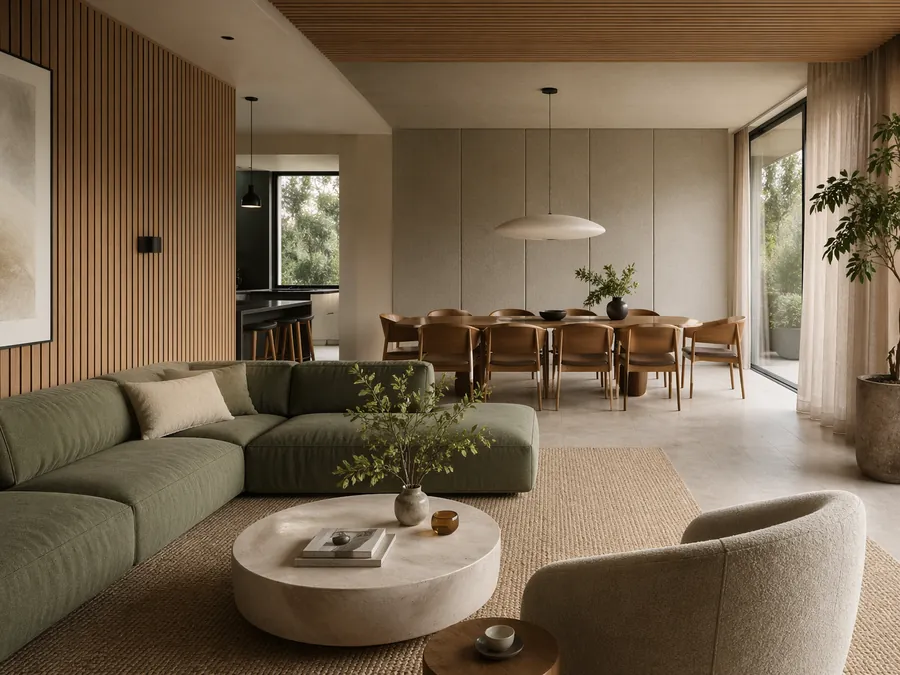
Open-plan living room acoustics are shaped by the way sound travels between connected kitchen, dining, lounge, media and circulation zones. The goal is not to close the room or make it silent, but to reduce excessive reflections and organise activity so the space remains comfortable.
What Are Open-Plan Living Room Acoustics?
Open-plan living room acoustics describes how room volume, ceilings, hard finishes, glazing, furniture, connected uses and sound transfer affect the way a large shared interior sounds and feels.
A room can appear calm but become tiring when conversation, cooking, television and movement are reinforced by glass, stone, plaster, timber floors and a high hard ceiling.
What Should a Successful Open-Plan Room Achieve?
- Conversation that remains comfortable between nearby users.
- Reduced harshness and reverberation without making the room dead.
- Kitchen, dining, living and study activities that are better organised.
- Television and music that do not need unnecessary level to remain clear.
- Treatment integrated with the architecture and material palette.
- A clear distinction between internal reverberation and sound transfer to other rooms.
Who Does This Guidance Apply To?
This guidance applies to homeowners, architects, interior designers and builders planning connected living, kitchen and dining spaces, as well as existing rooms that feel echoey, noisy or difficult for conversation.
How Do Different Open-Plan Zones Affect Each Other?
| Zone | Main activity | Common acoustic conflict | Useful design response |
|---|---|---|---|
| Kitchen | Cooking, appliances and conversation. | Hard finishes and services spread noise into the whole room. | Ceiling treatment, quieter services and balance from adjacent soft areas. |
| Dining | Conversation and entertaining. | Voices, chairs and tableware build up around hard surfaces. | Rugs, upholstery, curtains, ceiling absorption and acoustic joinery. |
| Living or media | Conversation, television and music. | Reflections reduce clarity and encourage higher playback levels. | Speaker layout, curtains, furniture and targeted wall or ceiling treatment. |
| Study nook | Focused work or homework. | Kitchen, television and circulation remain directly audible. | Better location, screening, soft finishes or stronger room separation. |
| Circulation | Movement between spaces and levels. | Stairs, voids and long sightlines carry sound. | Thresholds, ceiling changes, turns, curtains and absorptive surfaces. |
Why Do Open-Plan Rooms Become Echoey?
Large connected volumes give sound more room to travel. When floors, walls, glazing, kitchen joinery and ceilings are all reflective, sound remains in the room and overlaps with new activity.
Hard materials are not the problem by themselves. The problem is allowing every large surface to reflect without assigning enough area to absorption, scattering or soft furnishing.
How Can Hard Materials Be Preserved?
Stone, timber, glass, concrete and plaster can remain visually dominant when other elements provide acoustic relief. Rugs, curtains, upholstered furniture, acoustic plaster, ceiling systems, wall linings and joinery can be integrated without changing the room into a visibly technical space.
The amount and location matter. A few small decorative panels may have limited effect in a large room with extensive hard surfaces.
Related guidance on acoustic balance with timber, stone and glass and joinery and integrated acoustic treatment explains how material intent can be preserved while selected surfaces carry the acoustic work.
Why Is the Ceiling Often the Best Opportunity?
The ceiling is usually one of the largest continuous surfaces and can provide broad reverberation control without occupying walls or changing furniture layouts. Acoustic plaster, perforated systems, timber acoustic linings, rafts or integrated absorptive zones may be suitable depending on the architecture.
Lighting, air conditioning, sprinklers, speakers and access need to be coordinated early so the acoustic area is not fragmented. Where these decisions need to be resolved before documentation is fixed, technical acoustic consulting can help coordinate the acoustic intent with the architecture and services.
How Does Zoning Improve an Open Room?
Zoning helps connected uses coexist. Rugs, seating arrangements, curtains, screens, shelving, joinery, ceiling changes and material transitions can define acoustic areas while preserving visual openness.
A study nook or quiet corner may still need stronger separation if it sits directly beside active kitchen or media use. Zoning reduces conflict but does not create complete isolation. The guide to acoustic privacy, zoning and spatial planning explains how room relationships, openings and buffers can reduce conflict before construction details are fixed.
How Does Internal Treatment Differ From Sound Isolation?
Room treatment reduces echo and improves comfort inside the open-plan space. It does not automatically stop sound reaching bedrooms, neighbours or other levels. Sound transfer may require attention to doors, walls, floors, ceilings, services and planning.
What Are the Important Limitations?
Soft furnishings can help but may not be enough for a large or high-volume room. Treatment cannot fully compensate for a noisy appliance, direct stair path or incompatible room adjacency. Existing interiors may also limit ceiling access, treatment area and integration opportunities.
What Should Be Prepared Before Requesting Advice?
- Plans, dimensions, photographs and ceiling heights.
- The kitchen, dining, living, media and circulation layout.
- Major hard finishes and glazing areas.
- Furniture, curtains, rugs and joinery.
- Typical activities and the times when the room becomes difficult.
- Television, music, appliance and service noise.
- Nearby bedrooms, studies and neighbours.
- The project stage, visual brief and desired outcome.
When Should Acoustic Advice Be Sought?
Advice is useful before ceilings, lighting, services, finishes and joinery are fixed, or when an existing open-plan room feels echoey, noisy or hard to use for conversation.
Explore residential acoustic design, kitchen acoustic design and interior finishes and reverberation.
The open-plan kitchen and living acoustic design case study provides a related project example where hard finishes, integrated treatment and the wider interior brief were considered together.
Final Takeaway: Preserve Openness, Control Excess Reflection
An open-plan room can remain generous, bright and connected when ceilings, furniture, curtains, joinery, material balance and zoning give sound somewhere appropriate to go.
Discuss an open-plan residential acoustic project before the finishes and services are fixed.
Frequently Asked Questions
Open-Plan Residential Acoustic Design
Design-led acoustic advice for connected living, kitchen, dining and media spaces.
Open-Plan Residential Acoustic Design
Design-led acoustic advice for connected living, kitchen, dining and media spaces.
Read Nicholas Marriott's bio