
Acoustics, Productivity, Learning & Sensitive Groups
Acoustic guidance for study spaces, focus rooms, libraries and quieter environments that support concentration.

Quiet Study & Focus Environments: Acoustic Design for Concentration, Comfort and Calm
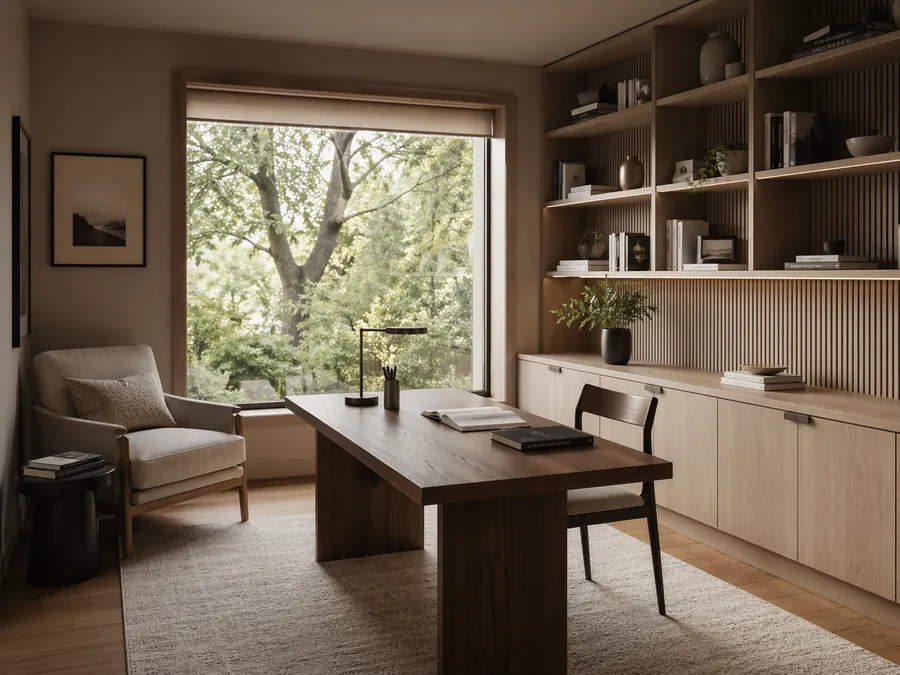
A practical guide to quiet study and focus environments, covering background noise, acoustic zoning, reverberation, speech distraction, room finishes, study rooms, libraries, home offices and the difference between silence and usable calm.

BY Nicholas marriott
March 31, 2026
updated
April 25, 2026
9 min read
Quiet study and focus environment with acoustic design, bookshelves, soft finishes and calm daylight.

Quiet study spaces are not only about silence

A good study or focus environment is not always silent. In fact, absolute silence can sometimes make small sounds more noticeable. A chair movement, a cough, a door closing or a conversation in the next room may feel sharper when the space has no acoustic softness or background balance.

The goal is not silence at all costs. The goal is usable calm.

A quiet study space should reduce unnecessary distraction, support attention and allow people to work, read, learn or think without constantly managing sound. It should feel settled, predictable and comfortable enough for sustained concentration.

This applies to libraries, study rooms, home offices, school focus areas, university spaces, workplace quiet rooms, tutoring rooms, reading rooms and sensory-aware environments.

Good acoustic design helps these spaces feel quiet without making them feel sterile, tense or overly controlled.

Focus depends on reducing avoidable distraction

Concentration is affected by many things: light, temperature, ergonomics, visual clutter, task difficulty, stress and the behaviour of other people. Sound is only one part of that picture, but it can be a powerful one.

The most distracting sounds are often not the loudest. They are the sounds that pull attention away from the task. Speech is a common example because it carries meaning. Even a relatively quiet conversation can be distracting if the words are intelligible.

Other distractions may include footsteps, chairs, doors, fans, keyboards, phones, traffic, air conditioning, corridor noise, music, plumbing or activity from adjacent spaces.

A focus environment should reduce the sounds that are most likely to interrupt attention. That may involve acoustic zoning, room separation, softer finishes, better doors, ceiling treatment, background noise control or layout changes.

Speech distraction is a major focus problem

Speech is one of the most difficult sounds to ignore. If a nearby conversation is clear enough to understand, it can draw attention even when it is not very loud.

This is why quiet study spaces need to consider speech paths carefully. A library study zone beside a service desk may struggle. A home office beside a kitchen may be distracting. A workplace focus room next to a meeting room may fail if the wall or door leaks speech. A school study area near a corridor may be interrupted throughout the day.

The issue is not only volume. It is intelligibility.

Good acoustic design can reduce speech distraction by increasing separation, reducing direct sound paths, improving door and wall performance, adding absorption and using zoning so speaking activities are located away from focus areas.

Usable calm is different from dead quiet

A focus space that is too acoustically dead can feel uncomfortable. It may make users overly aware of small sounds. It may feel oppressive or unnatural. It may also remove the subtle background texture that helps a room feel occupied and comfortable.

A good quiet environment usually has controlled reverberation, low intrusive noise and a gentle sense of acoustic softness. It should reduce distraction without making the room feel lifeless.

This balance matters in libraries, study rooms and home offices. People need to feel calm, but also comfortable enough to stay in the room for long periods.

The right acoustic environment supports attention without drawing attention to itself.

Reverberation affects focus

Reverberation is the way sound lingers in a room. In a study space, too much reverberation can make small sounds feel larger and allow activity to spread across the room.

Hard ceilings, glass, plasterboard, concrete, timber floors and minimal furniture can all make a room feel more reflective. In a quiet study room, even subtle sounds may become noticeable if they reflect repeatedly.

Reducing reverberation can help the room feel calmer and less sharp. This may involve acoustic ceiling treatment, wall panels, curtains, rugs, upholstered furniture, bookshelves, acoustic plaster or integrated joinery treatment.

The aim is not to remove every reflection. It is to reduce the build-up that makes the room feel exposed or distracting.

Background noise should be controlled, not ignored

Background noise can support or undermine focus depending on its character.

A steady, low-level background sound may be acceptable or even useful in some environments because it reduces the contrast between silence and small noises. But intrusive, uneven or mechanical noise can be highly distracting.

Air conditioning, fans, traffic, plumbing, lifts, doors, external plant, fridges and adjacent activity can all affect study spaces. Intermittent noise is often more distracting than steady noise because it is less predictable.

Good acoustic design should consider the background sound environment. A quiet study room beside noisy services may never feel calm. A focus zone facing a busy road may need façade and glazing attention. A library with noisy mechanical systems may need services review as much as room treatment.

The background sound should feel stable, not intrusive.

Libraries need acoustic zoning

Libraries are often expected to support several different behaviours: silent study, reading, group work, tutoring, technology use, circulation, service desks, collections, children’s areas and informal gathering.

These uses do not all need the same acoustic environment.

A successful library needs acoustic zoning. Quiet study areas should be separated from active service points and group work zones. Children’s areas should not spill directly into silent study. Technology and collaboration spaces should be located and treated so they do not dominate the whole library.

Zoning can be achieved with distance, furniture, shelves, partial screens, curtains, ceiling treatment, wall absorption, layout and behavioural expectations.

The library does not need to be silent everywhere. It needs each zone to make sense.

Study rooms need privacy and comfort

Small study rooms, tutoring rooms and focus rooms can be valuable, but only if they are designed properly.

A study room with hard walls, a noisy fan, poor lighting and a weak door may not support focus. A room that leaks speech to the corridor may not feel private. A room that is too small and over-treated may feel uncomfortable. A room with no ventilation may be avoided.

Study rooms need acoustic privacy, controlled internal sound, comfortable background noise, usable furniture and adequate ventilation. They also need doors and walls that match the privacy expectation.

A study room should feel protected, but not sealed off in a way that makes it unpleasant to use.

Home offices need acoustic separation from household activity

Home offices and study rooms have become more important as work, learning and creative tasks have moved into domestic spaces.

The main acoustic challenge is often separation from household activity. Kitchens, living rooms, laundries, children’s spaces, televisions, pets, bathrooms and outdoor noise can all affect concentration.

A home office may not need studio-level isolation, but it often benefits from better planning. Door location, door seals, wall construction, curtains, soft finishes, background noise and room choice all matter.

A desk in an open-plan living area may work for light tasks, but sustained focus usually needs more acoustic protection. The best home office is not only visually calm. It is spatially and acoustically separated enough to support the task.

Focus rooms in workplaces need to be more than leftover spaces

In offices, focus rooms are often created to support concentrated work away from open-plan areas. But they only work if they feel genuinely calmer than the surrounding workplace.

A focus room beside a kitchen, breakout area or meeting room may be compromised before any treatment is added. A room with poor door seals may leak speech. A small room with hard surfaces may feel sharp. A room with noisy ventilation may be irritating. A room with no visual comfort may be used reluctantly.

Focus rooms should be deliberately located, treated and detailed. They need suitable separation, internal absorption, quiet services, good lighting and comfortable furniture.

If a focus room is not meaningfully different from the open office, it will not solve the workplace problem.

Schools and universities need a range of focus settings

Learning environments often need more than one kind of study space. A school or university may need quiet individual study, small group work, library areas, exam spaces, tutoring rooms, sensory retreat spaces and informal focus zones.

Each setting has different acoustic needs. Individual study needs low distraction. Group work needs enough separation to avoid disturbing others. Exam spaces need calm and predictable conditions. Tutoring rooms need speech clarity and privacy. Sensory spaces may need reduced stimulation and low background noise.

A single acoustic approach will not suit every study activity.

Good planning provides a range of acoustic settings so students can choose or be directed to the environment that suits the task.

Sensory-sensitive users may need more predictable sound

Some users are more sensitive to noise, sudden sounds, overlapping speech or reverberation. This may include neurodiverse users, people with sensory processing differences, people with anxiety, people recovering from fatigue or people who simply need stronger focus conditions.

For these users, the acoustic environment should be predictable. Sudden noises, sharp reflections, loud mechanical systems and uncontrolled speech can all increase stress or reduce usability.

Quiet study and focus environments can support sensory comfort by reducing reverberation, avoiding sharp acoustic surfaces, controlling background noise, providing retreat areas and separating active zones from calm zones.

The aim is not to create a completely silent space. It is to create a space where sound feels less chaotic and more manageable.

Acoustic treatment should be placed where it matters

Adding acoustic panels randomly is rarely the best approach. Treatment should be placed where it addresses the actual problem.

If the room is reverberant, ceiling treatment may provide the most value. If speech reflections are sharp near study desks, wall treatment may help. If a glass wall creates reflections, curtains or absorptive surfaces nearby may be useful. If sound enters through a door, treatment inside the room may not solve the problem. If traffic noise enters through a window, glazing and seals may matter more.

The first step is to identify the sound problem: reverberation, speech distraction, sound transfer, background noise, impact noise, services noise or poor zoning.

Once the problem is clear, treatment can be targeted.

Bookshelves and soft materials can help

Study spaces often include bookshelves, furniture, rugs, curtains, pinboards, upholstered chairs and soft surfaces. These can contribute to acoustic comfort.

Bookshelves can scatter sound and reduce flat reflections. Rugs can soften floor reflections. Curtains can reduce reflections from glazing. Upholstered seating can reduce local harshness. Pinboard-style panels can provide useful absorption if they are properly constructed.

These elements can make study spaces feel more comfortable and less exposed.

However, they are not always enough. A large room with a hard ceiling and extensive glass may need more substantial treatment. A room with speech leakage through a door may need sealing or separation. A noisy mechanical system will not be fixed by bookshelves.

Soft materials are useful, but they should be part of a broader acoustic strategy.

Doors and thresholds support quiet zones

Doors are important in focus environments because they create the boundary between a quiet space and the surrounding activity.

A poor door can undermine a study room, home office or focus room. Gaps around the frame, a large undercut, a lightweight door leaf or no seals can allow speech and noise to pass easily.

Thresholds also matter. A small lobby, corridor turn, door offset or transition zone can reduce direct sound paths into a quiet room. In libraries and workplaces, threshold design can help separate active areas from study zones without making the space feel closed.

The acoustic boundary should match the room’s purpose. A focus room needs more than visual separation.

Windows can support comfort or create distraction

Windows bring daylight, outlook and comfort, which are important for focus. But they can also introduce external noise and internal reflections.

A study room facing a busy street may need better window seals, glazing or façade treatment. A library near outdoor activity may need careful window and ventilation planning. A home office near a neighbour or street may be affected by intermittent noise.

Internally, large glazing can make a room feel reflective. Curtains, blinds, soft furniture and ceiling treatment can help balance the room while still allowing light.

Windows should be considered both for their acoustic weakness and their contribution to wellbeing. A windowless room may be quiet but unpleasant. A bright room may feel good but require acoustic balancing.

Study environments should not be visually or acoustically sterile

A focus space should feel calm, but it should not feel empty, harsh or institutional unless that is the intended use.

Texture, warmth, soft materials, natural light, books, timber, plants and comfortable furniture can all support a better focus environment. These design elements can also help acoustically when selected carefully.

A sterile quiet room may not be used well. A room that feels comfortable and settled is more likely to support sustained attention.

Acoustic design should work with atmosphere. Quietness alone is not the whole goal.

Group study requires separation from quiet study

Group study is important, but it should not be placed directly inside a quiet zone without acoustic control.

A group study room may need speech clarity inside and containment outside. If it is poorly separated, it can disturb nearby individual study areas. If it is too reverberant inside, group members may raise their voices. If the door or glazing is weak, speech can spill into the library or corridor.

The design should recognise group study as an active sound source. It should be placed and detailed accordingly.

Quiet study and group study can coexist, but they need spatial and acoustic boundaries.

Exam and assessment spaces need predictable conditions

Exam rooms, assessment spaces and formal study areas often need predictable acoustic conditions. Sudden noise, reverberation, corridor activity, mechanical noise and speech intrusion can all affect concentration.

These spaces may not need high-level isolation, but they do need stability. Doors, corridors, adjacent rooms, services and surface finishes should all be considered.

A calm assessment environment supports fairness because students are less likely to be affected by avoidable acoustic distraction.

In multi-use spaces, temporary acoustic measures, layout planning and scheduling may also be needed to support assessment use.

Mechanical services can undermine focus

Mechanical services are often overlooked in quiet spaces. Air conditioning, fans, grilles, ducts, plant, pumps and equipment can all create background noise.

In a focus environment, even moderate mechanical noise may become distracting if it is tonal, intermittent or uneven. A fan cycling on and off can be more distracting than a steady low-level sound. A noisy grille near a desk can affect concentration. A quiet room with a loud air-conditioning unit may not feel quiet at all.

Services should be coordinated with the acoustic goal of the room. Quiet study spaces need comfort, but they also need low-distraction air movement.

Sound masking may be useful in some settings

In some focus environments, controlled background sound can help reduce speech distraction by making unwanted speech less intelligible. This is often called sound masking.

Sound masking can be useful in workplaces, libraries and study settings, but it must be used carefully. If it is too loud, uneven or tonally unpleasant, it can become another source of distraction. It should not be used to cover up poor room design, excessive reverberation or weak separation.

Masking works best as part of a broader strategy: zoning, absorption, separation, quiet services and behaviour.

The goal is not to add noise for its own sake. The goal is to improve the usability of the space.

Existing study spaces can be improved

Many quiet study and focus spaces are created in existing buildings. A home office may be too exposed. A library may be too noisy. A study room may leak speech. A workplace focus room may be uncomfortable. A classroom breakout space may not support concentration.

Improvement is usually possible, but the first step is diagnosis.

Is the issue reverberation? Speech distraction? Poor door separation? Mechanical noise? External noise? Group activity? Hard finishes? Poor zoning? Visual exposure? A combination of several factors?

Once the issue is clear, solutions can be targeted: acoustic ceiling treatment, door seals, wall panels, curtains, rugs, furniture, zoning changes, services review, glazing upgrades or behaviour and booking strategies.

A quiet space should be improved according to the problem, not according to a generic product list.

Buildability and maintenance matter

Study and focus environments often need robust, maintainable solutions. Libraries, schools, universities and workplaces all involve daily use, cleaning, furniture movement and changing needs.

Acoustic treatment should be durable enough for the environment. Wall panels should survive contact. Ceiling systems should allow access to services. Curtains should be operable and maintainable. Furniture should support acoustic goals without becoming fragile. Doors and seals should be easy enough to use that people do not leave them open.

A quiet space that is difficult to maintain may not stay quiet.

Buildability and usability are part of the acoustic design.

When to get acoustic advice

It is worth getting acoustic advice when a study room, library, home office, workplace focus room or learning space feels distracting, echoey, exposed or difficult to use for concentration.

Advice is especially useful before designing new study areas, refurbishing libraries, planning workplace focus rooms, creating home offices, designing exam spaces or developing sensory-aware learning environments.

An acoustic review can identify whether the problem is background noise, reverberation, speech distraction, sound transfer, zoning or services. From there, the design can focus on changes that will make the space genuinely more usable.

Final thought

A quiet study or focus environment is not defined by silence. It is defined by how well it supports attention.

The best spaces feel calm, stable and comfortable. They reduce avoidable distraction without becoming sterile. They provide acoustic separation where needed, absorb excessive reflections, control background noise and support the people who use the room.

Good acoustic design helps create spaces where study, reading, thinking and focused work feel easier. That is the real measure of success.

Frequently asked questions

Frequently Asked Questions

What makes a good quiet study environment?
Is silence always best for focus?
How do you reduce speech distraction in study spaces?
Do acoustic panels help a study room?
How can a home office be made quieter?
Do libraries need acoustic zoning?
When should I get acoustic advice for a focus space?
RELEVAnt service

Quiet Study & Focus Environment Acoustic Advice

Practical acoustic guidance for libraries, study rooms, home offices, workplace focus rooms and calmer learning spaces.

Quiet Study & Focus Environment Acoustic Advice

Practical acoustic guidance for libraries, study rooms, home offices, workplace focus rooms and calmer learning spaces.

Read Nicholas Marriott's bio
Acoustics
Sustainability
Construction