
Acoustic Design for Sensory-Sensitive and Neurodivergent People
A practical guide to acoustic design for sensory-sensitive and neurodivergent people, covering noise sensitivity, reverberation, background noise, quiet zones, spatial predictability, retreat spaces, classrooms, workplaces, homes and shared environments.


.avif)
Sensory-sensitive acoustic design starts with reducing uncertainty
For many people, sound is not just background. It can be tiring, distracting, painful, disorienting or difficult to filter. This may be especially relevant for some autistic people, ADHD people, people with sensory processing differences, people recovering from stress or fatigue, and others who are more affected by noise, reverberation or unpredictable sound.
The important word is some. Sensory needs vary. One person may be highly sensitive to background chatter, another may find mechanical hum difficult, another may seek stronger sensory input, and another may need a space that simply feels predictable and controllable.
Good acoustic design for sensory-sensitive and neurodivergent people does not assume one universal solution. It creates environments with better control, clearer choices and fewer unnecessary acoustic stressors.
The goal is not to make every space silent. The goal is to reduce avoidable acoustic overload and give people places where sound feels more manageable.
Noise sensitivity is not only about loud sounds
A space does not need to be extremely loud to be difficult. Some of the most challenging sounds are small, repetitive or unpredictable.
Examples might include:
air-conditioning hum
chairs scraping
overlapping conversations
corridor noise
cutlery and hard surfaces
children’s voices in a reverberant room
hand dryers
fluorescent lighting buzz
music from another area
sudden door slams
traffic or aircraft noise
equipment fans
echo in hard rooms
For some people, the issue is not only sound level. It is the character of the sound, the ability to predict it, the ability to escape it and the amount of control the person has over the environment.
This is why sensory-sensitive acoustic design needs to consider background noise, reverberation, sharp sounds, sudden changes, transitions, retreat spaces and the relationship between active and quiet zones.
Predictability matters
Predictable sound is often easier to manage than unpredictable sound.
A steady low-level background sound may be less disruptive than a sudden intermittent noise. A clearly zoned room may feel easier to navigate than a space where different activities overlap without boundaries. A quiet retreat space may reduce stress simply because people know it is available.
Predictability can be created through spatial planning and acoustic design. Active areas should not spill directly into calm areas. Corridors should not constantly interrupt focus rooms. Quiet rooms should not sit beside noisy services. Mechanical systems should not cycle loudly or create tonal noise. Materials should reduce sharp reflections rather than exaggerate them.
A predictable sound environment helps people understand what to expect from the space.
Reverberation can increase sensory load
Reverberation is the way sound lingers in a room after the source has stopped. In a reverberant space, sound builds up, overlaps and becomes harder to separate.
For sensory-sensitive people, reverberation can make ordinary activity feel more intense. Several conversations may merge together. Children’s voices may feel sharper. Movement may seem louder. A dining room, classroom or shared space may become tiring more quickly.
Reducing excessive reverberation is one of the most useful acoustic design moves in sensory-aware spaces. This may involve acoustic ceiling treatment, wall absorption, curtains, rugs, upholstered furniture, acoustic plaster, soft furnishings, integrated joinery treatment or a more careful material palette.
The aim is not to make the room dead. It is to reduce the sound build-up that makes the room feel chaotic or overwhelming.
Background noise should be low, stable and non-intrusive
Background noise can either support a space or undermine it.
In some settings, a gentle and stable background sound may make small noises less noticeable. But intrusive mechanical noise, tonal hum, intermittent fans, loud grilles, plumbing noise or unpredictable external sounds can become significant stressors.
Sensory-sensitive acoustic design should pay close attention to services. Air conditioning, ventilation, fans, plant, projectors, equipment, refrigerators, hand dryers and pumps can all affect the room.
The ideal is not always absolute quiet. The ideal is a background sound environment that is low enough, stable enough and comfortable enough for the intended use.
Mechanical noise should not be an afterthought. It can define how a space feels.
Quiet zones need to be genuinely quieter
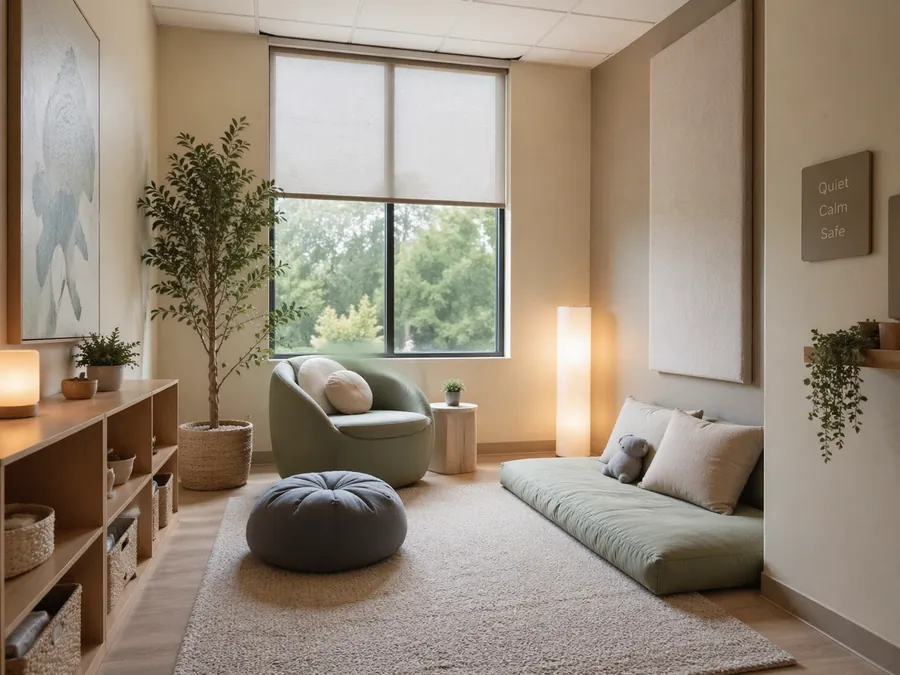
Many inclusive environments include a quiet zone or retreat space. This is useful only if the zone actually feels calmer than the surrounding areas.
A quiet zone beside a noisy corridor, kitchen, open office, classroom, playground, reception desk or mechanical plant may not provide the intended relief. A room with a weak door, hard finishes, poor ventilation or visual clutter may also fail to feel restorative.
A good quiet zone should consider:
location away from major noise sources
controlled reverberation
soft finishes
low background noise
comfortable lighting
predictable layout
good ventilation
simple wayfinding
privacy without feeling isolated
durable and calm materials
The quiet zone should feel available, usable and respected. It should not be the leftover space at the edge of the plan.
Retreat spaces are different from punishment spaces
A retreat space should not feel like a place of exclusion or discipline. It should feel like a legitimate option for regulation, rest or decompression.
This matters in schools, workplaces, community spaces, clinics, homes and shared environments. A person may need to step away from sound and activity without being treated as if they have failed to participate.
Acoustically, a retreat space should reduce stimulation while still feeling safe and comfortable. It may need soft materials, reduced reverberation, lower background noise, fewer sudden sounds and a sense of enclosure.
The design should support dignity and choice. A calming room should not be hidden, stigmatised or unpleasant to use.
Sensory-sensitive spaces need acoustic zoning
Zoning is one of the most important design tools for sensory comfort. It separates spaces by activity level and expected sound level.
Active zones might include kitchens, collaboration areas, classrooms, play spaces, reception areas, circulation, dining areas or social zones. Calm zones might include study areas, therapy rooms, quiet rooms, retreat spaces, sensory rooms, bedrooms, focus rooms or support spaces.
If active and calm zones are placed too close together without separation, the calmer space may not work. Sound travels through doors, openings, corridors, ceilings, glazing, walls and service paths.
Good acoustic zoning creates a gradient. A person can move from active to semi-calm to quiet, rather than being forced from noisy directly into silent or from calm directly into overwhelming.
This supports predictability and choice.
Transitions can be acoustically difficult
Transitions between spaces are often overlooked. Moving from a quiet room into a noisy corridor, from a classroom into a playground, or from a calm office into a lively breakout space can be difficult for some people.
Acoustic transitions can be softened through thresholds, lobbies, corridors, curtains, door placement, material changes, ceiling treatment and visual cues. These elements help people understand that they are entering a different sound environment.
A transition zone can also reduce direct sound transfer. For example, a small lobby outside a quiet room can reduce corridor noise. A softened threshold between a classroom and shared learning area can reduce acoustic shock. A curtain or screen can signal a change in sound expectation.
Good sensory-aware design considers not only each room, but the movement between rooms.
Sound control should not rely only on headphones
Headphones, ear defenders or noise-cancelling devices can be useful for some people. But the built environment should not assume that individuals must always manage the acoustic problem themselves.
If a space is consistently overwhelming, the room should be reviewed. Is it too reverberant? Are mechanical systems intrusive? Are active and quiet zones poorly separated? Is speech carrying too far? Are hard surfaces exaggerating sound? Are there too many sudden noise sources?
Personal tools can support individual choice, but they should not replace environmental design.
A more inclusive acoustic environment reduces the amount of self-management required.
Classrooms need clearer and calmer sound
In learning environments, acoustic clarity matters for all students, but it can be especially important for students who find background noise, overlapping speech or reverberation difficult.
A classroom with excessive reverberation can make speech harder to follow and activity harder to regulate. A noisy mechanical system can mask instructions. A hard open learning space can make group work overwhelming. A corridor or adjacent classroom can become a constant distraction.
Better acoustic design can support clearer listening and calmer participation. Ceiling absorption, wall treatment, soft furnishings, better zoning, controlled services noise, improved door separation and quiet retreat areas can all help.
Some research and guidance in autism-focused contexts has specifically highlighted classroom noise and listening conditions as important design considerations.
Workplaces need acoustic choice
Neurodivergent and sensory-sensitive workers may not all need the same environment. Some may prefer quiet focus areas. Some may prefer moderate background sound. Some may need fewer unexpected interruptions. Some may need places to take calls without surrounding noise. Some may need retreat spaces after high-stimulation meetings.
A workplace that offers only one acoustic condition is less flexible. An open-plan office with no quiet rooms forces everyone to adapt to the same sound environment. A silent workplace may also be uncomfortable if every small sound becomes noticeable.
Better workplace acoustic design provides choice:
focus rooms
quiet zones
meeting rooms with good speech containment
call rooms
lower-stimulation retreat spaces
collaboration areas located away from quiet work
controlled reverberation
low-noise services
clear zoning
This helps people match the space to the task and their sensory needs.
Homes need calm areas, not just functional rooms
In homes, sensory-sensitive acoustic design often begins with identifying which rooms need to feel calm. Bedrooms, study rooms, retreat spaces, children’s rooms and living areas may all need different acoustic conditions.
A child’s bedroom beside a noisy living area may be difficult. A home office in an open-plan kitchen may not support focus. A sensory retreat room near a laundry or bathroom may be interrupted by services noise. A living room with hard surfaces and high reverberation may make daily family life feel louder than expected.
Residential acoustic design can support calmer homes through better zoning, door sealing, soft finishes, curtains, rugs, ceiling treatment, background noise control and careful planning of active and quiet areas.
The goal is not to make the whole home silent. It is to create places where sound feels manageable.
Shared spaces need lower acoustic intensity
Shared spaces often create the most difficulty because many sound sources occur at once.
Reception areas, waiting rooms, corridors, dining rooms, libraries, workplaces, school common areas, therapy centres, community spaces and breakout rooms can all become acoustically intense.
The problem may be overlapping speech, hard finishes, chair noise, music, footfall, mechanical noise, doors, children’s activity or general reverberation. In these spaces, sensory-sensitive design should reduce the overall acoustic intensity.
This may involve absorption, zoning, quieter materials, soft furniture, acoustic ceilings, reduced music levels, better service design, calmer transitions and defined quiet areas.
Shared spaces should not force everyone into the loudest possible version of the room.
Mechanical systems should be designed for comfort, not just compliance
Air conditioning and ventilation are essential, but they can become a major acoustic issue.
A tonal hum, intermittent fan, high-velocity grille or noisy unit can make a sensory-sensitive room difficult to use. Even if the sound level seems acceptable in a general sense, the character of the noise may still be intrusive.
Design teams should consider where plant is located, how ducts are routed, what grilles are used, whether vibration is controlled and how the system sounds during normal use.
Comfort is not only thermal. It is also acoustic.
A calm room with a distracting mechanical system is not truly calm.
Material choices should reduce sharpness
Hard materials can make sound feel sharper. Glass, stone, tile, concrete, plasterboard and timber floors may all contribute to acoustic brightness when used without balance.
Sensory-sensitive interiors often benefit from softer material strategies: acoustic ceilings, curtains, rugs, upholstered furniture, fabric panels, acoustic plaster, timber systems with absorptive backing, soft wall zones and integrated treatment.
The material palette should reduce unnecessary sharpness without becoming visually cluttered. Calm visual design and calm acoustic design often support each other.
The best spaces feel considered, not padded. Acoustic comfort can be refined and architectural.
Avoid over-designing a single “sensory room”
A sensory room can be useful, but it should not be the only sensory-aware part of a building.
If the rest of the environment is overwhelming, one room may become a coping space rather than a sign of inclusive design. A better approach is to improve the whole acoustic environment where possible, while also providing quieter retreat spaces.
This means thinking about classrooms, corridors, reception areas, workplaces, bathrooms, waiting rooms, dining areas and circulation routes. It also means considering transitions between them.
Sensory-sensitive design should be distributed through the building, not isolated in one special room.
Acoustics should support agency and choice
Different people regulate differently. Some need quiet. Some need movement. Some need predictable background sound. Some need to leave and return. Some need to avoid sudden sounds. Some may use headphones or other personal tools.
The built environment should support agency. That means providing options rather than forcing one condition.
Acoustic choice might include a quiet retreat room, a lower-stimulation zone, a normal social zone, a more active space, a private call room, a calm study area and clear pathways between them.
Choice is especially important because sensory needs can change from day to day and task to task.
A good environment does not assume it knows one perfect setting for everyone.
Existing spaces can still be improved
Many sensory-sensitive acoustic improvements happen in existing buildings. A classroom may feel too loud. A workplace may be too distracting. A waiting room may be overwhelming. A home may not have a calm retreat space. A library may not separate quiet and active zones well.
Improvement is possible, but the first step is diagnosis.
Is the issue reverberation? Mechanical noise? Speech distraction? Poor zoning? External noise? Hard finishes? Door leakage? Lack of retreat spaces? Sudden impact noise? A combination of several things?
Once the issue is clear, solutions can be targeted. These may include ceiling treatment, wall absorption, curtains, door seals, services review, furniture changes, zoning changes, soft finishes, quiet rooms or behavioural and operational adjustments.
The most useful solution is the one that addresses the real source of overload.
Buildability and maintenance matter
Sensory-sensitive acoustic design needs to work in real life. Materials should be durable, cleanable, safe and suitable for the users of the space. Quiet rooms need ventilation. Panels need to withstand contact. Curtains need to be operable. Doors and seals need to be practical. Soft materials need maintenance. Ceiling treatment needs service access.
A treatment that performs well acoustically but is fragile, difficult to clean or hard to use may not be suitable.
Buildability and maintenance are part of inclusion. A space that cannot be maintained will not remain supportive.
Consultation and lived experience matter
Acoustic design should not assume what sensory-sensitive or neurodivergent people need without listening.
Where possible, design decisions should be informed by the people who will use the space, or by carers, educators, therapists, staff and others who understand the day-to-day needs of the setting. Different users may have different preferences, and those preferences may change over time.
Post-occupancy feedback can also be valuable. A room may meet the design intent on paper but still need adjustment once people use it.
Inclusive acoustic design is not a one-time product selection. It is a process of understanding, designing, testing and refining.
When to get acoustic advice
It is worth getting acoustic advice when a space is used by sensory-sensitive people, neurodivergent people, children, students, staff, patients or community members who may be affected by noise, reverberation or unpredictable sound.
Advice is especially useful for classrooms, therapy rooms, early learning centres, libraries, homes, workplaces, waiting rooms, retreat spaces, sensory rooms, shared spaces and specialist environments.
An acoustic review can help identify whether the issue is reverberation, background noise, mechanical noise, speech distraction, sound transfer, poor zoning or material balance. From there, the design can focus on practical changes that make the space calmer and more usable.
Final thought
Acoustic design for sensory-sensitive and neurodivergent people should be careful, respectful and practical.
It should not assume that everyone has the same needs. It should not rely only on one quiet room or one acoustic product. It should not make individuals carry the full burden of managing an overwhelming environment.
The strongest approach is to create spaces with lower unnecessary noise, reduced reverberation, calmer transitions, clearer zoning, quiet options and better control.
A good sensory-aware acoustic environment does not demand silence. It offers predictability, comfort and choice.
Frequently Asked Questions
Acoustic Design for Sensory-Sensitive Spaces
Practical acoustic advice for calmer classrooms, workplaces, homes, retreat rooms and inclusive shared environments.
Acoustic Design for Sensory-Sensitive Spaces
Practical acoustic advice for calmer classrooms, workplaces, homes, retreat rooms and inclusive shared environments.
Read Nicholas Marriott's bio