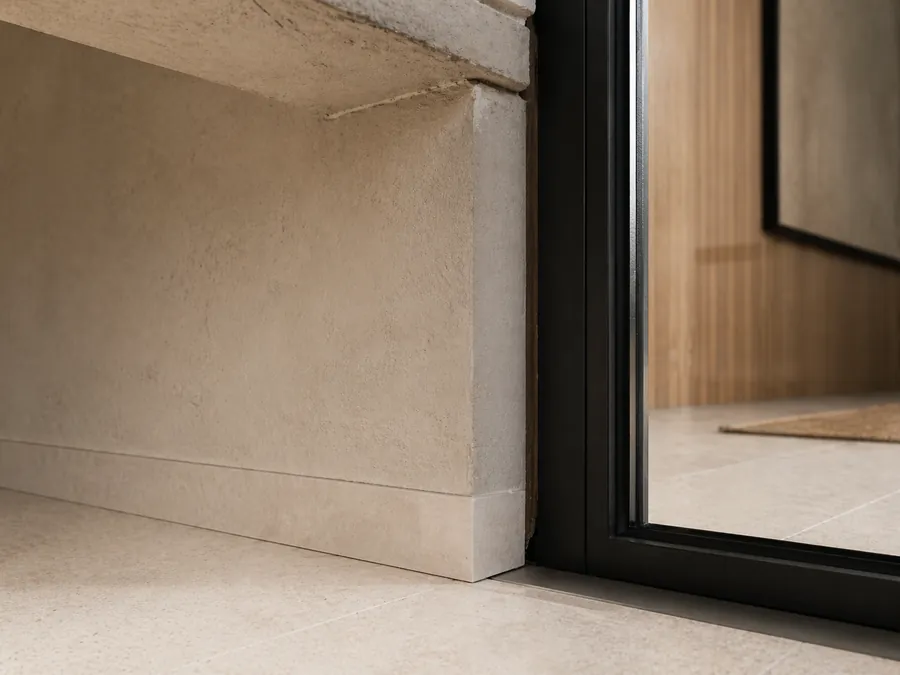
Timber, Stone & Glass: Acoustic Balance in High-Design Interiors
A practical guide to acoustic balance in interiors that use timber, stone, glass and other hard finishes, covering reverberation, reflection control, material strategy, ceilings, curtains, rugs, joinery and integrated acoustic treatment.

On this page
Beautiful materials can still create difficult rooms
Timber, stone and glass are central to many refined interiors. They bring warmth, texture, durability, light, contrast and architectural clarity. They can make a space feel resolved, generous and carefully designed.
But acoustically, these materials need balance.
Glass reflects sound. Stone reflects sound. Polished concrete, tile and plaster can also reflect sound. Timber can be warm visually, but it is not automatically absorptive. In many interiors, the materials that look calm in photographs can make the room feel bright, loud or tiring once people begin using the space.
This does not mean hard architectural materials should be avoided. The aim is not to make every room soft. The aim is to understand which materials are reflective, where sound will build up and how acoustic comfort can be integrated without compromising the design intent.
Good acoustic design allows timber, stone and glass to remain part of the architecture while preventing them from dominating the room acoustically.
Acoustic balance is different from acoustic softness
A common mistake is to assume that acoustic comfort means making a space soft everywhere. That is rarely the right approach.
A room can still have energy, brightness and material contrast while feeling comfortable. The goal is acoustic balance: enough absorption, scattering, enclosure and planning to support the room’s purpose.
A dining room may need conversation comfort without feeling dead. A living room may need calm without losing openness. A gallery may need atmosphere without excessive echo. A workplace may need clarity without becoming flat. A kitchen may need hard surfaces for function but enough acoustic relief for daily use.
Acoustic balance means deciding which surfaces can remain reflective and which surfaces need to do acoustic work.
Glass brings light, but also reflection
Glass is one of the most acoustically reflective materials in contemporary interiors. Large windows, sliding doors, glass balustrades, internal glazing and glazed partitions can all increase brightness and visual connection, but they can also contribute to echo, flutter and harshness.
This is especially noticeable in spaces with high ceilings, hard floors and minimal furniture. Voices may feel sharper. Dining may become louder. Open-plan spaces may feel more active than expected. Music and television may lose clarity.
The solution is not necessarily to remove glass. Glass often performs an essential architectural role. Instead, the design should balance it.
Curtains, rugs, soft furniture, ceiling treatment, acoustic plaster, absorptive joinery, textured wall zones and careful layout can all help reduce the acoustic dominance of large glazed areas.
If the issue is external noise entering through glass, that becomes a sound isolation question involving glazing, frames, seals and installation. If the issue is reflection inside the room, the solution is usually about internal acoustic balance.
Stone and tile need acoustic counterpoints
Stone benchtops, tiled floors, marble bathrooms, porcelain surfaces and concrete elements can be visually powerful and highly durable. They are also hard reflective surfaces.
In kitchens, bathrooms, dining rooms, lobbies and open-plan living areas, these finishes can make everyday sounds feel sharper. Cutlery, chairs, footsteps, children’s voices, appliances and conversation can all become more noticeable.
Stone and tile do not need to be avoided. They need counterpoints.
A hard stone island may be balanced by acoustic ceiling treatment above. A tiled dining area may need a rug, upholstered chairs or curtains nearby. A bathroom may need careful door separation from bedrooms. A lobby may need absorptive ceiling or wall treatment to prevent sound from building.
The acoustic question is not whether stone is good or bad. It is whether the rest of the room has enough acoustic relief.
Timber is not automatically acoustic
Timber is often described as warm, and visually it is. But acoustically, timber depends entirely on how it is detailed.
A flat timber panel can be reflective. Timber flooring can contribute to brightness. Timber joinery can create hard surfaces. Timber battens may scatter sound, but if there is no absorptive backing behind them, they may provide limited absorption.
Timber becomes acoustically useful when it is designed as an acoustic system. A slatted timber wall with absorptive backing and a suitable cavity can provide meaningful sound control. Perforated timber can work well with the right backing, depth and open area. Timber ceilings can be designed to combine visual rhythm with acoustic performance.
The important point is that timber’s acoustic role must be intentional. It should not be assumed simply because the material feels natural or warm.
The room’s largest surfaces matter most
In many interiors, acoustic comfort is shaped by the largest surfaces: floor, ceiling, glazing and major wall areas.
If the floor is stone or timber, the ceiling is plasterboard, the walls are mostly hard and the windows are large, the room will likely be reflective. Adding a few small decorative panels may not change the overall feel very much.
The acoustic strategy should look at the room as a whole. Which surfaces are large enough to make a difference? Which can accept treatment without compromising the design? Which are fixed by function, budget or heritage? Which can be balanced by furniture, curtains, joinery or ceiling systems?
A small amount of treatment in the right place can be more effective than scattered treatment placed only where it is visually convenient.
Ceilings are often the best place to restore balance
In interiors with timber, stone and glass, the ceiling is often the most valuable acoustic opportunity.
The ceiling can provide a large treatment area without taking over the walls or interrupting the material palette. This is useful in open-plan homes, kitchens, dining areas, hospitality spaces, galleries, offices and studios where the walls may be visually important or already occupied by glazing and joinery.
Ceiling treatment can be discreet. It may involve acoustic plaster, perforated plasterboard, timber acoustic systems, fabric-wrapped panels, baffles, rafts or integrated ceiling zones. The right system depends on the room’s design language, services, lighting, budget and performance needs.
The ceiling should be considered early. Once lighting, air conditioning, sprinklers, speakers and access panels are locked in, acoustic treatment can become harder to integrate elegantly.
Curtains can soften glass without fighting it
Curtains are one of the most design-friendly ways to balance large areas of glass. They can support privacy, light control, softness and acoustic comfort at the same time.
Full-height curtains with appropriate fabric weight, fullness and coverage can reduce some mid and high-frequency reflections from glazing. They can make a room feel calmer and less exposed, especially in living rooms, bedrooms, dining rooms, studios and listening spaces.
However, curtains should not be oversold. They do not replace acoustic glazing when the problem is external noise entering the room. They also do not solve bass or low-frequency issues. Their role is to soften the internal room response and reduce some reflections.
When designed properly, curtains can be both acoustic and architectural.
Rugs and upholstery help create usable comfort
Rugs, upholstered seating, cushions, banquettes, fabric chairs and soft furniture all help reduce reflections and make interiors feel more settled.
A rug can be particularly useful where hard flooring is important to the design. Upholstered dining chairs can improve conversation comfort. A soft sofa can help a living room feel less sharp. Banquette seating can add acoustic value in dining, hospitality and residential settings.
These elements are often easier to integrate than technical acoustic products because they are already part of the interior design language.
But they still have limits. In a large room with high ceilings and extensive glazing, furniture and rugs may help but not fully solve the acoustic problem. They work best as part of a wider material strategy.
Acoustic treatment can be hidden in plain sight
Acoustic treatment does not need to look like a panel added after the design is complete. In high-design interiors, the strongest solutions are often integrated into architectural elements.
Treatment can be built into timber linings, acoustic plaster ceilings, fabric wall zones, joinery, banquettes, curtains, media walls, bookshelves, screens, ceiling features and custom furniture. These elements can support both the visual and acoustic intent of the room.
The key is to decide early what the acoustic element needs to do. A slatted wall may need absorption behind it. A ceiling feature may need enough surface area to matter. A fabric wall may need the right backing and depth. A bookshelf may scatter sound but may not provide much absorption.
When treatment is integrated properly, it feels like part of the architecture rather than a correction.
The danger of acoustic-looking details
Some details look acoustic but do not perform as expected.
Timber battens without absorption behind them may provide little absorption. Thin felt panels may affect high frequencies but not the broader reverberation problem. Decorative perforations may not have enough open area. Small panels may be visually interesting but too limited in surface area. A rug may help the floor reflection but leave the ceiling and glass untreated.
This is why acoustic appearance should not be confused with acoustic performance.
A detail should be selected because it addresses a specific room behaviour: reverberation, early reflections, speech clarity, bass control, privacy or comfort. If the function is unclear, the result may be disappointing.
Good acoustic design gives each detail a purpose.
High-design interiors often need early acoustic input
The more refined the interior, the earlier acoustics should be considered. This is because late-stage acoustic solutions can feel visually intrusive.
If the room is already documented with hard ceilings, full-height glazing, stone floors, minimal furniture and precise joinery, acoustic options may become limited. The project may then be forced to choose between visual integrity and acoustic comfort.
Early input allows acoustic performance to be integrated into the design language. A ceiling can be selected for both appearance and absorption. A timber wall can be detailed with acoustic backing. Curtain tracks can be recessed. Joinery can include absorptive zones. Soft furnishings can be scaled appropriately.
Acoustics should not arrive after the design has already used every surface.
Material contrast can support acoustic contrast
Interiors often use material contrast visually: hard and soft, light and dark, smooth and textured, reflective and matte. The same thinking can support acoustics.
A stone floor can be balanced by a soft ceiling. A glass wall can be balanced by curtains. Timber joinery can be balanced with absorptive backing. A hard dining table can be supported by upholstered seating. A minimal room can include one or two strategically absorbent surfaces without losing its calmness.
Acoustic contrast does not need to be obvious. It simply needs to be present.
The most successful interiors often have a layered acoustic character: some surfaces reflect, some absorb, some scatter and some provide softness through furniture and fabric.
Hard surfaces affect speech clarity
Hard reflective rooms can make speech less clear, especially when several people are speaking or when background noise is present.
This matters in dining rooms, open-plan living areas, meeting rooms, reception spaces, hospitality venues, classrooms, galleries and workplaces. When sound lingers, voices overlap. People speak louder. The room becomes noisier. This cycle can make a space feel tiring even if the design looks calm.
Improving speech clarity usually requires reducing excessive reflections and controlling reverberation. This may involve ceiling treatment, wall absorption, curtains, rugs, furniture or acoustic joinery.
A room does not need to be silent to be comfortable. It needs speech to remain intelligible at the level of activity expected in the space.
Hard surfaces affect music and media playback
Timber, stone and glass can also influence music, television, home cinema and hi-fi playback.
Reflective surfaces can blur detail, increase brightness, affect imaging and make sound feel less controlled. Bass may also be affected by room shape, boundaries and furniture placement, even when the surfaces themselves are not the main low-frequency issue.
In media rooms and listening spaces, the acoustic strategy may need to be more precise. Speaker placement, reflection control, rug location, curtains, wall treatment, ceiling treatment and seating position all matter.
A beautiful room can still support high-quality playback if the acoustic design is considered early enough.
Bathrooms and wet areas need special consideration
Bathrooms and wet areas often use stone, tile, glass and hard plaster surfaces. They can become very reverberant, but treatment options are limited by moisture, cleaning and durability.
The acoustic issue is not only the bathroom itself. Bathroom noise can affect adjacent bedrooms, studies and living areas through walls, doors, plumbing and ventilation.
In these cases, acoustic planning may involve room adjacency, door selection, seals, wall construction, plumbing location, services coordination and careful separation rather than visible absorption inside the wet area.
Hard surfaces are often unavoidable in bathrooms. Planning and construction details become more important.
Kitchens need functional hardness and acoustic relief
Kitchens require durable hard surfaces. Stone benchtops, tiled splashbacks, timber joinery, glass doors and hard floors are common for practical reasons.
The acoustic challenge is that kitchens are also active, noisy rooms. Appliances, rangehoods, dishes, chairs, cutlery, conversation and family activity all add sound.
A good kitchen acoustic strategy does not fight the functional materials. It introduces acoustic relief around them: dining rugs, upholstered chairs, acoustic ceiling treatment, curtains, soft seating, absorptive joinery or nearby wall treatment.
The kitchen can remain durable and refined while still feeling less sharp and more comfortable.
Hospitality and workplace interiors need more than atmosphere
In hospitality and workplace settings, timber, stone and glass often contribute to brand identity and spatial character. But acoustic comfort has a direct effect on usability.
A restaurant that looks beautiful but forces people to shout will feel exhausting. A workplace with glass meeting rooms may struggle with speech privacy. A reception space with stone floors and hard ceilings may feel impressive but loud. A gallery may need atmosphere without excessive echo.
These spaces require acoustic design that respects the material palette while making the room functional for people.
The right balance depends on use. A lively restaurant does not need to sound like a library. A workplace meeting room does not need to sound like a studio. But each needs an acoustic response that supports its purpose.
Buildability determines whether the idea works
Acoustic balance is not achieved by naming materials alone. The details need to be buildable.
A timber acoustic lining needs the right backing, cavity and edge detail. Acoustic plaster needs the correct system and substrate. Curtains need track coordination and fabric selection. Ceiling treatment must work with lights, air conditioning, sprinklers, speakers and access panels. Joinery-based absorption needs to survive real use.
A design can be acoustically promising but fail if it is not constructed properly.
Buildability should be considered when the material strategy is being developed, not after the details are already documented.
When to get acoustic advice
It is worth getting acoustic advice when a project uses large areas of timber, stone, glass, tile, concrete or plaster and the room also needs comfort, clarity or privacy.
Advice is especially useful for open-plan homes, kitchens, dining rooms, hospitality spaces, workplaces, galleries, studios, media rooms, listening spaces and any interior where the material palette is visually important but acoustics cannot be ignored.
An acoustic review can help identify which surfaces can remain hard, where absorption should be integrated, and how the design can maintain its visual character while improving the sound.
Final thought
Timber, stone and glass can all be part of excellent acoustic interiors. The issue is not the materials themselves. The issue is imbalance.
A room becomes uncomfortable when every major surface reflects sound and no surface is given the job of controlling it.
The strongest interiors use acoustic design as part of the material strategy. They allow hard finishes to remain beautiful while introducing softness, absorption, scattering and treatment where it matters most.
Good acoustic balance is not about hiding the architecture. It is about helping the architecture feel as good as it looks.
Frequently Asked Questions
Yes. Timber, stone and glass all affect how sound behaves in a room. Glass, stone and flat timber surfaces often reflect sound, which can increase reverberation and make spaces feel louder or sharper if they are not balanced with softer or absorptive elements.
Timber can be good for acoustic design when it is detailed properly. Flat timber may reflect sound, while slatted or perforated timber systems can provide absorption or scattering when designed with the correct backing, cavity and construction.
A glass-heavy room can often be improved with curtains, rugs, upholstered furniture, ceiling treatment, acoustic plaster, absorptive joinery or carefully placed wall treatment. The goal is to balance the reflective glass with enough acoustic relief elsewhere in the room.
Hard finishes do not always make a room echoey, but large areas of hard reflective surfaces can increase reverberation if there is not enough absorption or soft furnishing elsewhere. The result depends on room size, ceiling height, furniture, surface area and material balance.
Yes. Acoustic treatment can often be integrated into ceilings, timber linings, joinery, curtains, rugs, upholstery, acoustic plaster, wall panels or custom interior details. Early design coordination makes it much easier to keep the treatment discreet.
Acoustic balance means using the right mix of reflective, absorptive and scattering surfaces so a room feels comfortable for its purpose. It does not mean making every surface soft. It means deciding which materials can remain hard and where acoustic control should be introduced.
Get acoustic advice before finalising major finishes, ceilings, glazing, curtains, joinery and furniture layouts, especially if the room uses large areas of timber, stone, glass, tile or concrete. Early advice helps acoustic comfort become part of the design rather than a late correction.
Acoustic Design for High-Design Interiors
Design-led acoustic advice for interiors using timber, stone, glass and other hard architectural finishes.
Acoustic Design for High-Design Interiors
Design-led acoustic advice for interiors using timber, stone, glass and other hard architectural finishes.
Read Nicholas Marriott's bio