
Workplace Acoustics & Productivity: Open-Plan Offices, Hybrid Work and Focus
A practical guide to workplace acoustics, covering open-plan offices, hybrid work, speech distraction, focus rooms, meeting rooms, acoustic zoning, reverberation, background noise and the design decisions that support more usable work environments.


.avif)
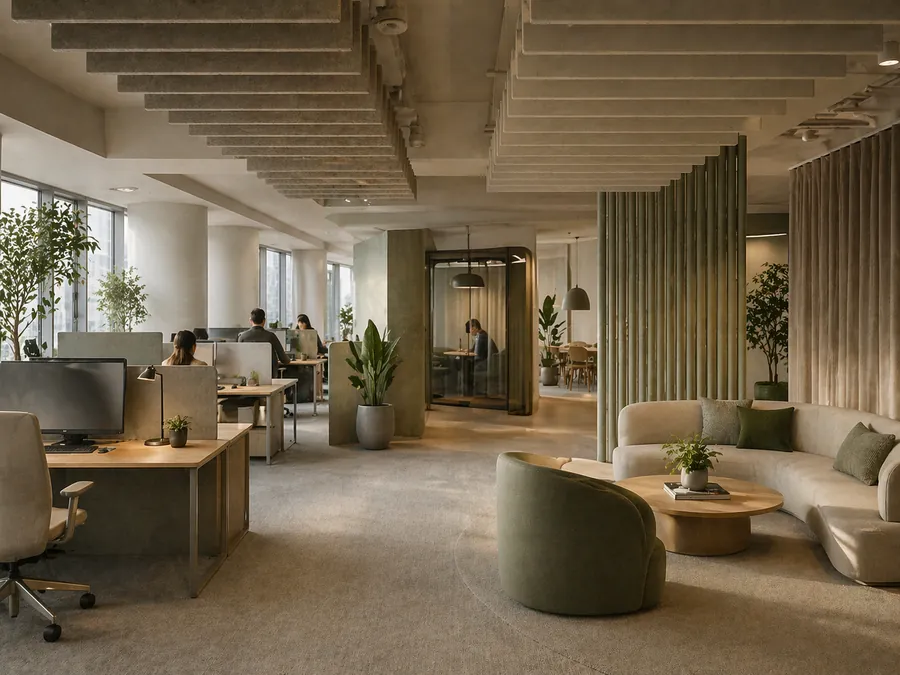
Workplace acoustics shape how people focus
Workplace acoustics are not only about making an office quieter. They are about making the office easier to use.
A workplace may look organised, generous and well designed, but still feel distracting if sound is not planned properly. Conversations carry across the room. Video calls spill into nearby desks. Meeting rooms leak speech. Hard finishes create echo. Breakout zones become too lively. Quiet work areas sit too close to social spaces.
When the acoustic environment is poorly balanced, people often adapt around it. They wear headphones all day. They avoid certain desks. They leave the office for focused work. They take calls in corridors. They use meeting rooms for tasks that should not require a room.
Good workplace acoustic design supports the actual activities happening in the space: focus, collaboration, calls, meetings, informal conversation, reception, movement and recovery.
The goal is not silence. The goal is a workplace where sound feels managed, predictable and appropriate.
Productivity depends on acoustic fit
Productivity is not created by acoustics alone, but acoustics can strongly influence whether a workplace supports the work it is meant to hold.
Different tasks need different sound conditions. Focused writing, design work, technical work, confidential calls, team discussion, client meetings and casual collaboration all have different acoustic needs.
A workplace that treats every area the same will usually disappoint someone. An open desk area may be too distracting for deep work. A collaboration zone may be too subdued for conversation. A meeting room may be too live for video calls. A quiet room may be too close to circulation.
Acoustic fit means aligning the sound environment with the task. That is the real productivity question.
The better the fit, the less energy people spend managing distraction.
Open-plan offices need acoustic zoning
Open-plan offices are not automatically bad, but they do require acoustic zoning.
An open-plan office often contains many activities in one visual field: individual work, phone calls, collaboration, circulation, informal meetings, kitchen use, reception and video conferencing. If these activities are not acoustically organised, they compete with each other.
Zoning helps separate uses without necessarily building walls everywhere. Focus zones, collaboration zones, meeting rooms, phone booths, quiet rooms, breakout areas and social spaces should be located with sound in mind.
A quiet desk area beside a kitchen will struggle. A focus zone next to a busy meeting room may not feel focused. A collaboration zone in the middle of workstations may create constant disruption. A phone booth beside a concentrated work area may create door and speech noise even if the booth itself performs reasonably well.
Good workplace planning reduces these conflicts before treatment is added.
Speech is often the most distracting sound
In offices, speech is often more distracting than general background noise because it carries meaning. People may be able to ignore a steady hum, but nearby conversation pulls attention.
This is especially true in open-plan work areas where speech from colleagues is clear enough to understand but unrelated to the listener’s task. The issue is not only volume. It is intelligibility, proximity and unpredictability.
Workplace acoustic design should therefore consider where speech happens, how far it travels and whether it needs to be understood.
In some areas, speech clarity is essential. Meeting rooms, training rooms and collaboration spaces need people to hear each other clearly. In other areas, speech privacy or reduced intelligibility may be more important. Focus zones, confidential rooms and adjacent desk areas need speech to be contained or less intrusive.
Good acoustic design treats speech differently depending on the space.
Hybrid work has changed the acoustic brief
Hybrid work has made office acoustics more complex. Many workplaces now include more video calls, online meetings, small group sessions and people speaking into microphones throughout the day.
This changes the acoustic demands on the office.
A room that worked for occasional meetings may not work well for daily video calls. An open area that supported quiet desk work may become distracting when multiple people are on calls. A meeting room with hard surfaces may sound poor for remote participants. A phone booth may become overused if there are not enough alternative call spaces.
Hybrid workplaces need a mix of acoustic settings. Not every call should happen at a desk. Not every meeting needs a large room. Not every focused task should require headphones.
The acoustic design should provide choice: open desks, quiet zones, focus rooms, call rooms, collaboration spaces and properly treated meeting rooms.
Meeting rooms need clarity and containment
Meeting rooms need two things that are sometimes confused: clarity inside the room and containment outside the room.
Clarity inside the room means people can hear each other without strain. This depends on reverberation, room size, table shape, ceiling treatment, wall finishes, background noise and audio equipment.
Containment outside the room means speech does not disturb nearby work areas or become easily understood outside. This depends on walls, doors, seals, glazing, ceilings, services and flanking paths.
A meeting room can have good internal treatment but poor privacy if the door leaks. It can have solid walls but still sound unclear inside if the finishes are too hard. It can look enclosed with glass but fail to contain speech if the door, ceiling or seals are weak.
A useful meeting room design considers both conditions from the beginning.
Phone booths and focus pods are not a complete acoustic strategy
Phone booths and focus pods can be useful, but they should not be treated as the whole workplace acoustic solution.
A booth can provide a place for calls, but it may not solve speech distraction across the open office. If there are too few booths, people will still take calls at desks. If booths are located poorly, door openings and nearby waiting activity can disturb focus areas. If ventilation is noisy or uncomfortable, people may avoid using them.
Pods also vary in acoustic performance. Some provide reasonable speech containment. Others mainly provide visual separation.
Booths work best as part of a wider acoustic plan that includes zoning, meeting rooms, desk planning, treatment, behaviour and enough call spaces for the actual work pattern.
Reverberation affects comfort and clarity
Reverberation is the way sound remains in a room after the source stops. In workplaces, too much reverberation can make spaces feel loud, tiring and difficult for conversation.
Hard ceilings, glass partitions, concrete floors, plasterboard walls and minimal soft furnishings can all increase acoustic harshness. In open offices, reverberation can allow voices and activity to spread further than expected.
Controlling reverberation usually requires absorption in the right places. Ceilings are often especially important because they provide large surface area. Wall treatment, curtains, soft furniture, rugs, acoustic plaster, baffles, rafts and joinery-based treatment can also contribute depending on the design.
The aim is not to make the office dead. It is to reduce the build-up that makes the workplace tiring.
Ceilings are often the main acoustic opportunity
In many workplaces, the ceiling is the largest and most useful acoustic surface. It can help reduce reverberation, control sound build-up and improve the overall comfort of open-plan and meeting spaces.
Ceiling treatment may include acoustic tiles, baffles, rafts, acoustic plaster, perforated linings, timber acoustic systems or integrated absorptive zones. The right solution depends on the architecture, services, lighting, fire requirements, budget and design language.
The ceiling also needs coordination. Air conditioning, sprinklers, lighting, speakers, sensors and access panels can all interrupt acoustic treatment. If these systems are not coordinated early, the ceiling may lose acoustic effectiveness or become visually fragmented.
A good workplace acoustic ceiling strategy is both technical and architectural.
Workstations need more than distance
Desk planning affects acoustic comfort, but distance alone is not always enough.
The orientation of desks, team groupings, screen height, circulation paths, nearby call areas, meeting room locations and ceiling treatment all influence how sound travels. A person may be physically several metres away from a conversation but still distracted if the room is reflective and the speech is clear.
Furniture systems can help by providing some screening and absorption, but they rarely solve the whole problem on their own. Low desk screens may provide visual separation but limited acoustic benefit. High screens can support privacy but may affect openness and collaboration. Soft furniture can help, but the broader room still matters.
Workstations should be planned as part of an acoustic zoning strategy, not treated as isolated furniture selections.
Breakout and collaboration areas need boundaries
Collaboration areas are meant to generate sound. That is not a problem unless they are placed where the sound conflicts with focused work.
A breakout area near desks may create constant distraction. A kitchen or social zone beside meeting rooms may affect privacy. A collaboration table in the middle of an open office may make nearby workstations harder to use.
These spaces need boundaries. The boundary may be distance, orientation, ceiling treatment, soft furniture, partial screens, joinery, planting, curtains, acoustic wall treatment or a separate room.
The goal is not to suppress collaboration. It is to locate and shape it so that it does not undermine other work.
Quiet rooms need to feel genuinely quiet
A quiet room should not be a leftover small room with a desk. It should feel protected enough to support concentrated work.
That means it needs to be located away from the noisiest activity, treated internally to avoid harshness, and separated from adjacent spaces with suitable doors, seals and wall or ceiling details. It also needs good lighting, ventilation, comfort and usability.
If a quiet room is next to a kitchen, has a poor door, contains a noisy fan or feels visually exposed, people may not use it for serious focus.
A quiet room does not need to be overbuilt, but it does need to be intentional.
Speech privacy requires the whole path to be considered
Speech privacy is important in meeting rooms, HR rooms, executive offices, consulting rooms, phone rooms and confidential work areas.
It depends on more than wall rating. Speech can travel through doors, glazing, ceilings, service penetrations, corridors, return-air paths and poorly sealed junctions. It can also be affected by how quiet the surrounding space is. In a very quiet adjacent area, speech leakage may be more noticeable.
Good speech privacy design considers the full path between the speaker and the listener outside the room. It also considers whether the issue is speech being audible or speech being intelligible.
A room may not need to block all sound, but it may need to prevent conversations from being understood.
Sound masking can help, but it is not a substitute for planning
Sound masking can be useful in some workplaces. It adds a controlled background sound to reduce the intelligibility of speech and make distractions less noticeable.
However, sound masking should not be used as a substitute for poor planning, weak meeting rooms or insufficient treatment. If a room is too reverberant, if calls happen everywhere or if privacy rooms leak badly, masking alone will not create a good workplace.
Masking works best when it is part of a broader acoustic strategy that includes zoning, absorption, room separation, meeting room design and behavioural expectations.
It also needs careful commissioning. If it is too loud, uneven or tonally unpleasant, it can become another source of irritation.
Background noise from services matters
Air conditioning, fans, plant, lifts, plumbing, equipment, fridges and ventilation systems all contribute to the workplace sound environment.
Some background noise can help reduce the contrast between speech and silence, but intrusive or uneven mechanical noise can be distracting. A noisy meeting room fan may affect video calls. A loud return grille may make a focus room uncomfortable. Plant noise near quiet areas may reduce the value of those spaces.
Services should be coordinated with acoustic goals. A workplace should not rely on accidental noise to provide privacy, and it should not allow mechanical systems to undermine comfort.
Good services design supports the acoustic environment without drawing attention to itself.
Material choices influence workplace feel
Workplace interiors often use glass, concrete, plasterboard, exposed services, timber, metal, stone, carpet, fabric and soft furniture. Each material affects the acoustic feel.
Glass meeting rooms may support visibility but create privacy challenges. Exposed concrete may look strong but reflect sound. Carpet can soften footfall and reduce some floor reflections. Upholstered furniture can help breakout areas. Acoustic ceilings can control reverberation. Wall panels and fabric zones can reduce harsh reflections.
The material palette should be reviewed acoustically, not only visually. A workplace can be open, refined and contemporary while still providing enough absorption and separation to be usable.
Workplace behaviour still matters
Design can do a lot, but behaviour still matters.
If people take long video calls at open desks, hold loud conversations beside focus areas or use quiet rooms for casual meetings, the acoustic strategy may be undermined. If there are not enough call rooms, behaviour will adapt in the wrong direction. If meeting rooms are difficult to book, people will use open areas for meetings.
Workplace acoustics should be supported by planning, room availability and simple expectations around use.
The design should make good behaviour easy. People should not need to fight the workplace to work well.
Sensitive users may need more predictable sound environments
Some people are more affected by noise than others. This may include neurodiverse users, people with sensory sensitivity, people doing cognitively demanding work, people recovering from stress, or people who simply need more control over distraction.
A workplace acoustic strategy should include choice. Not everyone needs the same sound environment all day. Some people may need access to quieter rooms, lower-stimulation zones, predictable background sound, better separation from social spaces or fewer sudden noise events.
This does not mean designing the whole workplace as a silent zone. It means providing a range of settings so people can choose the acoustic environment that suits the task and their needs.
A more inclusive workplace is often one with better acoustic variety.
Existing workplaces can still be improved
Many acoustic improvements happen after a workplace is already occupied. The office may feel too loud, meeting rooms may leak, video calls may be difficult, or staff may avoid certain zones.
Improvement is still possible, but the first step is diagnosis.
Is the problem reverberation? Speech distraction? Poor zoning? Meeting room leakage? Lack of call spaces? Noisy services? Hard finishes? Behaviour? A combination of several issues?
Once the main issues are clear, upgrades can be targeted. Options may include ceiling treatment, wall treatment, meeting room door seals, layout changes, more call spaces, soft furniture, sound masking, service adjustments or better zoning.
The best improvement path is specific to the workplace, not a generic acoustic product list.
Buildability and tenancy limits matter
Workplace acoustic upgrades often need to work within tenancy constraints, budgets, lease conditions, services, existing ceilings, fire systems and programme requirements.
A ceiling upgrade may be limited by services. Meeting room privacy may be limited by existing glazing. Wall treatment may need to avoid damage to base building finishes. A sound masking system may require commissioning. A focus room may need ventilation upgrades. A layout change may need furniture and power coordination.
Buildability matters because the solution needs to be installed without creating new problems.
The best acoustic advice is practical. It identifies what will make a real difference within the limits of the workplace.
When to get acoustic advice
It is worth getting acoustic advice when an office feels distracting, loud, echoey, hard to focus in or difficult for confidential conversations. It is also useful when a workplace is being designed, refurbished or adapted for hybrid work.
Early advice can help with zoning, meeting room design, ceiling strategy, call room planning, material selection, speech privacy and services coordination. For existing offices, an on-site review can help identify why the space is not working and which upgrades are most likely to help.
Workplace acoustic problems can become expensive when the wrong issue is treated first. A practical assessment helps focus the design.
Final thought
Workplace acoustics are not about forcing every office to be quiet. They are about making different kinds of work possible in the right places.
A good workplace needs focus, collaboration, speech privacy, call spaces, meeting clarity, social energy and quieter retreat. These needs cannot all be solved by one product or one room type.
The strongest workplace acoustic design starts with the work itself. It asks what people need to do, where sound is created, where distraction occurs and how the plan, materials, rooms and behaviour can support better focus and communication.
When the acoustic environment fits the work, the office becomes easier to use.
Frequently Asked Questions
Workplace Acoustic Design & Productivity Advice
Practical acoustic guidance for open-plan offices, hybrid workplaces, focus rooms, meeting spaces and speech privacy.

Workplace Acoustic Design & Productivity Advice
Practical acoustic guidance for open-plan offices, hybrid workplaces, focus rooms, meeting spaces and speech privacy.
Read Nicholas Marriott's bio