
Acoustic Design, Soundproofing and Acoustic Treatment Explained
TL;DR
Soundproofing, acoustic treatment and acoustic design address different parts of an acoustic problem.
- Soundproofing or sound isolation reduces sound travelling into or out of a space.
- Acoustic treatment controls reflections, reverberation and clarity inside the room.
- Acoustic design coordinates isolation, room acoustics, layout, services, external noise and construction.
- Foam and decorative panels generally do not stop sound passing through a wall.
- Simple, reversible room improvements may not require professional advice.
- Engage a consultant when the cause is unclear, construction is involved, a formal assessment is needed or performance is critical.
The key point: diagnose the acoustic problem before buying products or changing the building.


.avif)
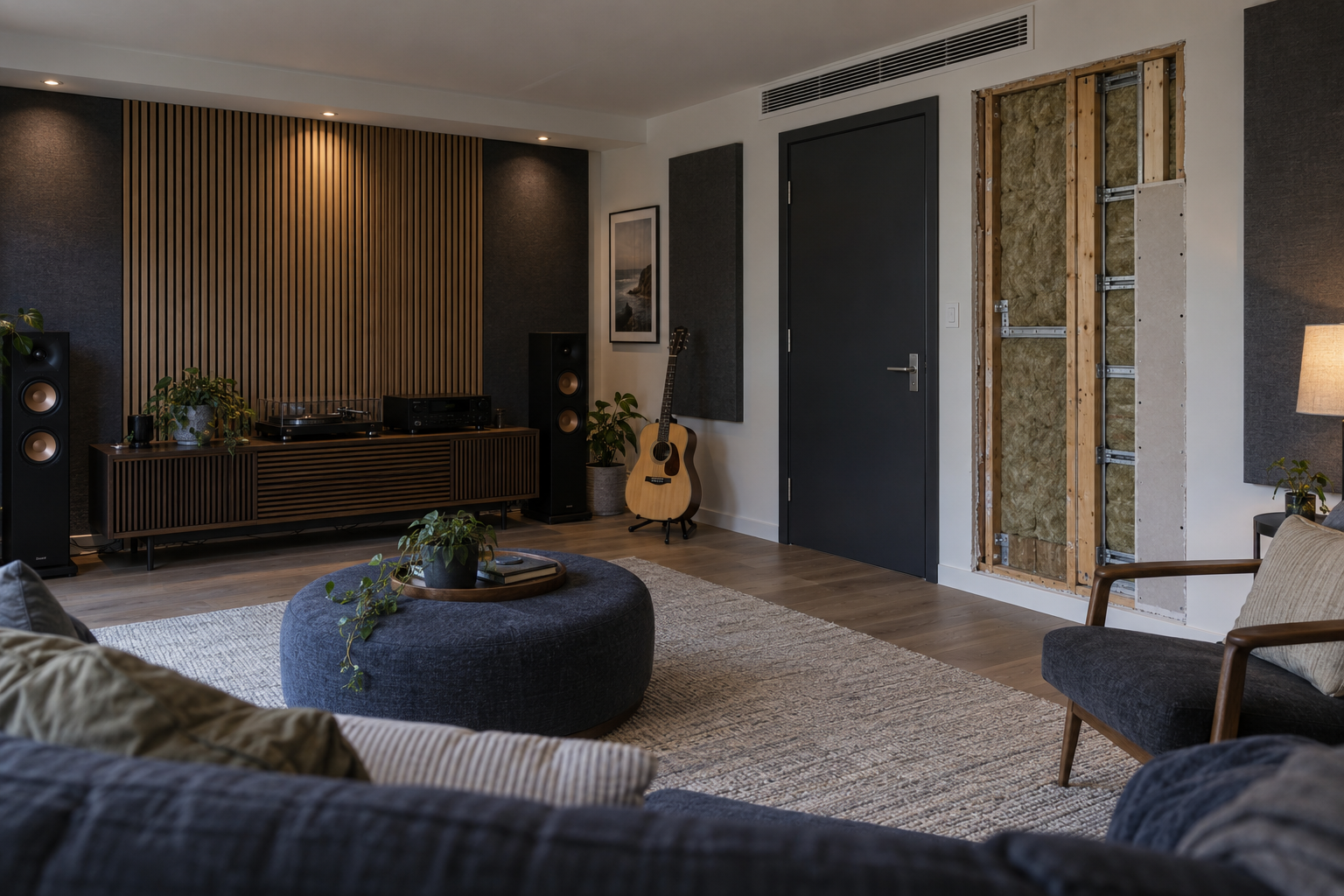
Soundproofing, acoustic treatment and acoustic design solve different problems. Soundproofing—or more precisely, sound isolation—reduces sound travelling between spaces. Acoustic treatment controls reflections and reverberation within a room. Acoustic design brings those issues together with layout, construction, building services, external noise and the intended use of the space.
You may need an acoustic consultant when the cause is unclear, the outcome matters, construction is involved, a report or approval is required, or a simple product purchase could create an expensive mistake.
What Is the Difference at a Glance?
| Approach | Main question | Typical measures | Common examples |
|---|---|---|---|
| Sound isolation | How can sound entering or leaving the space be reduced? | Airborne and impact sound-isolation ratings, site measurements and project-specific criteria. | Walls, floors, ceilings, doors, glazing, seals, penetrations and isolated structures. |
| Acoustic treatment | How should sound behave inside the room? | Reverberation time, speech intelligibility, frequency response and decay. | Absorbers, bass control, reflectors and diffusers placed for the room and its use. |
| Acoustic design | How should the building and room work acoustically as one system? | The relevant isolation, room-acoustic, noise, vibration and services criteria. | Planning, zoning, assemblies, junctions, façades, ventilation, services and interior finishes. |
Which Problem Are You Trying to Solve?
- If sound is crossing a wall, floor, ceiling, door or façade, investigate sound isolation.
- If speech, television or music sounds harsh or unclear inside the room, investigate acoustic treatment.
- If layout, construction, services and room performance must work together, begin with acoustic design.
- If the cause or transmission path is uncertain, begin with diagnosis rather than a product.
What Is Soundproofing?
Soundproofing is the everyday term for reducing sound transfer. In technical work, sound isolation is usually the more accurate term because no ordinary construction makes a room completely soundproof.
Sound can pass through a separating wall, floor or ceiling, but it can also travel around it through flanking paths. Doors, glazing, gaps, services penetrations, ducts, ceiling voids and rigid structural connections can all limit the final result.
What Makes Sound Isolation Work?
Effective systems use several principles together:
- Mass: heavier layers can reduce transmission, provided the complete system is designed correctly.
- Separation: double-stud frames, isolated linings or resilient connections can reduce direct vibration transfer.
- Cavity absorption: suitable insulation within a cavity helps control resonance.
- Airtightness: gaps and poorly sealed penetrations can undermine an otherwise capable assembly.
- Flanking control: junctions, floors, façades, roofs and services paths must be considered, not only the obvious wall.
Adding foam or decorative acoustic panels to a wall will not normally provide meaningful sound isolation. Those products primarily affect reflections inside the room.
What Is Acoustic Treatment?
Acoustic treatment changes how sound behaves within a space. It can reduce echo, improve speech clarity, control strong reflections, manage low-frequency decay and create a more suitable listening or recording environment.
Porous absorbers reduce reflected energy across a frequency range determined by their material, thickness, mounting and air gap. Low-frequency treatment usually requires greater depth or another deliberately engineered approach. Diffusion or reflection may be useful where energy should be redistributed or retained rather than absorbed.
Why Is Covering Every Surface Not the Answer?
Too much thin absorption can remove high-frequency energy while leaving low-frequency problems largely unchanged. The room may sound dull without becoming accurate, comfortable or well controlled.
Treatment should respond to room dimensions, surface finishes, speaker and listener positions, occupancy and the intended use. A living room, classroom, meeting room, cinema and recording studio do not need the same acoustic character.
What Is Acoustic Design?
Acoustic design is the wider process of setting performance goals and coordinating the building, room and services so they can achieve them. It may include sound isolation and acoustic treatment, but it begins earlier and covers more than either one alone.
A coordinated design can address:
- the location of quiet and noisy rooms;
- external road, rail, aircraft or neighbourhood noise;
- wall, floor, ceiling, door and glazing performance;
- junctions, penetrations and flanking paths;
- mechanical-services noise and ventilation openings;
- structure-borne noise and vibration;
- reverberation, speech clarity and listening conditions; and
- drawings, specifications, construction review and completion testing.
AS/NZS 2107:2016, where applicable to the project, provides recommended design sound levels and reverberation times for building interiors. Other criteria may come from the National Construction Code, planning controls, consent conditions, workplace requirements, strata rules or a project-specific brief.
When Can You Solve the Problem Without a Consultant?
You may not need an acoustic consultant for a low-risk, reversible improvement. Rugs, curtains, bookcases, soft furnishings and carefully chosen absorptive finishes can make a reflective living room more comfortable. Moving a loudspeaker or workstation can also improve the result without construction.
Be cautious when the proposed solution involves removing linings, changing doors or glazing, fixing resilient systems, modifying ventilation or spending heavily on acoustic products. At that point, diagnosis and design can cost less than rebuilding an unsuitable solution.
When Should You Engage an Acoustic Consultant?
Professional advice is useful when one or more of the following applies.
The Noise Path Is Unclear
Neighbour noise, impact noise, plumbing, lifts, plant and traffic can arrive through several paths. A site inspection and targeted measurements can distinguish the likely source and transmission route before work is specified.
Construction or Renovation Is Planned
Walls, ceilings, floors, services and joinery interact. Early acoustic input can identify conflicts before documentation and construction make changes expensive.
A Formal Report or Approval Is Required
Planning authorities, certifiers, owners corporations, project briefs or consent conditions may require an acoustic assessment. The correct report, criteria and consultant credentials depend on the jurisdiction and purpose.
The Space Has Critical Listening or Communication Needs
Recording studios, listening rooms, home cinemas, classrooms, offices, meeting rooms and performance spaces can require controlled reverberation, background noise and sound isolation. Product selection alone does not establish those outcomes.
A Dispute or Evidentiary Matter Is Developing
For neighbour, strata or building-performance disputes, independent measurements and a clearly defined assessment method may be important. Confirm the consultant’s testing, reporting and expert-evidence experience before appointment.
Mechanical Noise or Vibration Is Involved
Air conditioners, heat pumps, pool equipment, pumps, ducts and other plant can generate airborne and structure-borne noise. Effective control may require source data, measurements, vibration isolation, enclosures, barriers or airflow-sensitive attenuation.
When Should the Consultant Join the Project?
The best time is usually before layouts and assemblies are fixed. Early input creates more options: noisy and quiet rooms can be separated, service routes coordinated, façade openings reviewed and realistic performance targets agreed.
A consultant can still diagnose an existing problem, but retrospective work commonly has more constraints. Finishes may need removal, ceiling voids may be inaccessible and improvements can be limited by untreated flanking paths.
What Should an Acoustic Consultant Deliver?
The scope should be written in practical terms. Depending on the project, it may include a site inspection, measurements, performance criteria, calculations or modelling, marked-up plans, construction details, specifications, coordination meetings, site reviews and verification testing.
Ask what is excluded, who will complete the work, which standards or criteria apply and how the finished result will be checked. A report that identifies targets without giving the project team buildable information may not be enough.
What Information Should You Prepare Before Requesting Advice?
- The sound source, affected room and times or operating conditions.
- Plans, room dimensions, photographs and known construction details.
- Doors, glazing, penetrations, ventilation and building-services information.
- The intended room use, work already attempted and required outcome.
- The project stage, approval context, budget range and timing.
Start with the Problem, Not the Product
If sound is crossing a boundary, investigate sound isolation. If the room is echoing or sounds unclear, investigate acoustic treatment. If the layout, construction and services need to work together—or the cause is uncertain—start with acoustic design and diagnosis.
Explore residential acoustic design, music and studio acoustics, and technical acoustic consulting.
Discuss your acoustic problem or project before committing to products or construction.
Frequently Asked Questions
Technical Acoustic Consulting
Diagnosis, design criteria and buildable acoustic guidance for residential, studio, workplace and architectural projects.
Technical Acoustic Consulting
Diagnosis, design criteria and buildable acoustic guidance for residential, studio, workplace and architectural projects.
Read Nicholas Marriott's bio