
How Do I Stop Noise from Neighbours in an Australian Apartment?
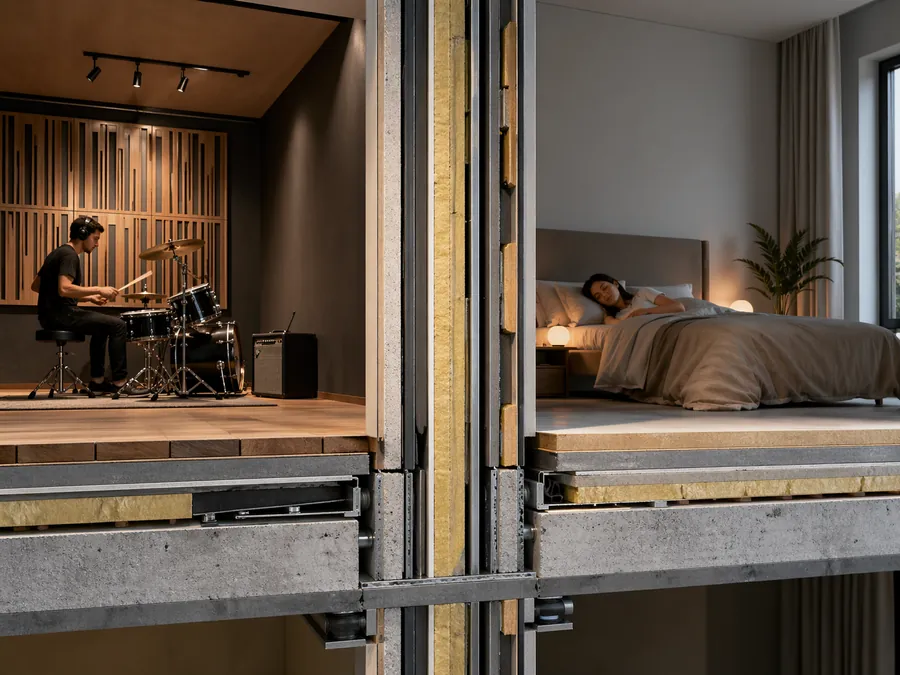
TL;DR
Stopping neighbour noise in an apartment starts with identifying the sound type and the path it uses to enter your home.
- Separate airborne noise, such as voices and television, from impact noise, such as footsteps and furniture movement.
- Treat confirmed weak paths rather than assuming the nearest wall or ceiling is responsible.
- Use seals, independent linings, resilient systems and penetration treatment only where they suit the existing construction.
- Check strata or body corporate rules before altering floors, doors, windows, services or common property.
- Keep a detailed noise log and collect building or flooring records.
- Use field testing when compliance, expensive remediation or a dispute requires objective evidence.
The key point: acoustic panels do not soundproof an apartment; the solution must address the actual airborne, impact or structure-borne transmission path.


.avif)
To stop noise from neighbours in an Australian apartment, first identify whether the sound is airborne, impact or structure-borne. Then target the actual transmission path, check the building’s strata or body corporate rules, and use acoustic testing where compliance or a dispute needs objective evidence.
Voices, television and music require a different response from footsteps, dragging chairs or plumbing vibration. Treating the wrong surface can waste money and deliver very little improvement.
What Does the Noise Symptom Suggest?
| Symptom | Likely noise type | First investigation | Common ineffective response |
|---|---|---|---|
| Speech, television or music | Airborne noise | Separating construction, gaps and flanking paths | Adding decorative acoustic foam |
| Footsteps, dropped items or furniture movement | Impact or structure-borne noise | Source floor, connected structure and approvals | Treating room reverberation below |
| Pumps, plumbing or plant vibration | Services or structure-borne noise | Operating conditions, supports and transmission paths | Upgrading an unrelated wall |
How Is the Noise Reaching Your Apartment?
Start by identifying the type of sound and its likely path. The wall, floor or ceiling where the noise seems loudest may not be the only route into the room.
| Noise type | Typical examples | How it travels | Usual response |
|---|---|---|---|
| Airborne noise | Voices, television, music and barking dogs. | Through walls, doors, windows, gaps, cavities and service penetrations. | Add mass and separation, improve airtightness, and treat weak openings and flanking paths. |
| Impact noise | Footsteps, dropped objects and furniture movement. | As vibration through floors, ceilings, walls and connected structure. | Treat the source floor where possible, or assess an isolated ceiling below. |
| Structure-borne noise | Pumps, plumbing, lifts, plant and bass vibration. | Through slabs, framing, pipes, supports and rigid connections. | Find where vibration enters the building and isolate it at or near the source. |
What Is Airborne Noise?
Airborne noise travels through the air before passing through a building element or opening. Common examples include speech, television, music and dogs. It is controlled by the complete separating system: the wall or floor, its junctions, penetrations, doors, windows and any bypass paths.
What Is Impact Noise?
Impact noise begins when an object strikes or moves across a building surface. Footsteps, dropped items and dragging furniture excite the structure directly, so acoustic foam or decorative wall panels in the receiving apartment will not stop it.
What Can You Fix Within Your Own Apartment?
Start with work that addresses confirmed weak points and does not alter common property. Approval requirements vary between buildings, so check before changing doors, windows, floors, services or structural elements.
Can Door Seals Reduce Hallway Noise?
Yes, when sound is entering around an apartment entry door. Continuous perimeter seals and an automatic drop seal can improve airtightness, but the door’s fire and smoke performance must not be compromised. Any product and installation should suit the existing door assembly and applicable approval requirements.
Will Acoustic Panels Stop Footsteps from Above?
No. Acoustic panels and foam reduce reverberation inside a room; they do not isolate structural impact noise. If the source floor cannot be treated, an independent or resiliently suspended plasterboard ceiling with cavity insulation may help, but flanking through walls and the slab can limit the result.
Can a Shared Wall Be Upgraded?
Airborne noise through a party wall may be reduced with an independent lining or a correctly designed resilient system using suitable plasterboard, cavity absorption and sealed junctions. Fixing another standard plasterboard layer directly to the existing wall may provide only limited improvement when rigid connections or flanking paths remain.
Why Do Service Penetrations Matter?
Electrical boxes, downlights, ducts, pipe penetrations and unsealed gaps can bypass an otherwise substantial wall or ceiling. These details need compatible acoustic and fire-rated treatment where required; sealing the visible face alone may not address a concealed shared cavity.
How Can Strata or Body Corporate Rules Help?
Apartment noise is also governed by state or territory legislation and the building’s registered by-laws or rules. The exact process differs between jurisdictions, so obtain current advice for your scheme rather than assuming one state’s procedure applies nationally.
What Should You Check About Hard Flooring?
Many schemes regulate timber, tile, vinyl or hybrid flooring because inadequate underlay or poor perimeter detailing can increase impact noise below. If carpet has been replaced, ask the strata manager or body corporate for the relevant by-law, approval record and acoustic documentation.
Should You Keep a Noise Log?
Yes. Record the date, start and finish time, affected room, type of sound and how it affected the use of the apartment. A consistent noise log over a representative period is more useful than occasional descriptions and can support discussion with the neighbour, building manager, strata committee or acoustic consultant.
When Should You Make a Formal Complaint?
Begin with the building’s established process and provide clear records. Formal notices, mediation and tribunal applications are legal or strata matters and differ between states and territories. An acoustic report can supply technical evidence, but it does not replace legal advice.
What Acoustic Standards Apply to Apartment Walls and Floors?
The National Construction Code sets minimum airborne and impact sound-isolation requirements for separating construction in Class 2 buildings. The applicable NCC edition and provisions depend on when the building work was approved, and a current building may still allow clearly audible sound while meeting the minimum requirement.
| Construction element | Sound type | NCC performance referenced in the draft | How to read the result |
|---|---|---|---|
| Floor between apartments | Impact | LnT,w ≤ 62 dB | Lower is quieter. |
| Floor between apartments | Airborne | Rw + Ctr ≥ 50 | Higher is better. |
| Wall between living areas | Airborne | Rw + Ctr ≥ 50 | Higher is better. |
| Wall between services or bathrooms and bedrooms | Airborne | Rw + Ctr ≥ 50, with discontinuous construction where required | The construction details and junctions matter as well as the rating. |
Important: An NCC minimum is not a promise of inaudibility or acoustic comfort. Confirm the applicable NCC edition, building approval date, test method and project requirements before relying on a numerical criterion.
Important Limitations and Approvals
Apartment work may involve common property, fire and smoke doors, waterproofing, building services, strata or body-corporate approval and access to the source dwelling. Technical advice does not replace legal or strata advice, and the improvement available from work inside one apartment may be limited by untreated flanking paths or construction outside the lot.
When Is Acoustic Testing Worthwhile?
Testing is useful when the transmission path is unclear, a flooring approval specifies a measurable criterion, substantial remedial work is being considered, or a dispute needs objective evidence.
What Does Field Testing Measure?
Depending on the problem, an acoustic consultant may use a standard tapping machine to assess impact sound or loudspeaker measurements to assess airborne sound isolation. Site observations are also important because a compliant laboratory-rated product can underperform when installation, junctions or flanking paths are poor.
What Should an Independent Report Explain?
- The noise source, receiving room and observed transmission path.
- The applicable test method and assessment criterion.
- The measured results and relevant limitations.
- Whether the result appears consistent with the nominated requirement.
- Practical remedial options, priorities and expected constraints.
What Should You Do Before Spending Money?
- Record when and where the noise occurs.
- Separate voices and music from footsteps, plumbing or plant vibration.
- Collect plans, photographs and available construction details.
- Check flooring approvals, strata by-laws and previous acoustic reports.
- Identify which elements are within your lot and which may be common property.
- Confirm whether the source can be treated before designing work only in the receiving room.
- Set a realistic improvement target and budget.
What Is the Best First Step?
Diagnose the sound type and dominant path before choosing a product or construction system. For airborne noise, examine airtightness, mass, separation and flanking. For impact or structure-borne noise, investigate the source and connected structure first.
Explore residential acoustic design, acoustic reports and noise compliance, and sound isolation and neighbour impact.
Diagnose the Noise Path Before Designing the Fix
The most effective response is based on how the sound actually enters the apartment. Once the source, path, construction and approval constraints are understood, the likely value and limitations of floor, ceiling, wall, glazing, door or service work become much clearer.
Discuss an apartment neighbour-noise problem before committing to a remedial scope.
Frequently Asked Questions
Apartment Neighbour-Noise Acoustic Advice
Practical diagnosis, testing and design guidance for airborne, impact and structure-borne noise in Australian apartments.
Apartment Neighbour-Noise Acoustic Advice
Practical diagnosis, testing and design guidance for airborne, impact and structure-borne noise in Australian apartments.
Read Nicholas Marriott's bio