
What Should I Look for When Choosing an Acoustic Consultant in Australia?
TL;DR
Choose an acoustic consultant whose experience, method and deliverables match your specific project and approval pathway.
- Check relevant qualifications and current professional membership.
- Ask for comparable project and regulatory experience.
- Confirm appropriate Class 1 equipment and traceable calibration where formal testing is required.
- Understand who will complete and sign the work.
- Check for product, supplier or installation conflicts.
- Require a proposal that clearly defines methods, deliverables, revisions, exclusions and fees.
The key point: select the consultant for relevant competence, independence and usable documentation—not credentials or price in isolation.


.avif)
When choosing an acoustic consultant in Australia, look for relevant professional standing, suitable project experience, calibrated instrumentation appropriate to the proposed measurements where testing is required, clear reporting, appropriate insurance and advice that is independent of product sales.
The best consultant is not simply the person with the most equipment or the longest list of services. They should understand your project type, the applicable approval or assessment framework, and how their recommendations will be designed, documented and built.
What Should You Check Before Appointing an Acoustic Consultant?
Check professional standing, technical capability, relevant experience and commercial independence together. No single credential proves that a consultant is right for every type of acoustic work.
| Selection criterion | What to verify | Why it matters |
|---|---|---|
| Professional standing | Relevant qualifications and current membership of a recognised professional body, where applicable. | It helps establish training, experience and accountability, but should still be considered alongside the proposed scope. |
| Instrumentation | Appropriate Class 1 equipment and current traceable calibration documentation when formal measurements are required. | The equipment, calibration, method and operator all affect whether measured results are suitable for their intended purpose. |
| Commercial independence | Whether the consultant receives income or incentives from recommended products, suppliers or installers. | Potential conflicts should be transparent so recommendations can be assessed on technical merit and buildability. |
| Relevant track record | Comparable projects, approval pathways, building types and reporting requirements. | Acoustic work varies greatly between planning, buildings, studios, workplaces and disputes. |
Which Professional Memberships Are Relevant in Australia?
The Association of Australasian Acoustical Consultants and the Australian Acoustical Society are useful places to check professional standing, but their roles are different.
What Does AAAC Membership Indicate?
The Association of Australasian Acoustical Consultants represents consulting firms. If AAAC membership matters to your project, confirm the firm’s current status directly and check that the proposed personnel and scope are covered by the firm’s quality, insurance and professional arrangements.
What Does AAS Membership Indicate?
The Australian Acoustical Society is a professional society for individuals. Ask what grade of membership the consultant holds, what qualifications and experience support it, and whether that experience is relevant to your project.
Is Engineering Registration Always Required?
No. The required qualification or registration depends on the work, jurisdiction, approval authority and purpose of the report. Some projects may require engineering registration or another prescribed competency, while other acoustic design and assessment work may not. Confirm the requirement with the relevant authority or certifier before appointment.
Important: Membership of a professional body is a useful trust signal, not a substitute for checking the consultant’s actual scope, experience, insurance, methodology and proposed deliverables.
Does the Consultant Have the Right Experience for Your Project?
Choose experience that closely matches the problem you need solved. Acoustics includes distinct specialisms, and capability in one area does not automatically transfer to another.
Who Should Prepare a DA or Planning Noise Assessment?
Choose a consultant experienced in environmental and planning acoustics, the relevant state policy framework, local planning controls and the consent authority’s reporting expectations. Ask for examples involving a comparable use, such as mechanical plant, licensed premises, childcare, gyms, mixed-use development or residential development.
Who Should Investigate Strata or Residential Noise?
Choose someone experienced in airborne, impact and structure-borne transmission, existing-building constraints and field testing where needed. If the matter may enter mediation or a tribunal, ask about independent expert reporting and the applicable expert-witness obligations.
Who Should Design Room Acoustics?
Choose a consultant with architectural or room-acoustic design experience relevant to the space. A recording studio, classroom, restaurant, workplace and high-ceiling living room require different design priorities, prediction methods and construction details.
What Equipment and Calibration Should You Ask About?
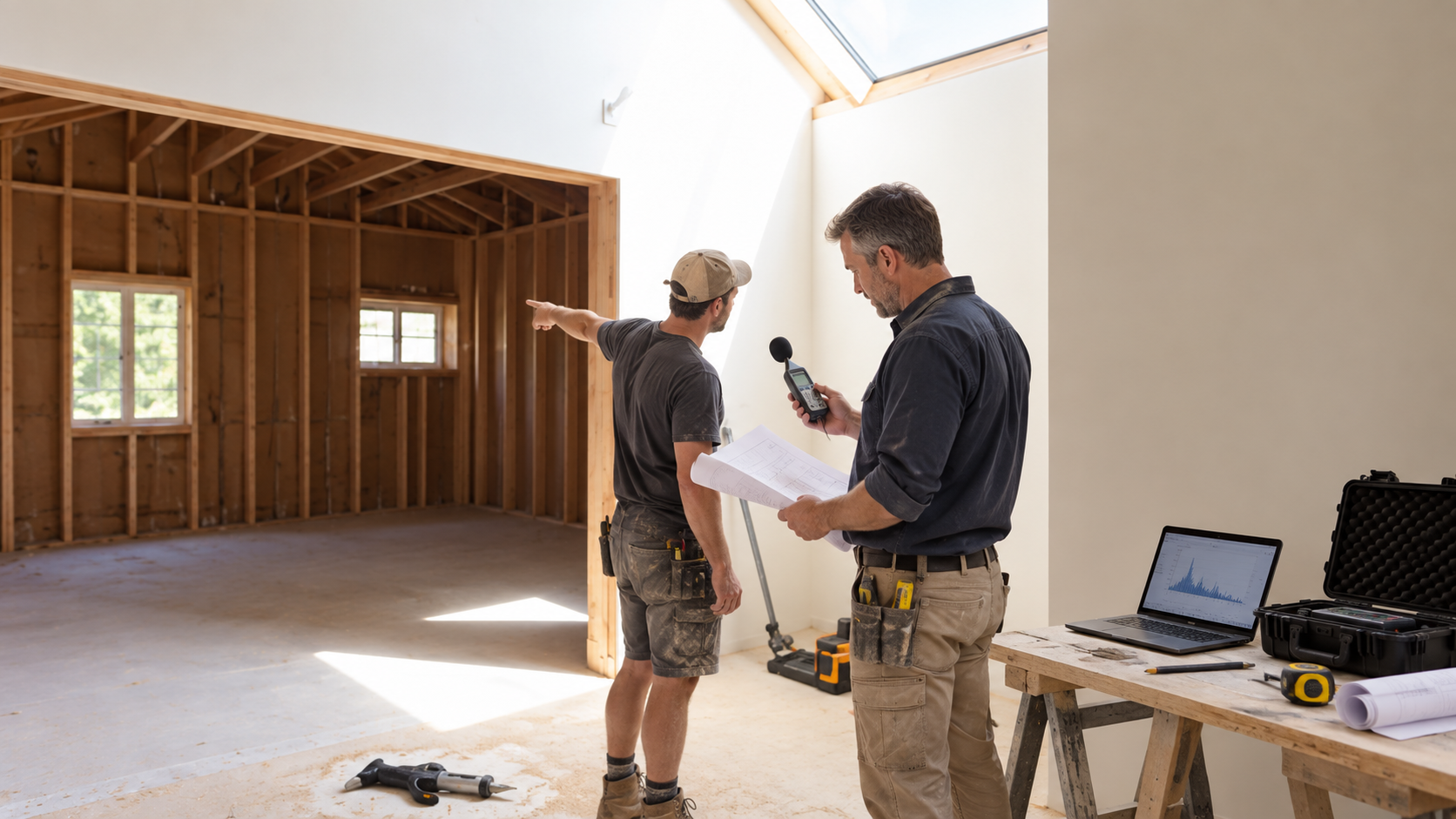
For formal testing, ask what equipment will be used, which standard or method applies, and whether calibration records are current and traceable. Class 1 sound level meters are commonly required for professional environmental and building-acoustic measurements, but equipment classification alone does not make a test valid.
The report should identify the instrumentation, calibration checks, measurement conditions, method, results and limitations. Ask to see calibration documentation when the evidence may be relied on by a council, certifier, strata scheme or tribunal.
How Can You Assess Commercial Independence?
Ask whether the consultant sells, installs or receives commissions from any recommended products or systems. A consultant may legitimately provide both design and construction services, but the relationship, scope and responsibility should be transparent.
Good advice should explain the required acoustic function and construction principles rather than relying only on a proprietary product name. Where a branded system is necessary, the reason and acceptable alternatives should be clear.
What Should the Fee Proposal Include?
A useful proposal should define what is included, what information the client must provide, what will be measured or modelled, and exactly what will be delivered.
- The project problem, objectives and assessment criteria.
- Site visits, measurements, modelling or calculations included.
- The report, drawings, specifications or design details to be issued.
- Assumptions, exclusions and limitations.
- Who will complete the work and review or sign the report.
- The number of meetings, revisions and authority responses included.
- Fees for additional attendance, testing or redesign.
- Programme, information requirements and payment terms.
What Questions Should You Ask Before Paying a Deposit?
Ask direct questions that reveal how the consultant will approach your actual project, not simply whether they offer acoustic services.
- Have you completed projects with a similar building type, noise source and approval pathway?
- Who will carry out the work, and what qualifications or professional memberships do they hold?
- If testing is required, what method, equipment and calibration records will be used?
- Which standards, policies, consent conditions or project criteria will the report assess?
- Does the fee include reasonable revisions or responses to council, certifier or design-team questions?
- Do you sell or receive incentives from any products or systems you may recommend?
- Will the recommendations be documented clearly enough for pricing, coordination and construction?
What Are the Warning Signs?
Be cautious when the scope is vague, the consultant cannot explain the assessment criterion, or a product is recommended before the noise path and construction are understood.
- Guaranteed silence or an absolute performance promise without investigation.
- No clear distinction between acoustic treatment and sound isolation.
- Testing proposed without a stated method or suitable calibration records.
- A generic report that does not address the actual building or approval requirement.
- Recommendations that omit junctions, penetrations, flanking paths or buildability.
- No explanation of exclusions, uncertainties or likely limitations.
- A fee that excludes foreseeable coordination or authority responses without making that clear.
Important Limitations
No membership, instrument, software package or generic report format proves that a consultant is suitable for a particular project. The appointment should be based on relevant experience, an appropriate method, clear deliverables and a scope matched to the decision the client needs to make.
How Should You Make the Final Choice?
Compare the proposed method and deliverables rather than choosing on fee alone. The strongest appointment is usually the consultant who understands the specific problem, explains the limits of the work, provides evidence of relevant capability and produces information that others can use.
Explore technical acoustic consulting, acoustic reports and noise compliance, and acoustic design and build.
Choose for Relevant Experience, Independence and Clear Deliverables
A professional membership or Class 1 meter is useful evidence, but neither replaces good judgment. Choose a consultant whose experience matches the project, whose methodology is appropriate, and whose advice can be understood, approved and built.
Discuss your acoustic project before commissioning the assessment or design scope.
Frequently Asked Questions
Technical Acoustic Consulting
Independent acoustic strategy, assessment and buildable documentation for homes, studios, workplaces and architectural projects.
Technical Acoustic Consulting
Independent acoustic strategy, assessment and buildable documentation for homes, studios, workplaces and architectural projects.
Read Nicholas Marriott's bio