
How Much Does Soundproofing Cost in Sydney?
Soundproofing costs in Sydney range from a few hundred dollars for a consultation to tens of thousands for a full construction scope. This guide explains why diagnosis drives cost, what each scope actually involves, and what makes the real difference between a project that works and one that doesn't.


.avif)
The short answer
Soundproofing in Sydney costs anywhere from a few hundred dollars for a targeted consultation to tens of thousands for a full construction scope. The range is that wide because "soundproofing" covers an enormous variety of problems, building types and solutions.
The most important thing to understand first is this: the cost of soundproofing is almost entirely determined by the diagnosis, not the product.
Why diagnosis comes before cost
Most people approach soundproofing the wrong way. They ask "how much does it cost to soundproof a wall?" before they've understood where the noise is actually coming from.
In Sydney apartments and homes, noise transmission is rarely simple. You might think the noise is coming through the wall when it's actually travelling through the floor, the ceiling cavity, or a shared building service like a duct or pipe. Getting this wrong means spending money on the wrong surface and still having the problem.
A proper acoustic site visit typically costs $300–$600 and gives you a clear diagnosis of the primary noise path, realistic expectations about what can be improved, and a prioritised scope of work. That hour or two of professional time almost always saves thousands downstream.
What soundproofing actually costs — by scope
Targeted single-element treatment — $2,000–$8,000
If the diagnosis points to one specific weak point — a poorly sealed party wall, a single window facing a noisy street, or a lightweight floor-to-ceiling junction — a targeted treatment can address a significant portion of the problem without touching the whole room.
Examples include secondary glazing or acoustic laminate glass on a single window, a decoupled wall lining on one shared wall, or an acoustic underlay and floating floor system over a single room. This scope suits apartments with one dominant noise path and is the most cost-effective starting point.
Full room acoustic treatment — $8,000–$25,000
When multiple surfaces need treatment, or the room requires a coordinated approach across walls, floor and ceiling, costs rise substantially. This is typical for a bedroom conversion in a terrace house sharing a wall with a neighbour, a home studio requiring meaningful isolation, or an open-plan apartment with significant impact noise from above.
At this level, the quality of detailing matters enormously. A floating floor with poorly sealed perimeter junctions will underperform compared to one built correctly. The construction knowledge matters as much as the specification.
Purpose-built acoustic spaces — $25,000–$100,000+
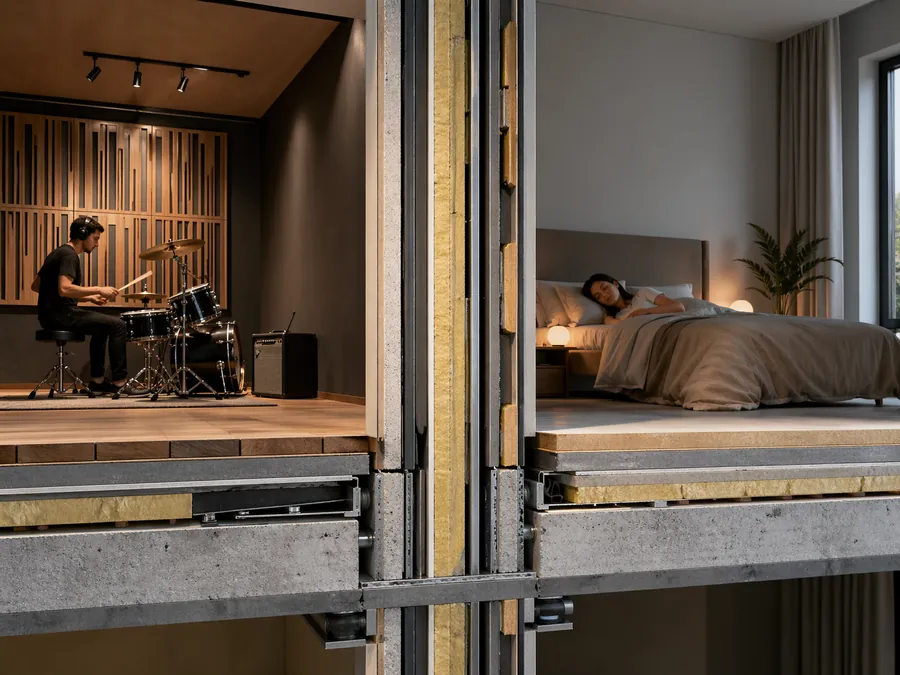
A recording studio, home theatre, or high-performance listening room designed for genuine acoustic isolation is a significant construction project. It requires structural decoupling, mass-loaded barriers, acoustic seals on every penetration, and often a room-within-a-room approach.
At this scope, combining acoustic design and construction under one person typically delivers better results than engaging separate consultants and builders — primarily because the acoustic intent survives the build.
What drives the cost up
Building type affects cost significantly. Concrete apartments transmit structure-borne impact noise differently to timber-frame houses. Retrofitting acoustic performance into an existing structure always costs more than designing it in from the start.
Access and disruption add to the bill when work requires moving out, removing existing finishes, or working within strata by-law constraints.
Poor diagnosis is one of the most common ways soundproofing projects blow out. Treating the wrong surface — or adding layers of acoustic products without understanding the transmission path — wastes money and leaves the problem unsolved.
Detailing quality has an outsized effect on performance. Acoustic performance depends heavily on junctions, seals and connections. A specification that looks impressive on paper can underperform significantly if the construction details aren't followed correctly on site.
What actually makes the difference
After working as both an acoustic designer and a licensed builder in Sydney, the clearest pattern is this: the projects that achieve good acoustic outcomes are the ones where the diagnosis is accurate, the scope is realistic, and the construction details are followed correctly.
In practice that means getting a proper site visit before committing to any product or scope, working with someone who understands both the acoustic science and how buildings actually go together, and not treating soundproofing as a product purchase — it's a design and construction problem.
A note on Sydney-specific context
Sydney's housing stock creates some specific challenges. Older terrace houses, post-war brick apartments and newer high-rise residential buildings all have different acoustic characteristics and different constraints.
Strata buildings add an additional layer — any work affecting common property or structural elements requires strata approval, and the acoustic solution needs to work within those constraints. This is an area where having a builder's licence alongside acoustic knowledge is genuinely useful.
What to do next
If you're dealing with a noise problem in Sydney, the best first step is an on-site consultation. It's the only way to get an accurate picture of what's actually happening acoustically and what it would realistically cost to improve.
Frequently Asked Questions
Soundproofing & Residential Acoustic Design
Practical acoustic diagnosis, design and construction for Sydney homes, apartments and renovations.
Soundproofing & Residential Acoustic Design
Practical acoustic diagnosis, design and construction for Sydney homes, apartments and renovations.
Read Nicholas Marriott's bio