
Critical Listening Room Acoustic Design
TL;DR
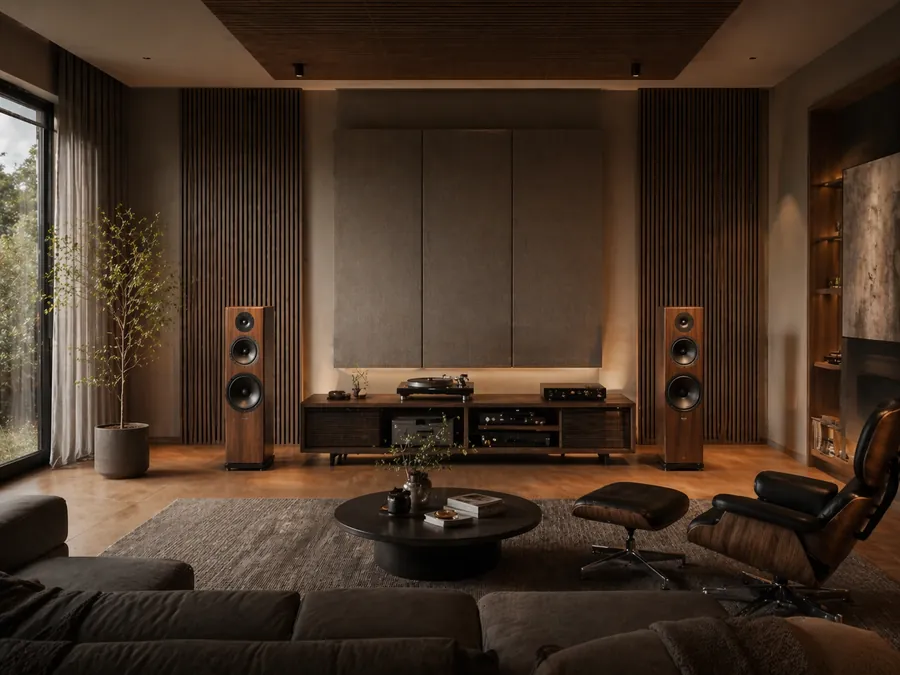
A critical listening room is part of the audio system: the speakers, listening position and room boundaries must be designed as one connected arrangement.
- Set speaker and listener geometry before choosing treatment or finalising furniture.
- Use symmetry and controlled early reflections to support stable stereo imaging.
- Address bass through placement, listening position, suitable treatment and measurement.
- Balance absorption and diffusion rather than making the room completely dead.
- Coordinate furniture, joinery, glazing, ventilation and background-noise control.
- Use calibration after the room fundamentals have been addressed.
The key point: reliable listening comes from coordinated placement, bass control, reflection management, low background noise and a room that remains comfortable to use.


.avif)
Critical listening room acoustic design aligns the loudspeakers, listening position and room so playback is clear, balanced and trustworthy. This guide explains the decisions that shape stereo imaging, bass response, reflections, background noise and practical integration in hi-fi and reference spaces.
What Is a Critical Listening Room?
A critical listening room is a space designed for attentive playback, evaluation or serious music listening. It may support hi-fi listening, mastering checks, mix review, reference playback, audio evaluation or film-sound review.
The room is part of the audio system. Its dimensions, boundaries, finishes, furniture and background noise influence tonal balance, imaging, depth, clarity and low-frequency consistency.
What Should a Successful Listening Room Achieve?
A successful listening room should help the listener trust what they hear. It should reveal detail without becoming fatiguing, support controlled bass without boom, and preserve a stable stereo image while remaining comfortable and visually coherent.
- A focused centre image with believable width and depth.
- Smoother bass at the intended listening position.
- Controlled early reflections without an unnaturally dead room.
- Background noise appropriate to the room’s use.
- Treatment, furniture and services integrated with the interior.
Who Does This Guidance Apply To?
This guidance applies to hi-fi owners, audio professionals, designers and project teams planning a dedicated listening room, review room, media room or residential space used for serious playback. Casual listening spaces may benefit from improvement without requiring the same level of control.
Which Decisions Shape the Result?
The highest-value decisions concern geometry, low frequencies, reflections and background noise. They should be coordinated before product selection or calibration.
| Decision | Why it matters | Practical consideration |
|---|---|---|
| Speaker placement | Affects bass, boundary interaction, imaging and tonal balance. | Review distance from front and side walls, corners, speaker spacing, height and toe-in. |
| Listening position | Changes low-frequency balance and the relationship to reflections. | Avoid treating furniture convenience as the only placement criterion. |
| Symmetry | Different surfaces beside the left and right speakers can shift or blur the image. | Coordinate windows, openings, furniture and wall conditions around the stereo layout. |
| Reflection control | Strong early reflections can reduce clarity and focus. | Use targeted absorption, ceiling treatment, rugs, curtains, furniture or hybrid treatment. |
| Background noise | Traffic, services and equipment can mask quiet detail and decay. | Review glazing, doors, ventilation, equipment and adjacent noise sources. |
Why Are Speaker and Listener Positions So Important?
Speaker placement can change bass response, imaging and depth before treatment is installed. Distance from walls and corners, speaker height, toe-in, spacing and the relationship to the listener all matter.
The listening position is equally important. A seat in a low-frequency null may make bass seem weak, while another position may exaggerate certain notes. The speaker, listener and room should therefore be treated as one system.
How Should Bass and Reflections Be Controlled?
Bass Control
Low frequencies are strongly influenced by room dimensions, boundaries and position. A room may have too much bass at one seat and too little at another, with some notes booming while others disappear.
Improvement may involve speaker and listening-position changes, low-frequency absorption, bass trapping, boundary treatment, measurement-guided adjustment and, in some designs, multiple subwoofers. Thin panels or surface treatment alone rarely resolve the whole problem.
Early and Rear-Wall Reflections
Early reflections from side walls, ceiling, floor, furniture, windows and equipment can blur imaging. The aim is not to absorb everything, but to reduce reflections that confuse the direct sound while preserving a natural sense of space.
The wall behind the listener can strongly affect clarity, depth and bass, particularly when the listening position is close to it. Absorption, diffusion, deep treatment, shelving, furniture or a hybrid approach may be appropriate depending on room size and distance.
How Do Interior Design and Calibration Fit In?
Acoustic performance can be integrated through curtains, rugs, upholstered furniture, timber systems, fabric panels, bookshelves, acoustic plaster, ceiling features, joinery or custom wall linings. Furniture should support speaker symmetry, reflection control and listening comfort rather than being added after the geometry is fixed.
Measurement can identify frequency-response, decay and reflection problems, but it should support listening judgement rather than replace it. Digital correction may refine the system after layout and treatment are addressed; it cannot remove strong reflections, fix poor placement, shorten decay, solve deep nulls or provide sound isolation.
What Are the Important Limitations?
- A high-quality system cannot overcome every room constraint.
- Panels do not automatically fix bass, placement or isolation problems.
- Diffusion needs sufficient distance and may not suit every small room.
- Apartment projects may be limited by shared structure, neighbours and bass transfer.
- A living room can be improved, but furniture, windows and multiple uses may constrain critical performance.
- General guidance cannot replace room-specific listening, measurement and construction review.
What Should Be Prepared Before Requesting Advice?
- Room plans, dimensions, photographs and construction information.
- Speaker and subwoofer models, proposed locations and listening levels.
- The intended listening position and number of seats.
- Existing furniture, glazing, doors, joinery and finishes.
- Known bass, imaging, harshness or background-noise problems.
- Neighbour, bedroom or shared-building constraints.
- Renovation stage, visual brief, budget and desired outcome.
When Should Acoustic Advice Be Sought?
Seek advice before finalising speaker placement, furniture, treatment or renovation work when bass is uneven, imaging is unclear, the room is difficult, the system is high quality or the space must balance acoustic performance with interior design.
Explore music and studio acoustic design and related guidance on control room acoustic design, home studio and listening room design and interior finishes and reverberation.
Final Takeaway: Treat the Room as Part of the System
Reliable critical listening depends on coordinated speaker placement, listener position, symmetry, bass control, reflections, background noise and comfort. Address those fundamentals before relying on acoustic products or calibration.
Discuss a critical listening room project before the room layout or interior details are locked in.
Frequently Asked Questions
Critical Listening Room Acoustic Design
Acoustic design for hi-fi and reference listening rooms, integrating speaker geometry, bass control, treatment and interior detailing.
Critical Listening Room Acoustic Design
Acoustic design for hi-fi and reference listening rooms, integrating speaker geometry, bass control, treatment and interior detailing.
Read Nicholas Marriott's bio