
Interior Finishes & Reverberation: How Materials Shape the Acoustic Feel of a Space
TL;DR
Interior finishes shape reverberation, clarity and comfort as directly as they shape the visual character of a room.
- Recognise which large surfaces reflect and which provide absorption.
- Keep hard materials where they serve the design, but restore acoustic balance elsewhere.
- Use ceilings, curtains, rugs, upholstery and joinery according to their real roles.
- Consider treatment area, depth and frequency rather than appearance alone.
- Coordinate acoustic finishes with lighting, services, access and maintenance.
- Separate internal reverberation from external noise and sound isolation.
The key point: a comfortable interior assigns each major surface a deliberate acoustic role rather than relying on small corrective products later.


.avif)
Interior finishes are acoustic decisions as well as visual ones. Glass, stone, timber, plaster, concrete, tile, curtains, rugs, upholstery, ceilings and joinery determine how much sound is reflected, absorbed or scattered within a room.
How Do Interior Finishes Affect Reverberation?
Reverberation is the persistence of sound after the source stops. When large surfaces are reflective, speech and activity remain in the room longer, overlap and can make the space feel louder, less clear or more tiring.
The aim is not always to make a room as quiet or dry as possible. The appropriate acoustic character depends on whether the room is used for sleep, conversation, teaching, dining, work, music or display.
What Should a Successful Material Strategy Achieve?
- Reflective and absorptive surfaces balanced for the room’s use.
- Enough treatment area to make a meaningful difference.
- Hard architectural materials retained where appropriate.
- Ceilings, walls, curtains, furniture and joinery working together.
- Frequency and treatment depth considered rather than appearance alone.
- Buildable coordination with lighting, services, maintenance and access.
Who Does This Guidance Apply To?
This guidance applies to homes, workplaces, classrooms, hospitality interiors, galleries, studios and other spaces where material selection affects speech, listening, comfort or atmosphere.
How Do Common Interior Finishes Behave?
| Finish or element | Typical acoustic effect | Useful role | Important limitation |
|---|---|---|---|
| Glass | Reflects sound and can strengthen sharp or fluttering reflections. | Provide light and connection while nearby surfaces carry acoustic work. | Curtains may soften reflections but do not replace acoustic glazing. |
| Stone, tile and concrete | Hard, durable and highly reflective. | Remain as primary finishes when balanced by ceilings, furniture or soft zones. | Cleaning and moisture limit treatment options in some spaces. |
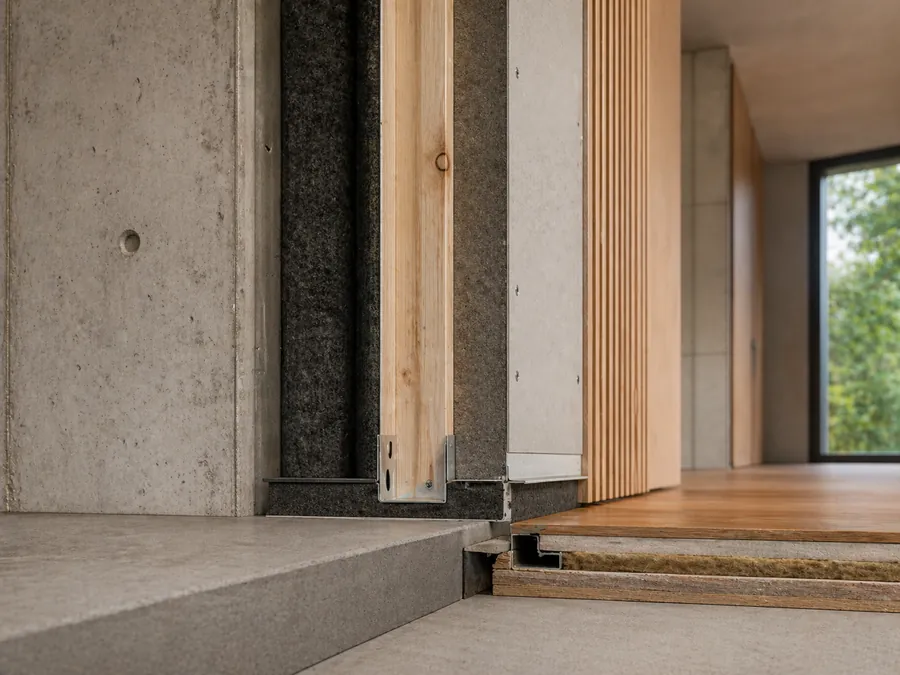
| Timber | Flat timber usually reflects; shaped systems may scatter or absorb. | Integrate rhythm, texture and treatment when detailed with backing and cavity. | Visual warmth does not guarantee absorption. |
| Curtains, rugs and upholstery | Reduce some mid- and high-frequency reflections. | Add acoustic softness close to glazing, floors and occupied zones. | They may not control bass or a large room alone. |
| Acoustic ceiling or plaster | Provides broad absorption across a large surface. | Controls reverberation while preserving wall and floor materials. | System depth, substrate, services and installation affect performance. |
| Joinery and wall linings | Can reflect, scatter or absorb depending on construction. | Integrates treatment into storage, media walls, seating or feature surfaces. | Decorative details may be too small or lack acoustic backing. |
Why Are Hard Finishes Not the Enemy?
Hard finishes provide durability, light, warmth, texture and architectural clarity. Problems arise when every major surface reflects sound and no substantial surface provides acoustic relief.
The design should decide which materials can remain reflective and which ceilings, walls, curtains, furnishings or joinery will control the room.
Why Is the Ceiling Often the Most Important Surface?
The ceiling is commonly the largest uninterrupted area and can absorb sound without covering feature walls or replacing a hard floor. Acoustic plaster, perforated plasterboard, timber systems, panels, rafts or baffles can be integrated according to the design language.
Lighting, air conditioning, sprinklers, speakers, sensors and access panels should be coordinated so the treatment area remains useful and buildable.
How Do Curtains, Rugs and Furniture Contribute?
Full-height curtains, rugs, upholstery, sofas, banquettes and soft seating reduce some reflections near occupants. They can make a room feel more settled and support conversation or rest.
Their effect depends on area, thickness, fullness, placement and surrounding surfaces. They should be treated as part of the strategy rather than assumed to solve a large room alone.
Why Does Frequency and Treatment Depth Matter?
Thin materials often absorb higher frequencies more readily than low-mid or bass energy. A room can therefore become dull at the top while still feeling congested or boomy.
Deeper porous treatment, cavities, tuned systems or specific placement may be required where broader or lower-frequency control matters.
How Should the Material Palette Be Reviewed?
A material palette should be reviewed for acoustic balance alongside appearance, cost, durability and maintenance. A room with stone floors, plaster ceilings, glass walls and minimal furniture may need a deliberate absorptive surface before finishes are locked in.
The amount and location of treatment should reflect room use and volume, not simply where a product is easiest to place.
How Do Room Acoustics and Sound Isolation Differ?
Finishes change sound within the room. They do not automatically stop traffic, neighbours, plant or sound transfer through walls, doors, glazing and structure. Isolation requires separate construction and services work.
What Are the Important Limitations?
A room cannot be assessed accurately from material names alone. Surface area, room volume, geometry, occupancy and construction matter. Decorative acoustic-looking products may provide limited performance, and internal treatment does not replace sound isolation or source control.
What Should Be Prepared Before Requesting Advice?
- Plans, room dimensions and ceiling heights.
- Finish schedules and glazing areas.
- Furniture, curtains, rugs and joinery.
- The room’s activities and occupancy.
- Where speech, music or activity becomes difficult.
- Lighting, services, access and maintenance constraints.
- Existing or proposed acoustic products.
- The project stage and visual priorities.
When Should Acoustic Advice Be Sought?
Advice is useful before finishes, ceilings, curtains and joinery are finalised, or when an existing interior feels echoey, harsh or tiring.
Explore technical acoustic consulting, acoustic balance with timber, stone and glass and integrated acoustic treatment.
Final Takeaway: Give Each Surface a Clear Role
The strongest interiors are balanced rather than over-treated. Reflective materials, furnishings, ceilings and integrated treatment should work together so the room feels resolved both visually and acoustically.
Discuss an interior material and reverberation strategy before the finishes are fixed.
Frequently Asked Questions
Interior Acoustic Design and Material Advice
Design-led acoustic guidance for finishes, reverberation control, material balance and integrated treatment.
Interior Acoustic Design and Material Advice
Design-led acoustic guidance for finishes, reverberation control, material balance and integrated treatment.
Read Nicholas Marriott's bio