
Home Studio Acoustic Design: Where to Start
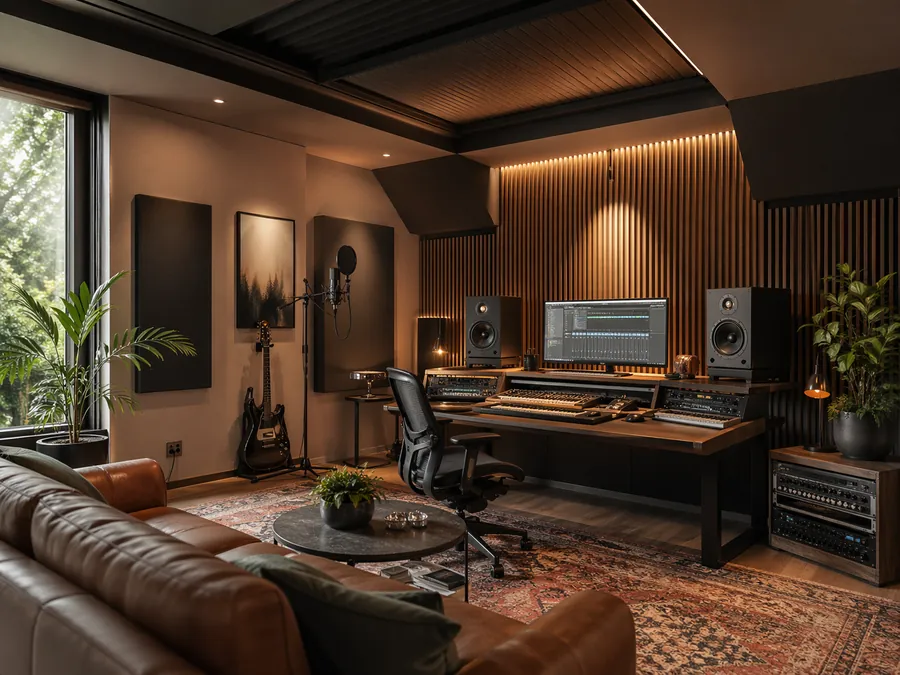
TL;DR
Home studio acoustic design should begin with the room’s purpose and layout before equipment, furniture or panels are fixed.
- Define whether the room is mainly for mixing, recording, production, voice work or several uses.
- Choose the available room with the fewest serious acoustic and practical compromises.
- Set speaker and listening positions before placing treatment or finalising furniture.
- Prioritise bass control and targeted reflection treatment over decorative foam.
- Separate internal room treatment from sound-isolation construction.
- Coordinate recording positions, workflow, ventilation and background noise.
The key point: a useful home studio comes from prioritising purpose, room choice, geometry and real acoustic problems rather than accumulating products.


.avif)
Home studio acoustic design starts by defining what the room must do, choosing the best available space and setting the monitoring layout before buying panels. Room choice, speaker geometry, bass, recording needs, isolation, workflow and ventilation should be treated as one practical brief.
What Is Home Studio Acoustic Design?
Home studio acoustic design is the coordinated planning of a room for recording, mixing, production, voice work or other creative use. It can address room choice, speaker and listener positions, bass control, early reflections, recording tone, sound isolation, background noise, ventilation and workflow.
The central question is not how many panels to buy. It is what decisions must be trusted in the room and what the building can realistically support.
What Should a Successful Home Studio Achieve?
A successful home studio should support its main work without creating avoidable acoustic or practical problems.
- Stable speaker and listener geometry.
- Controlled bass and early reflections at the monitoring position.
- An appropriate recording area for voice or instruments.
- Isolation expectations matched to source level and building context.
- Quiet ventilation and manageable equipment noise.
- A layout that supports equipment, storage and movement.
Who Does This Guidance Apply To?
This guidance applies to musicians, producers, engineers, podcasters, voice artists and homeowners planning a spare-bedroom studio, apartment room, garage, converted study or mixed-use creative space. A home studio should be designed around its actual use and available room rather than forced to imitate a larger commercial facility.
Where Should Home Studio Planning Begin?
| Project decision | What to establish | Why it matters |
|---|---|---|
| Purpose | Mixing, recording, production, writing, podcasting, voiceover or combined use. | The required monitoring accuracy, room tone and background noise differ by task. |
| Room choice | Size, shape, ceiling, construction, openings, neighbours and adjacent rooms. | Some rooms provide better placement and upgrade potential with fewer compromises. |
| Speaker geometry | Symmetry, speaker height, spacing, front-wall relationship and listening position. | Placement changes bass, clarity and stereo imaging before treatment is added. |
| Acoustic priorities | Bass, early reflections, recording tone, isolation or background noise. | The budget should address the dominant problem rather than the most visible product. |
| Workflow | Desk, equipment, instruments, storage, lighting, power and circulation. | Furniture and equipment can obstruct treatment, create reflections or disrupt symmetry. |
How Should Monitoring Be Planned?
Monitoring should be planned around the relationship between the speakers, listener and room. The left and right speakers should interact with the front of the room as similarly as practical, while the listening position should avoid obvious boundary and layout problems.
Speaker placement comes before treatment placement. Distance from walls and corners, speaker height, spacing, toe-in, desk size and the listener’s distance from the rear wall can all change bass, clarity and imaging.
Why Are Bass and Early Reflections Important?
Bass Control
Low-frequency sound is strongly affected by room dimensions, boundaries and position. One note may dominate while another disappears, causing work that sounds balanced in the studio to translate poorly elsewhere.
Improvement may involve speaker and listener positioning, broadband absorption, bass trapping and boundary treatment. Thin foam or light decorative panels do little for the main low-frequency problem.
Early Reflections
Reflections from side walls, ceiling, desk, windows or shelving can blur imaging and alter tonal balance. Treatment should be placed in relation to the actual speaker and listening positions rather than applied generically.
How Do Recording and Workflow Affect the Design?
A monitoring position is not automatically the best microphone position. Vocals, voiceover, guitar and other instruments may need different balances of reflection control, room tone and background noise.
Desk size, racks, instruments, storage, computers, lighting, cables and seating also affect the room. A useful design coordinates these elements so treatment remains effective and the layout supports regular work.
How Do Treatment and Sound Isolation Differ?
Acoustic treatment improves the sound inside the room; sound isolation reduces transfer to bedrooms, neighbours and other spaces. Panels, foam and curtains do not replace walls, ceilings, floors, doors, glazing, seals, penetrations, ventilation or flanking-path construction.
Quiet production and nearfield monitoring may require modest separation. Drums, amplified instruments, subwoofers, loud vocals or late-night use may require a more serious isolation strategy, particularly in apartments and shared buildings.
What Are the Important Limitations?
No available room is likely to be acoustically perfect. Room size and construction limit performance, decorative foam can leave bass uncontrolled, measurement needs interpretation, and isolation cannot be predicted from treatment alone. Sealing a room without planning ventilation can also make it uncomfortable or noisy to use.
What Should Be Prepared Before Requesting Advice?
- Room plans, approximate dimensions, photographs and construction information.
- The studio’s main tasks and recording sources.
- Speaker, subwoofer and equipment details.
- Proposed desk, storage and listening locations.
- Nearby bedrooms, neighbours and shared structures.
- Expected operating times and playback levels.
- Existing ventilation, windows, doors and background-noise sources.
- The project stage, budget and desired outcome.
When Should Acoustic Advice Be Sought?
Advice is useful before choosing the room, fixing the layout or buying substantial treatment, especially for mixing, regular recording, subwoofers, drums, amplified instruments, podcasts, voiceover or rooms near neighbours and bedrooms.
Explore music and studio acoustic design, or arrange an on-site acoustic consultation when the best room or dominant problem is unclear. Related guidance covers control room design, studio isolation and neighbour impact and vocal booth and recording room design.
Final Takeaway: Start With Purpose, Room and Layout
A useful home studio comes from prioritising purpose, room choice, geometry and real acoustic problems rather than accumulating products. Coordinate treatment, recording, isolation, workflow and ventilation around those decisions.
Discuss a home studio project before the layout or construction scope is fixed.
Frequently Asked Questions
Home Studio Acoustic Design
Acoustic design for home studios, production rooms and recording spaces, coordinated with monitoring, isolation, workflow and construction.
Home Studio Acoustic Design
Acoustic design for home studios, production rooms and recording spaces, coordinated with monitoring, isolation, workflow and construction.
Read Nicholas Marriott's bio